

The EU directive on sustainability has been taken into force from January 1, 2025. However, in 2026 the directive has been drastically changed following the Omnibus-1. The CSRD update was aimed to significantly reduce the regulatory and administrative burden for SMEs and is now only applicable to the largest companies (>1000 employees). Where the CSRD previously was an obligation for many, it is now primarily a requirement for the top tier, with several important implications for SMEs. In this guide, we provide detailed information about the obligations, what to report, how this affects SMEs, and the most important deadlines to consider.
What is CSRD?
The CSRD is a directive on sustainability reporting, arisen from the European Union's Green Deal. The Green Deal aims for Europe to become climate-neutral by 2050, aligning with the Paris Agreement formulated during the UN Climate Conference (COP21) in Paris on December 12, 2015, recognised by 194 countries and the European Union.
The CSRD builds on the Non-Financial Reporting Directive (NFRD), an obligation for large (>1000 employees), listed companies, banks, and insurance companies to report on aspects such as social responsibility, treatment of employees, human rights, and diversity. The lack of uniformity in reporting frameworks resulted in limited comparability between companies. CSRD introduces consistency in sustainability reporting, allowing for meaningful comparisons.
Both the CSRD and NFRD are examples of sustainability reporting, describing how organisations implement strategies and ambitions regarding sustainability. Sustainability is assessed in three dimensions: Environment, Social, and Governance, collectively known as ESG indicators, derived from the European Sustainability Reporting Standards (ESRS).
CSRD reporting provides comprehensive insights for financial stakeholders (e.g., shareholders, banks, creditors) and anyone interested in the company's impact on the environment (employees, customers, neighbours, or organisations focused on environmental and human rights). Standardised reporting allows for comparisons between companies.
Who is obligated to follow the CSRD? (UPDATE May 2026)
With the introduction of the Omnibus-I Directive at the beginning of 2026, the scope of the CSRD has changed significantly. The European Union has decided to raise the threshold values to alleviate the administrative burden on small and medium-sized enterprises. The focus is now solely on the largest companies.
An organisation must now comply with the CSRD if it meets two of the three following criteria.
- More than 1000 employees
- Revenue exceeding €450 million
- Balance sheet exceeding €225 million
What does this mean for SMEs? Companies with fewer than 1,000 employees are no longer subject to the direct legal obligation since the revision in 2026. However, the indirect pressure from the value chain remains. Large customers (>1,000 FTE) still need to report on their entire chain. Therefore, for SMEs, the VSME standard (Voluntary SME) has now become the norm for sharing sustainability data easily with large clients.
Hedgehog guides SMEs through the VSME standard to prepare them to provide the rights insights for large clients.
When do you need to report?
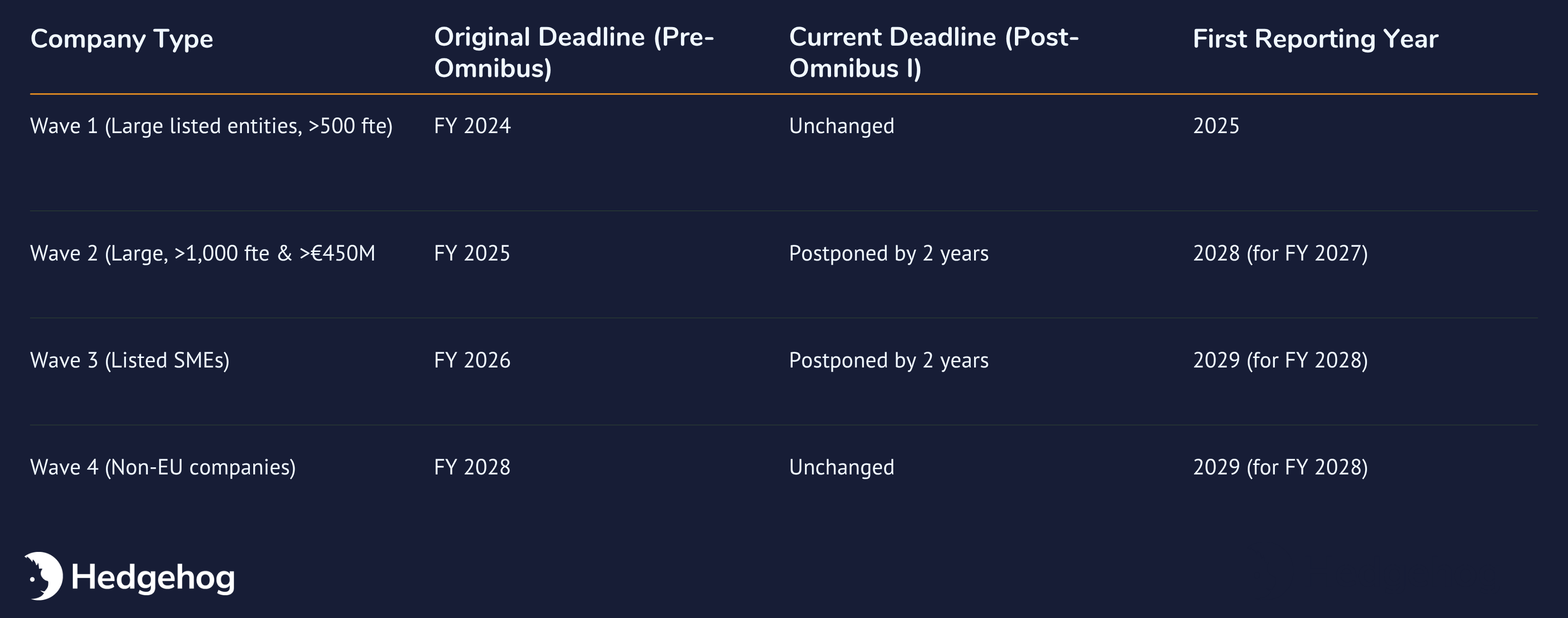
The implementation timeline for the CSRD has shifted significantly following the adoption of the Omnibus I Directive (EU 2026/470). The updated schedule introduces a general two-year delay ("Stop-the-Clock") for most reporting waves and narrows the mandatory scope to significantly larger companies.
The current reporting deadlines are structured as follows:
- Wave 1 (Large Public-Interest Entities): Companies previously subject to the NFRD (with over 500 employees) were the first to comply, having already published their first reports in 2025 (covering fiscal year 2024). Under the 2026 update, any Wave 1 company falling below the new higher thresholds can be granted a temporary transition exemption by member states for FY2025 and FY2026.
- Wave 2 (Large Corporations): This group applies to companies meeting the updated 2026 criteria of more than 1,000 employees and over €450 million in net turnover. Originally required to report in 2026 (for FY2025), their deadline has been deferred by two years. These corporations must now begin data collection for fiscal year 2027, with their first reports due in 2028.
- Wave 3 (Listed SMEs): Small and medium-sized enterprises listed on regulated markets have also received a two-year extension. Their mandatory reporting period now begins in fiscal year 2028, pushing their first submissions to 2029 (with simplified ESRS or VSME-based standards).
Wave 4 (Non-EU Companies): International firms generating a net turnover of more than €450 million within the EU (and possessing an EU subsidiary or branch exceeding €200 million) must report for fiscal year 2028, meaning their first publications are due in 2029.
What to report under CSRD?
What do companies subject to the CSRD need to report on? The reporting obligations under the CSRD have also been significantly changed since the introduction of the Omnibus I Directive in the spring of 2026. While the first versions of the legislation required very broad information provision on almost all sustainability topics, the current directive focuses on simplified reporting limited to specific sustainability themes relevant to your business operations.
The main change is the significant reduction in the amount of information companies are required to provide.
- 61% fewer data points: Over half of the original reporting requirements have been eliminated or made voluntary.
- No sector-specific rules: The plans for complex additional rules per sector (such as for construction or textiles) have been scrapped. Everyone is now reporting according to the same, highly simplified basic set.
- Focus on Materiality: Previously, there was uncertainty about what you were required to report. Now, you use the Double Materiality Analysis to determine which topic is relevant to your company. You need to report on that now. Later, we will delve deeper into the double materiality analysis.
What specifically needs to be in the report?
Despite the simplifications, the reporting structure still rests on three pillars (ESG). The following components are mandatory for companies that must comply with the CSRD:
- Double Materiality Analysis: The rationale behind the company's choices. This describes the company's impact on people and the environment, and what external sustainability risks could affect the company's financial position.
- Quantitative Core KPIs: The reporting focuses primarily on measurable results, including:
- Climate: the CO₂ footprint (Scope 1, 2, and the relevant categories of Scope 3).
- Energy: Total energy consumption and the percentage of renewable energy.
- Social: Data on its own employers, such as safety figures and the gender pay gap.
- Governance: Information on how the board oversees sustainability goals and compliance.
What does this mean for SMEs?
Legally, companies with fewer than 1000 employees are exempt from the direct reporting requirements of the CSRD. But because they are often part of the value chain of large companies, they can still be subject to information requests.
To prevent medium-sized and small businesses from being burdened with very complex questionnaires, the Value Chain Cap was introduced. This means that large, reporting companies may not require their SME suppliers to provide more data than what is stipulated in the VSME standard (Voluntary SME).
What do SMEs need to report?
When a customer or bank requests sustainability information, SMEs can use this voluntary VSME standard. This is a compact dataset that focuses on:
- Basic data on energy consumption and emissions.
- A brief description of the policy regarding working conditions and the environment.
- Essential figures on the workforce.
By using this standard, SMEs can meet the demand from large chain partners for sustainability information without having to go through a full CSRD process.
CSRD: explaining double materiality
A crucial aspect of CSRD is the principle of 'double materiality.' Organisations must report on the impact of their business activities on the environment, reflecting how their business affects people and the environment. This encompasses ecological and social material impact, contributing to biodiversity loss or human rights violations in the supply chain.
Simultaneously, organisations must report on the financial risks associated with ESG-related topics. How can their business operations be impacted by climate change? Consider financial risks arising from factors such as resource scarcity, extreme weather, and transition risks.
A step-by-step guide for a double materiality assessment could include:
- Determining and identifying relevant stakeholders, both internal and external. Who will be impacted by your environmental impact? And vice versa? This could include customers, partners, employees, NGOs, or suppliers.
- Identifying relevant ESG topics. The CSRD is part of the European Sustainability Reporting Standard (ESRS), which includes a list of possible ESG topics. Organisations must decide which are applicable to them.
- Defining how double materiality looks for your organisation. How does your organisation influence the climate? And how will climate change affect your organisation? Answering these questions involves interviews, focus groups, workshops, etc., with the stakeholders identified in step 1.
In the final sustainability report, organisations must elaborate on points derived from their double materiality assessment. What is the impact for these points? What actions will the company take to reduce this impact? What goals and measures will be implemented, and how will the organisation stay on course? Who is responsible, and what procedures will be followed?
CSRD: explaining GAP analysis
Another crucial aspect in complying with the CSRD is conducting a Gap Analysis. This involves comparing how you currently report on ESG indicators with what is required by the CSRD. You might discover missing data, inconsistencies in data collection, inadequate verification methods, or entirely absent reports.
Once you identify the gaps between your current reporting and the CSRD requirements, you can take steps to close these gaps and become fully and correctly compliant.
How to report?
The sustainability report becomes an integral part of your management report. After preparing your sustainability report according to the CSRD, an external accountant must verify it. Companies are obligated to include this sustainability report in their annual reports and publish it in the European Single Electronic Format (ESEF/XHTML).
The frameworks and guidelines for reporting according to the CSRD are established in various chapters of the European Sustainability Reporting Standard (ESRS). Find information about the CSRD from the European Union here.
Saro Campisano, Co-Founder Hedgehog Company:
“We have experienced major adjustments in the CSRD last year. We understand that especially small and medium enterprises struggle to find the right strategy towards these updates. What is clear, is that the CSRD and related VSME provide guidance for companies in their sustainability ambitions. The CSRD requires transparent communication about sustainability, making sustainability crucial for organisations, stakeholders, and the entire economy."
What happens if an organisation does not comply with the CSRD?
Following the regulatory updates, the consequences of non-compliance depend on whether an organisation falls under the direct statutory scope of the directive or is part of the indirect supply chain:
- For Direct-Scope Companies (>1,000 employees): Large enterprises that meet the criteria but fail to include an audited, compliant sustainability statement in their management report face direct legal and financial consequences. Enforcement is managed at the national level, where member states can impose administrative sanctions, public notices, and substantial financial penalties. Additionally, non-compliance can restrict access to capital markets, as institutional investors increasingly condition financing on verified ESG disclosures.
- For the Supply Chain and SMEs: Companies with fewer than 1,000 employees face no direct statutory fines or legal prosecution from regulators. However, they could face significant commercial risks. Because large, regulated enterprises are legally required to report on their value chains, they prioritise suppliers that can provide reliable data. Smaller businesses that cannot deliver basic ESG metrics, specifically those aligned with the VSME standard, risk losing contracts, being excluded from corporate procurement processes, or facing higher borrowing costs from banks.
Consequently, evaluating internal data collection processes and establishing a baseline of core sustainability metrics remains a practical necessity to protect commercial partnerships, even for organisations exempt from direct legal compliance.
How can Hedgehog Company guide me?
To report on all required topics, you need insights and data from your organisation and supply chain to support your sustainability ambitions and strategy. This involves mapping all impacts, risks, and opportunities (IRO) related to all relevant E, S, and G topics: Environment, Social, and Governance. We guide you through this process.
Our experts assist you with a double materiality assessment and gap analyses. Additionally, we can model your organisation's complete environmental impact through our expertise in life cycle assessments (LCAs) and carbon footprint modelling (modelling greenhouse gas emissions at the corporate level).
A life cycle assessment quantifies the environmental impact of your product or organisation over its entire lifespan and all phases, from raw material extraction, transport, production, and use to potential end-of-life processing.
With this, we meet your specific data needs to comply with the CSRD and provide guidance to elevate your sustainability performance.
