
Introduction
In 2026, sustainability for SMEs has moved far beyond a marketing “nice-to-have”; it is now a fundamental licence to operate. Although 2025 saw a perceived waning of political appetite for environmental regulations, market stakeholders have continued to pursue the path towards sustainable business. Whether driven by clients, suppliers, consumers, or employees, the momentum is irreversible. Starting your sustainability journey in 2026 is not just about regulations and compliance; it is about responding to fundamental shifts in market behaviour and societal values.
8 sustainability drivers for SMEs in 2026
The following drivers are making sustainability a strategic priority for SMEs:
- Tenders and government contracts: Public procurement increasingly requires verified proof of environmental performance. In the UK, this is structured through Carbon Reduction Plans via PPN 006 (formerly known as PPN 06/21). In the Netherlands, the 'CO₂-prestatieladder' remains a key requirement, while at the EU level, Green Public Procurement (GPP) standards are becoming the norm for winning bids.
- Pressure from the supply chain: Large EU-based corporations are now mandated to report on their full-value chain impact. This means suppliers, regardless of their size, must provide accurate CO₂ and sustainability data to their clients. Some examples from the Dutch market are businesses like Ahold Delhaize or Bol.com.
- Evolving EU legislation: While some aspects of the CSRD have been adjusted, other stringent regulations are coming into force. Most notably, Digital Product Passports (DPP) are being introduced for several sectors under the ESPR, and the Construction Product Regulation (CPR) now demands granular sustainability data at the product level.
- Employer branding and talent retention: Research indicates that professionals are increasingly willing to switch jobs if they feel their employer lacks a meaningful sustainability policy. To attract and retain top talent, a credible sustainability strategy is essential.
- Access to sustainable finance: Financial institutions are increasingly linking interest rates and credit availability to ESG performance. SMEs with a clear sustainability roadmap often gain better access to “green loans”, impact funds, transition finance or other financial instruments.
- Operational efficiency and cost reduction: Sustainability is often synonymous with resource efficiency. Reducing energy consumption, minimising waste, and optimising logistics directly improve your bottom line while lowering your carbon footprint.
- Future-proofing and risk management: The phased introduction of the Carbon Border Adjustment Mechanism (CBAM) and rising carbon taxes, alongside broader regulatory and global shifts, are creating new vulnerabilities in supply chains. Businesses that act now are mitigating the risk of sudden, significant cost increases and operational disruptions.
- Trust and anti-greenwashing: Global markets are increasingly demanding transparency. Providing verified sustainability data is the only way to protect your brand against greenwashing claims and meet the requirements of the EU Green Claims Directive.
At Hedgehog, we recognize that many businesses struggle to see the wood for the trees. This roadmap provides a summarised overview for SMEs where and how they can start.
1. The foundation: Carbon accounting
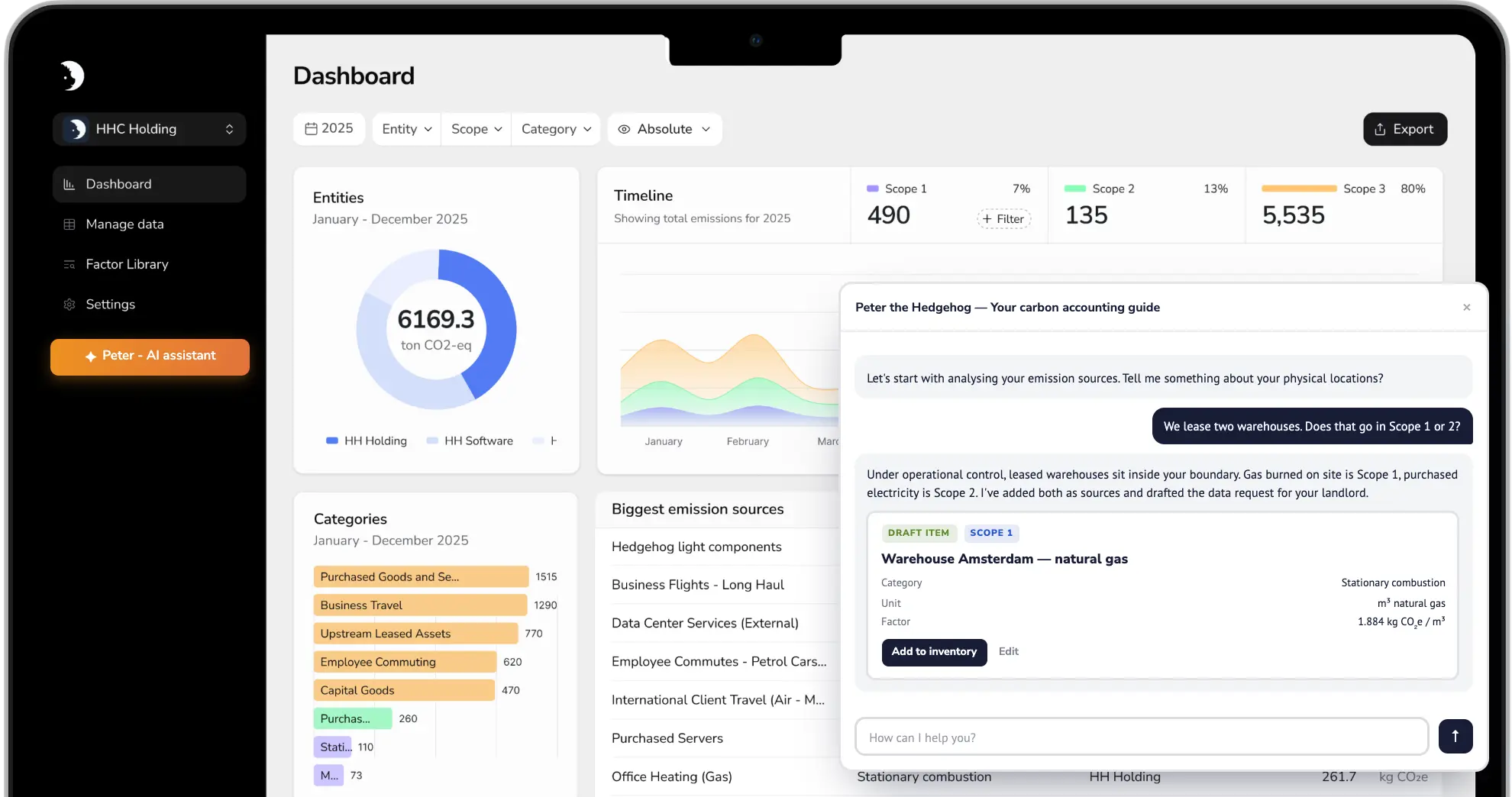
Everything begins with the organisation. Large customers and government agencies increasingly demand that their suppliers report on CO₂ emissions and share robust reduction plans. In the UK, a formal Carbon Reduction Plan is mandatory for government contracts exceeding £5 million under the requirements of PPN 006 (formerly known as PPN 06/21), in the Netherlands a similar system works with CO2-prestatieladder. Other CO2-data requests come from larger clients or other supply chain partner reporting on their sustainability, procurement policies, ISO 14001 implementation, or employee branding.
- The focus: Quantifying Scope 1, 2, and 3 emissions.
- The goal: Meeting client requirements and ensuring readiness for emerging regulations.
- The result: Securing critical contracts and obtained the insights for a grounded sustainability strategy. With your sustainability strategy, you can move to effective sustainability communication, avoid supply chain risks, be prepared for future legislation and build a sustainable business with happy and engaged employees.
Toolbox: Read more about carbon accounting and download our carbon report example to get started immediately.
.webp)
2. The depth: Life cycle assessment (LCA)
Once the organisational impact is clear, many hotspots become apparent. These hotspots in your supply chain can be covered by performing LCAs. In addition, following regulations, specific tender processes, clients, or other market actors often asks: “What is the specific impact of your product?” A life cycle assessment (LCA) is the scientific methodology used to calculate this, covering every stage from raw material extraction to end-of-life disposal (cradle-to-grave).
- Why LCA?: You can't manage what you don't measure. An LCA identifies environmental “hotspots” in your production process.
- Regulation: upcoming regulations such as the European Ecodesign for Sustainable Products Regulation (ESPR) that is demanding Digital Product Passports will ensure the need for LCAs of your products.
- Tenders and procurement: many EU countries require LCA insights in the form of EPDs for public tenders and procurement for government contracts, construction, and infrastructure.
- Scope 3 data gaps: LCAs are the perfect tool to improve the data quality in your scope 3 emissions of your carbon footprint, and creating insights to build effective carbon reduction strategy for your business.
Read more: LCA - The ultimate guide for beginners and download an LCA report example.
3. The evidence: Environmental product declarations (EPD)
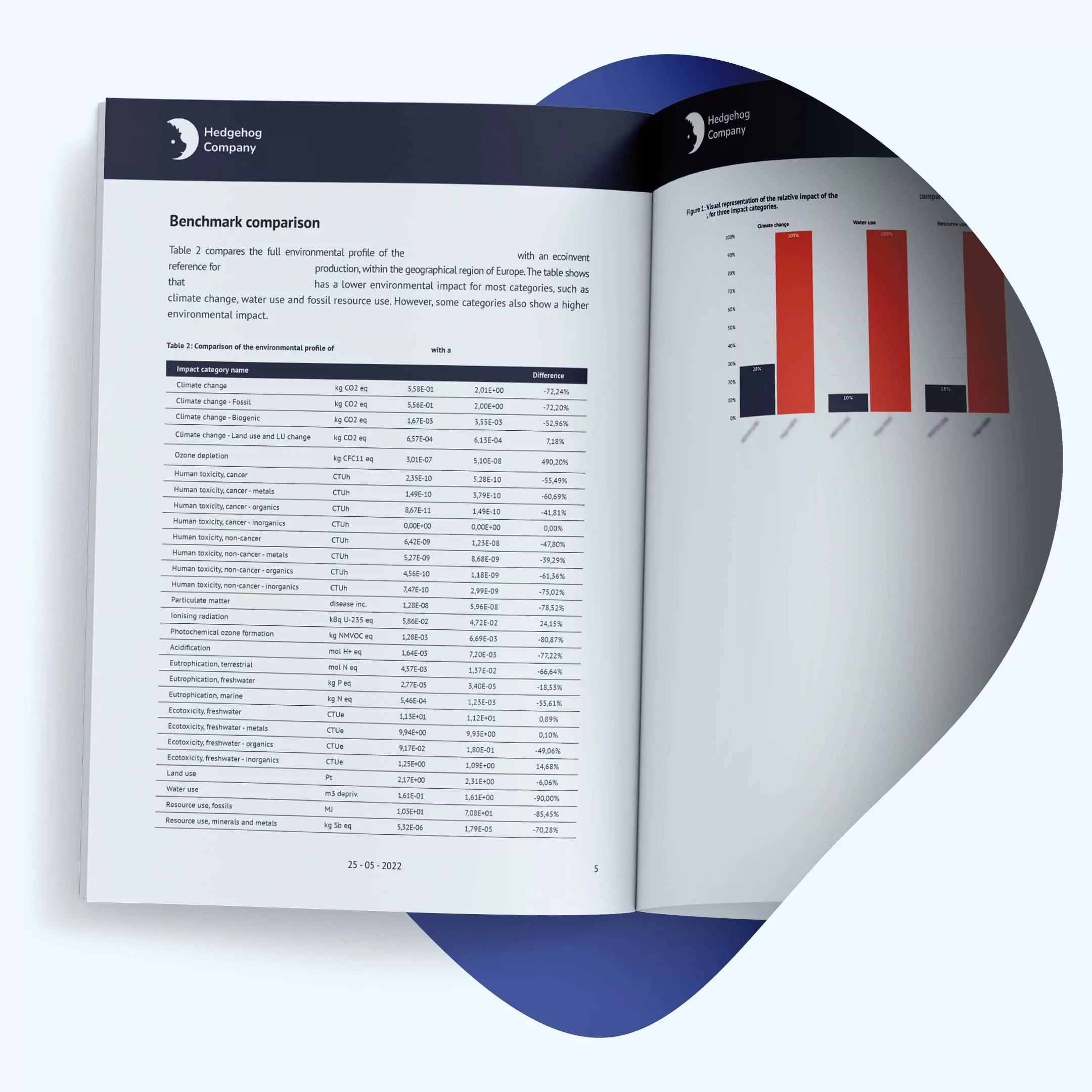
While an LCA is the technical calculation, an environmental product declaration (EPD) is the official, verified certificate.
In sectors such as construction and infrastructure, EPDs (based on ISO 14025 and EN 15804) are the only way to provide objective evidence in tenders. By having your data verified by an independent third-party and published in recognised databases like EPD International or the NMD (Nationale Milieudatabase), you create a level playing field.
In addition, EPDs are used to communicate your product impact in a B2B context, for example to your key clients with sustainable procurement policies or in generating your client's carbon footprint.
Deep dive: Explore our comprehensive guide to EPDs and view an example EPD.
4. The message: Effective sustainability communication
Data without a story is missed potential, but a story without data is greenwashing. With the EU Green Claims Directive and similar global standards approaching, transparency is non-negotiable.
Effective communication goes beyond annual reports; it is an ongoing dialogue with investors, employees, and your supply chain. By aligning your communication directly with verified LCA and carbon data, you build a brand that stakeholders can trust.
Toolbox: Download our sustainability communication guide for practical strategies.
5. The future: CSRD and supply chain regulations
Although the CSRD (Corporate Sustainability Reporting Directive) has become less important in 2025, it does still directly targets large corporations. Their CSRD requirements trickle down to SMEs through the value chain. As a supplier, you are part of their Scope 3 reporting. By adopting ESRS-aligned standards now, you position yourself as the preferred partner for large-scale players.
- Future compliance: sustainability will play part of your business' future, whether through regulatory or market developments. To avoid high, last-minute implementation costs, you can better be prepared.
Conclusion: Making sustainability part of your operations
Managing these complex data streams manually and without prior knowledge and expertise is a challenging task for most SMEs. And on top of this, sustainability cannot be regarded as a one-off project anymore, it's becoming an integral part of your business operations.
- Start with your first carbon footprint in our Hedgehog Carbon Platform
- Schedule a free consult with one of our experts to have a 30-minute conversation on your challenges
- Explore our knowledge base for more expert insights.
We guide your organisation towards more sustainability and aim to collaborate with your team and aligning with your resources. With our team of experts, and the Hedgehog Carbon Platform, we transfer our expertise and our tool so that your team can start with your carbon footprint and integrate sustainability in your operations.
