

Effective product design is crucial for moving towards a circular economy. Good design helps make recycling and repairing parts easier and prompts important questions about the materials used and where they come from. The Digital Product Passport (DPP) helps by bringing this important information together in one easy-to-access place for everyone involved.
Manufacturing and material extraction drive giant pressures on climate emissions and biodiversity. By giving products a clear, scannable identity, the EU intends to increase transparency, durability, make repairs straightforward, and boost recycling rates across the single market.
Let us look at where the framework stands today, what we know, and how your business can prepare for what is ahead.
What the Digital Product Passport (DPP) means for your business
Many companies already use digital product passports or similar systems to communicate information about their products. In that sense, the concept is not new or novel to the EU. What is new is that these digital product passports will become mandatory for key products, as set out in several pieces of legislation, most notably the Ecodesign for Sustainable Products Regulation (ESPR).
DDP is an online record that tracks a product throughout its entire life cycle. It acts like a digital folder tied permanently to a physical item via a data carrier. This carrier can be a QR code, an RFID tag, or an NFC chip attached directly to the product.
The QR leads to a unique link where you find the following information:
- Material composition and origin — which raw materials are used and where they come from
- Production — locations, processes, and energy consumption
- Environmental footprint — CO2 emissions, water consumption, and resource use
- Repair and maintenance — instructions, available spare parts, and expected lifespan
- Disassembly and recycling — how to take it apart and which materials are recoverable
- Hazardous substances — SVHCs under REACH and substances of concern
- Certificates — CE marking, declarations of conformity, and test results
The system is like a decentralized storage place of data. Instead of saving massive quantities of files on a single European server, the framework points to private or third-party secure databases managed by the company.
This data remains accessible to different groups based on specific access rights. For instance, a consumer might scan a label to view recycling info, while a market surveillance authority scans it to verify official compliance documents.
While the core concept is straightforward, the legal implementation is more complex. The baseline framework was set by the ESPR, but the practical rules for individual sectors depend on specific pieces of secondary legislation called delegated acts. This means the timeline and requirements vary depending on what you manufacture or sell.
Newest developments and technical framework updates
The year 2026 has brought several crucial updates that shift the passport system from a theoretical concept into a concrete operational reality. In March 2026 civil society organisations, including the European Environmental Bureau (EEB) and ECOS, shed light on the exact legislative realities we face in a comprehensive joint briefing.
What we know so far
We now have a much deeper understanding of the technical structure. The European Commission has finalised the plans for the central registry framework. This registry will serve as a shared index of unique product IDs, rather than a large, centralized data repository.
We also know that data security and verification are highly important. Only authorized parties with secure digital signatures are allowed to create or modify passport data. In addition, companies must keep track of the continuous monitoring of this data, register changes, and store data for up to ten years after a product is launched.
What we don't know yet
Despite the decisions made, major gaps remain. The committee responsible for determining the technical rules has missed its deadline. The rules for data exchange and software integration (APIs) are still just a draft. As a result, software developers currently have to work with temporary guidelines instead of finalised agreements.
Furthermore, it is still unclear how the government will verify data quality. Mountains of data are useless if the information is incorrect. While the rules state that data must be accurate, the system to check supply chain data and prevent fraudulent claims is still being designed.
Timeline and overview of product sectors
A DPP (Digital Product Passport) will not become mandatory for all products at once. It will take at least another ten years to establish the rules for all product categories. The ESPR was already adopted in 2024, but it is being phased in gradually, product group by product group. This timeline is determined by the progress of individual delegated acts. The work plan (COM (2025) 187, released in April 2025) indicates which categories will receive the most attention first.
An important point that is often overlooked is that a DPP is only required after the delegated act for that specific product group has been published and at least 18 months have passed. The deadlines being circulated are usually the dates when the delegated act is supposed to take place, not when you must comply. Here is an overview of the state of affairs as of March 2026:
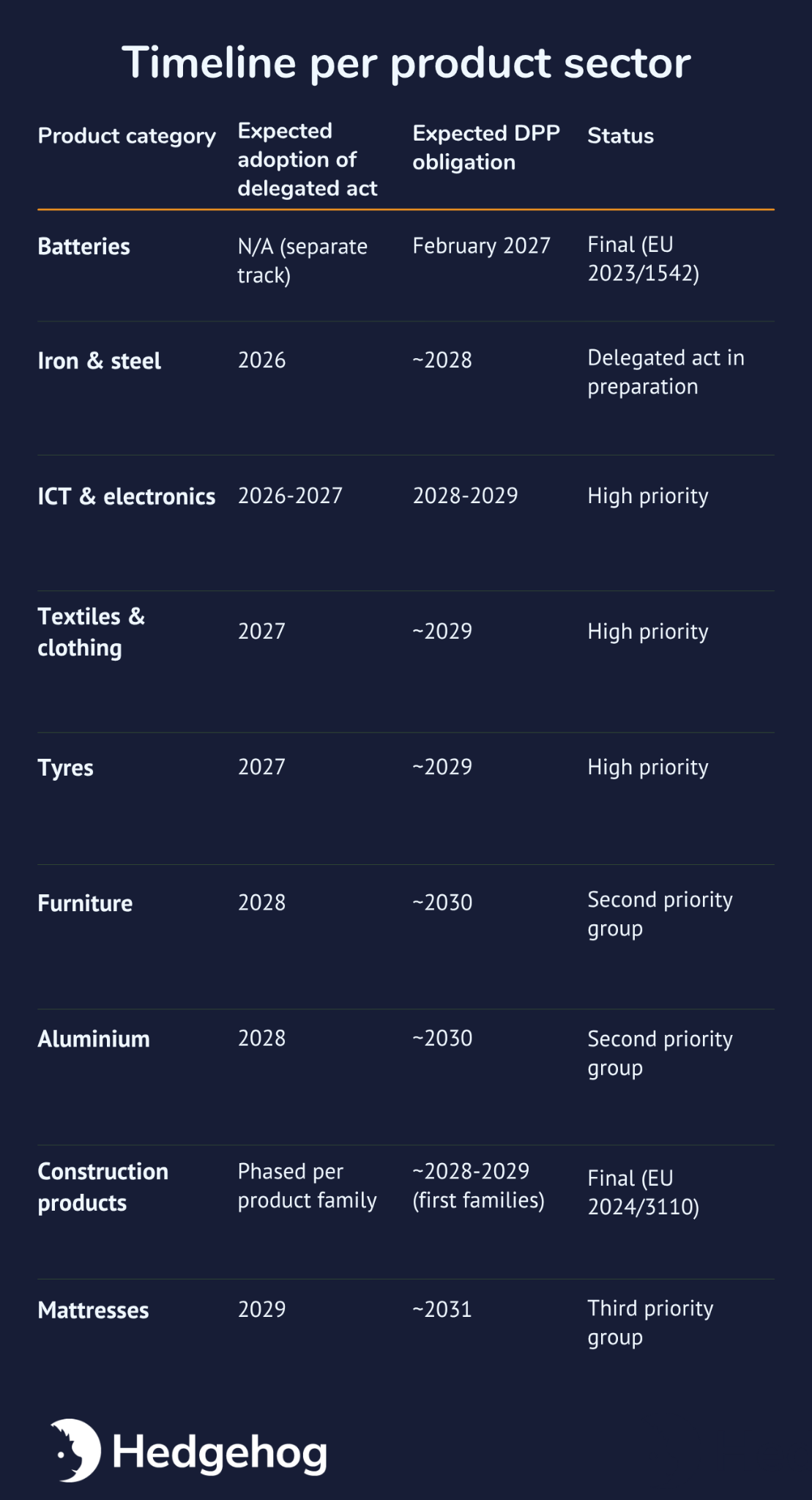
As the table shows, the deadlines are approaching quickly for high-impact sectors like textiles and batteries, while intermediate materials face longer implementation delays.
How small businesses can prepare for rules and regulations
For small and medium-sized enterprises (SMEs), these shifting deadlines can cause a lot of confusion. Managing complicated supply chains requires time and administration that smaller teams often lack. Starting early ensures you are well-prepared. Instead of waiting for the final regulations to come into force, you can take practical steps to prepare your internal systems.
- Use data mapping to find your gaps: Begin by assessing your existing product data. Look at where your raw materials come from and check whether your current suppliers can provide verified certificates.
- Focus on life cycle data early on: Consider conducting a simplified Life Cycle Assessment (LCA). By measuring your environmental impact now, you won't have to rush when specific rules for publishing data become mandatory.
- Avoid building temporary in-house software: Developing a bespoke, proprietary IT tool is risky at this stage because the EU data protocols are still evolving. Rely on flexible, external systems that adapt automatically to changing standards.
How to prepare your data for the DPP
Although the final technical standards for the Digital Product Passport are still being developed, it is wise to start building your own database now. Carrying out a Life Cycle Assessment (LCA) is the most effective way to calculate the precise product and material emissions that will ultimately be required for your DPP.
An LCA replaces vague estimates with reliable, audit-ready data that meets strict EU requirements. By mapping out every production stage, an LCA helps you identify exactly where most of your emissions come from. This data does not just ensure you comply with all laws; it shows you precisely where you can use fewer raw materials and reduce costs.
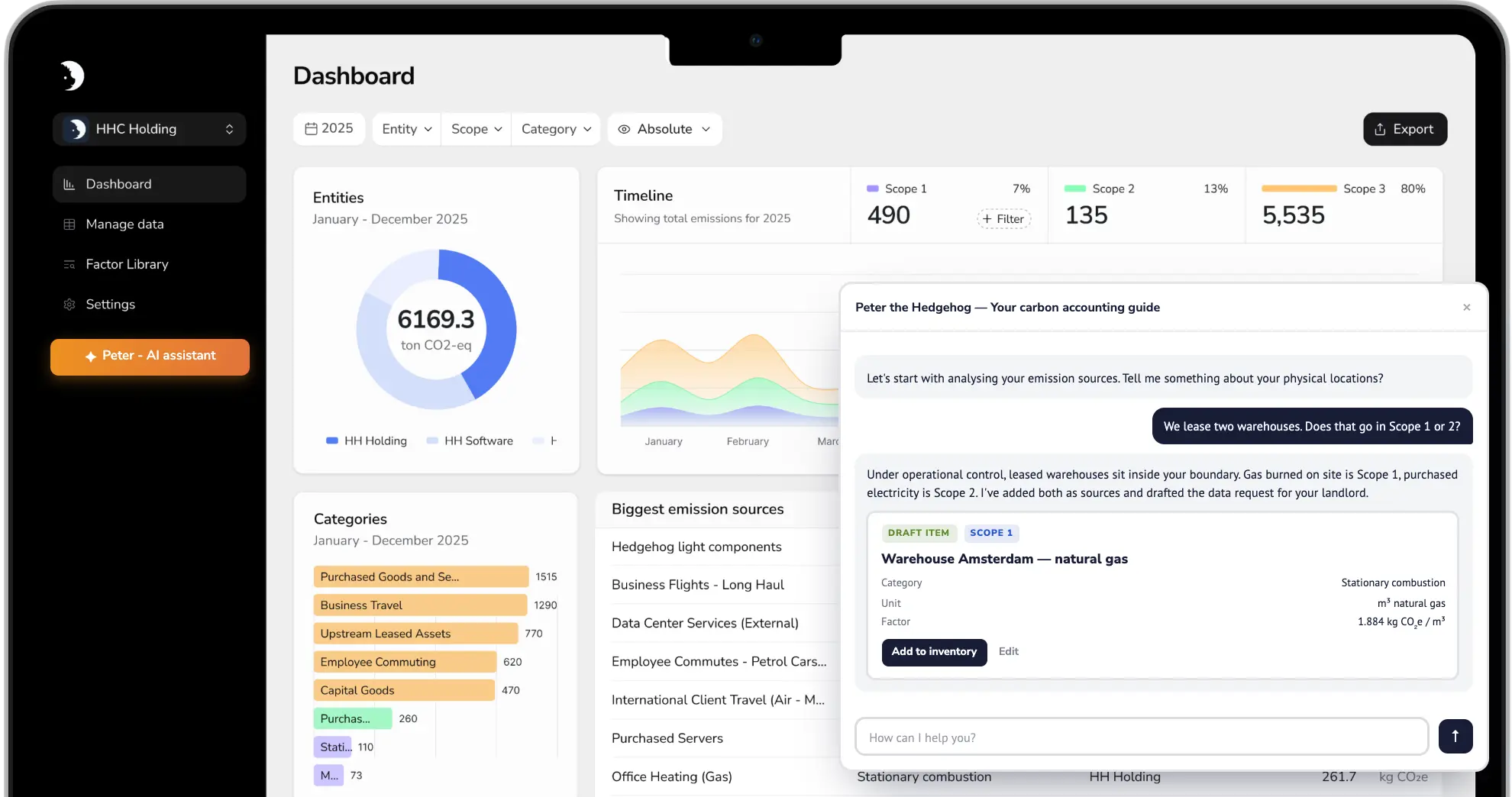
At Hedgehog, we offer expert LCA advice and our intuitive Carbon platform. The latter is a dedicated SaaS tool specifically designed to help SMEs efficiently measure, manage and report their carbon footprint, tailor-made for companies with smaller budgets.
By combining specific sustainability information with an efficient software solution, we help your business navigate changing EU requirements with confidence. Get in touch with our team today and find out how an LCA or our Carbon platform can get you started.


.avif)

