
In short
- The trigger is a role, not a size: placing textile, textile-related or footwear products on the market of a Member State.
- It is a directive, so your obligation starts on your country's date, at the latest 17 April 2028. There is no single European start date, and in the Netherlands producer responsibility for textiles has applied since 1 July 2023.
- The only size carve-out we can verify is a temporary one for enterprises with fewer than 10 persons and turnover and balance sheet not above EUR 2 million, and it ends on 17 April 2029.
You are in scope if you place textile products, textile-related products or footwear on the market of an EU Member State. That is a test about what you do, not about how large you are. Directive (EU) 2025/1892 makes extended producer responsibility for these products mandatory, and because it is a directive it binds governments rather than companies until each one writes it into national law. Member States must transpose by 17 June 2027 and have schemes running by 17 April 2028, so your obligation starts on a national date, at the latest 17 April 2028. Some countries started earlier: the Netherlands has run a mandatory scheme for textiles since 1 July 2023. Anyone quoting you one European start date is guessing.
The directive amends Directive 2008/98/EC, the waste framework directive, and entered into force on 16 October 2025. It is worth separating from the ecodesign rules on unsold stock, which run on a completely different test.
What are the parts of the test?
Three, and all three have to be true at once.
A role. You place the products on a market. That is the producer concept extended producer responsibility rests on, and it is about who first puts goods in front of buyers in a country rather than who made them. A brand that has garments made under contract is generally the one placing them on the market, not the factory.
A product. Textile products, textile-related products and footwear. Our verified record uses that phrasing and does not enumerate the exact product list, so if your range sits at the edge, home textiles, technical fabrics, accessories with mixed materials, read the annex to your own national implementing act rather than trusting a summary, including this one.
A territory. Each Member State runs its own scheme. The obligation attaches per country in which you place products, which is why the answer for a brand selling into six markets is usually six answers rather than one.
Why can nobody give you a single European date?
Because of what a directive is, and this is the most common mistake in this topic.
| Aspect | Regulation | Directive |
|---|---|---|
| Who it binds directly | Companies, across the EU | Member States |
| Where your obligation comes from | The EU text itself | Your national implementing law |
| The date that matters to you | The date in the act | The date in your country's law |
| Example in this cluster | The ecodesign rules on unsold goods, live since 19 July 2026 | Textiles producer responsibility, national date between 17 June 2027 and 17 April 2028 |
| What varies by country | Enforcement and penalties | Timing, and much of the detail |
Read the two rows about dates together and the practical point falls out. The ecodesign prohibition on destroying unsold apparel started on the same day in every Member State. Textiles producer responsibility will not. A brand can be registered and paying in one country while the scheme in the country next door has not opened. The Netherlands went ahead of the directive: its national decree on producer responsibility for textiles has applied since 1 July 2023.
Does being small get you out?
Only if you are very small, and only until a fixed date.
The one carve-out we can verify comes from the directive itself, which says that from 17 April 2029 the relevant articles shall apply to enterprises which employ fewer than 10 persons and whose annual turnover and annual balance sheet does not exceed EUR 2 million. Read that in the direction it is written: those enterprises are outside the scheme until 17 April 2029, and inside it from that day.
That is a narrower relief than most people assume when they hear that small companies are exempt. It is not a small enterprise exemption in the ordinary sense, it uses both a headcount test and a financial test, and it expires. If you are a ten-person brand with a two and a half million euro turnover, you do not qualify at all.
Note also how different this is from the ecodesign rules next door, where micro and small enterprises are excluded with no recorded end date and medium-sized ones come in on 19 July 2030. Two neighbouring instruments, two entirely different size regimes. Working out which one you are reading is half the job, and the general version of that skill is worth having: our note on the EmpCo claims checklist is another instrument in the same sector with a third scope test again.
Do you need one registration or several?
Almost certainly several, and here is where our verified record stops.
What we can say is that Member States must have schemes established, that producer obligations start on the national transposition date or at the latest on 17 April 2028, and that the scheme applies per market. What we do not have, and therefore do not state: how registration works in any given country, what the fees are or how they are calculated, whether fees are modulated by material or design, whether there is a duty to take goods back in store, what reporting the scheme requires and on what cadence, and what the penalties are.
Those are the six questions every brand asks next, and every one of them is answered by national law that mostly did not exist when we verified this on 28 August 2026. A page that answers them confidently today is describing either one country or an assumption. Ask which.
What do you do if you are in scope?
Three things, none of which requires the national text to exist yet.
Fix the country list. Write down every EU country into which you place product, including through marketplaces and your own webshop. That list is the shape of your obligation and it is often longer than the sales team's mental model.
Get the volumes right. Producer responsibility fees are charged on what you put on a market. Whatever the national formula turns out to be, it will need units and weights by country and by product category. Most brands can produce revenue by country instantly and physical volumes by country not at all.
Watch one source per country. The transposing act, not a newsletter. The date you need is the one in your own market's law.
What do you do if you are out of scope?
If you are inside the sub-ten-person carve-out, note 17 April 2029. Nothing is due under the directive before then. If you sell in the Netherlands, check the Dutch decree as well, because it already applies.
The pressure a smaller brand does feel meanwhile is commercial rather than legal: retail and wholesale customers collecting supply chain data for their own reporting, usually in a standard format such as the VSME standard. Where those requests get out of proportion to the relationship, our note on the value chain cap on ESG questions sets out what a customer can reasonably require.
Where does Hedgehog fit, and where does it not?
On neither side of this rule, and the honest answer is short.
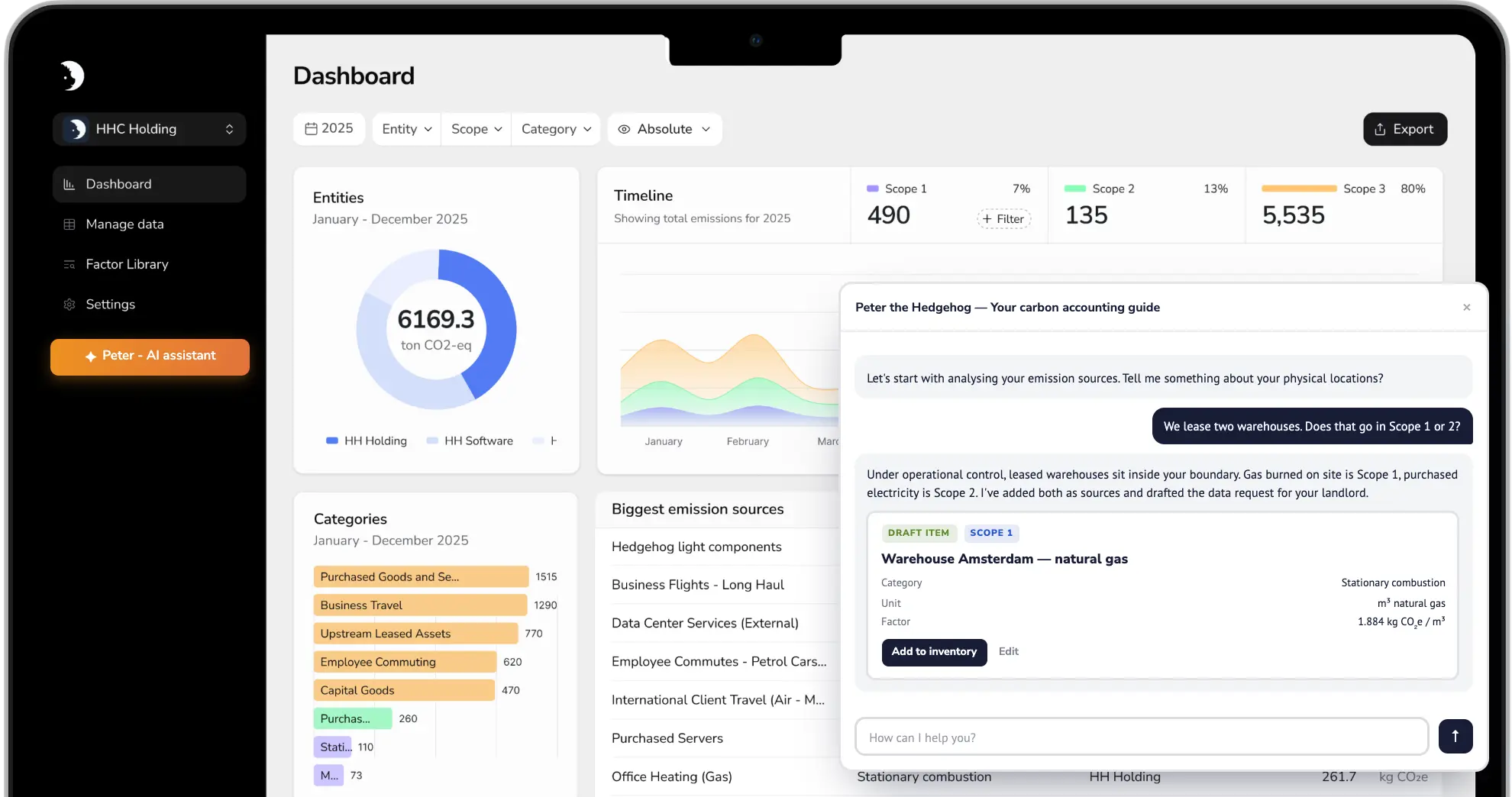
Producer responsibility is a fee and a collection duty calculated on the goods you place on a market. It asks for units and weights, not for emissions, and carbon accounting software does not register you, calculate your fee or file your return. What the Hedgehog platform does is the organisational carbon inventory that customers, claims rules and voluntary reporting formats ask for, with multi-entity management across locations and roles for data owners, auditors and managers, which is useful when the same brand operates as several companies across several markets. The platform page reports 5,000+ users.
The limitation we publish: a Mid-Market reviewer on G2 in July 2026 rated the platform 4 out of 5 and said applied conversion factors and distance calculations are not exposed to the user, so it is not always possible to trace how an input became an entry. If traceability is the reason you are buying, ask about it directly. Where the work is judgement rather than data entry, scope 3 consulting is the better fit.
Sources: Directive (EU) 2025/1892 amending Directive 2008/98/EC, Regulation (EU) 2024/1781, the Dutch Besluit uitgebreide producentenverantwoordelijkheid textiel (read 24 September 2026), the Hedgehog regulation fact base, and the Hedgehog platform page. Verified 28 August 2026.
Facts on this page were last verified on 2026-09-17.