In short
- Work out whether you need a product footprint or a company footprint first. They are different tools and different budgets.
- If you need an LCA, EPD or MKI, Hedgehog is a service and not a platform. Say so before you book a demo.
- The thing that decides an LCA tool is the database and the reviewer, not the interface.
Before you shortlist anything, settle one question: do you need a footprint for a product or a footprint for the company? Ecochain sits on the product side, and most people searching for an alternative to it are doing LCA, EPD or MKI work rather than annual corporate reporting. Those are two different categories of tool with two different budgets, and picking from the wrong one is the most expensive mistake available here. This page is about how to tell which you need, and it rules us out of one of them.
We sell carbon accounting software, so read the section about us with that in mind. We have also tried to make this page useful to someone who should not buy from us, because that is most of the people who arrive on it.
Which side of the line are you on?
The clearest way to tell is to look at what someone has asked you for.
| What you were asked for | What you need | Who it is bought by |
|---|---|---|
| An EPD for a specific product or pack | Product footprint, usually LCA software plus a reviewer | Product or technical manager |
| An MKI value for a building tender | Product data in a validated Dutch calculator | Bid or engineering lead |
| A carbon footprint of a specific SKU for a retail customer | Product footprint | Commercial or NPD lead |
| Our company emissions for a questionnaire, tender or VSME report | Organisational footprint | Sustainability, QHSE or finance |
| Scope 1, 2 and 3 for the year, repeated annually | Organisational footprint | Sustainability, QHSE or finance |
Plenty of businesses eventually need both. Almost nobody needs both in the same quarter, and buying the wrong one first is how a project stalls.
We class Ecochain in our own competitor census as a product data tool rather than a platform, alongside One Click LCA, Sphera and SimaPro, based on the shape of their published site when we mapped the category on 27 August 2026. That is our classification and not their description of themselves, so check it against their own site before you rely on it.
What actually decides a product footprint tool?
If you are on the product side, four things decide it, and the interface is not one of them.
The database behind it. A product footprint is only as good as the background data it draws on. Ask which database, which version, and what happens when it updates mid-project.
Whether the output is accepted where you need it. An EPD usually needs a programme operator and a verifier. An MKI value in the Netherlands has to come from a route the receiving party accepts. Ask for a worked example that was actually accepted by the body you need to satisfy, not a screenshot.
Who does the modelling. Some tools assume a trained LCA practitioner. Others assume a product manager with a spreadsheet. Getting this wrong is the difference between a project that finishes and one that quietly stops after the pilot.
What a second product costs. The first study is the one you are quoted for. Your real cost is study number twelve, when the range gets extended.
What actually decides an organisational tool?
If you are on the company side, the criteria change completely. These are the seven we would put to any vendor in this category, us included.
- Does it produce the report you are actually asked for, by name: VSME, CSRD, PPN 006, the CO2-Prestatieladder, a specific customer questionnaire?
- What happens to your baseline when emission factors update, and can you restate a prior year while keeping the original as published?
- Can you trace a reported figure back to the input file, the factor, and the conversion applied?
- What does year two cost for the same shape of business?
- How are entities and seats counted, and are data owners and auditors billable?
- What does it take to get your data out in a format someone else can read?
- How much of the first inventory is manual, and who does that work?
Question three is worth pressing hard whoever you buy from. A number you cannot trace is a number you cannot defend when a customer or an auditor asks how you got it.
Where does Hedgehog fit, and where does it not?
It does not fit the product side. The platform does organisational footprints. Product footprints, LCA, EPD, MKI and PCF, are delivered as a service by our consultancy rather than as something you do yourself in the software. If what you need is an EPD for a pack or an MKI for a tender, buying our platform will not give it to you. That work is LCA consulting, and if you would rather buy a tool and do it in house, we are not the answer and a dedicated product-data tool is.
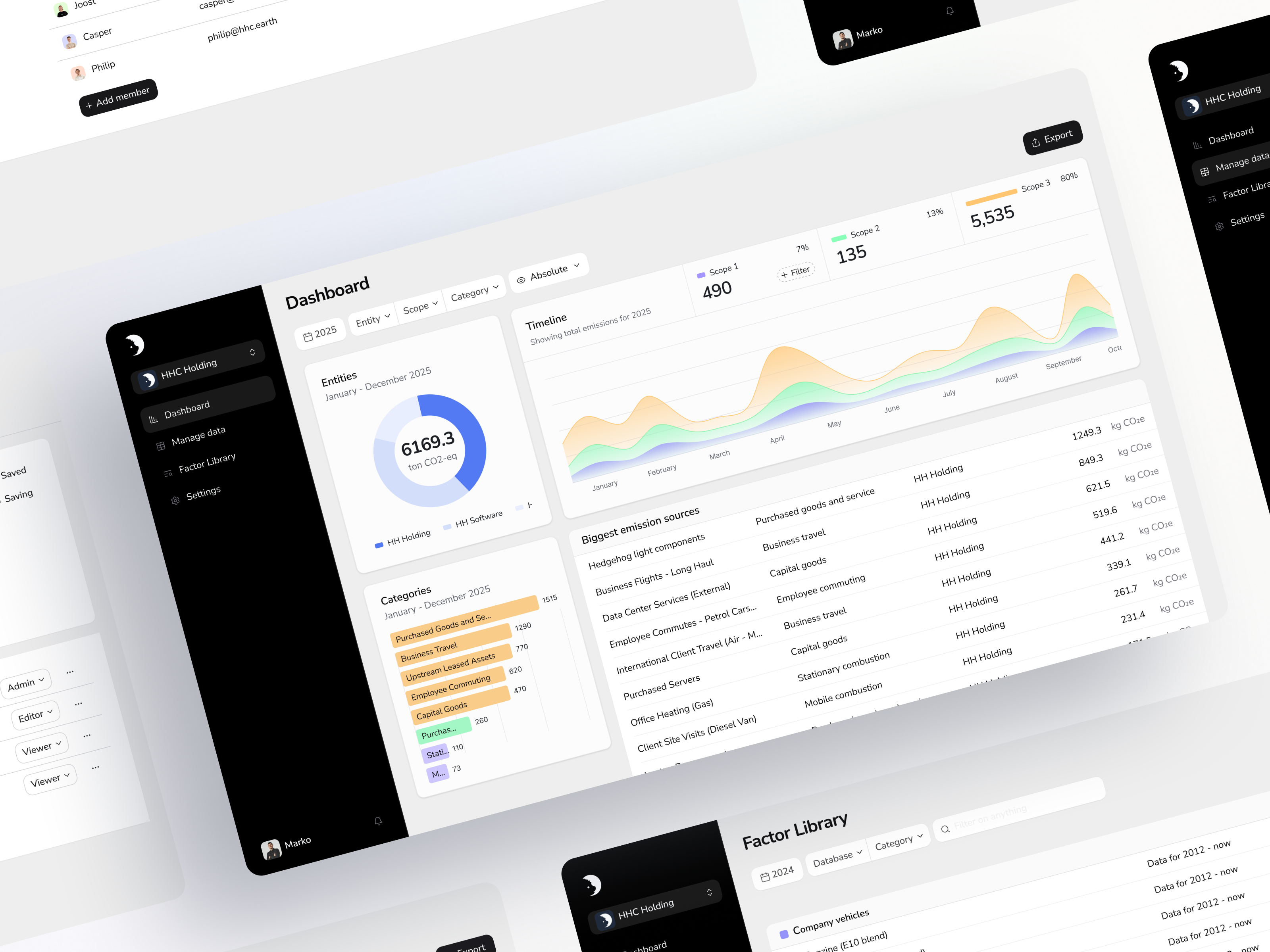
It fits the company side. GHG Protocol setup, a data collection plan, inventory building and reporting, guided by an AI assistant with human GHG experts reachable in-app. Over 20,000 spend-based and activity-based factors, with the option to add organisation-specific or supplier-specific data. Entity management across locations and sites with roles for data owners, auditors and managers. Reporting output covers the GHG Protocol, PPN 006 and the CO2-Prestatieladder, and named legislation support includes CSRD, SECR and SB253. A free account with no sales call, and Pro from EUR 1,200 a year.
Three things customers say we are not good at, so you do not find out later:
Loading the data is the work. A small-business customer said on G2 in August 2026 that it takes a lot of manual labour to load data, and that once the data is there it works perfectly. That is the honest shape of a first inventory, here and everywhere else.
You cannot always trace a conversion. A mid-market customer said on G2 in July 2026 that they wanted to see the conversion factor applied to a currency conversion and the calculator used for a distance calculation. That is question three above, and we do not fully pass our own test yet.
It is not a broad ESG suite. A mid-market customer rated us 3.5 out of 5 in June 2026 and said that for broader ESG and CSRD reporting the platform is less complete, with no data source management and no decarbonisation target monitoring.
How should you shortlist?
Work backwards from the artefact someone has demanded, not from a feature list.
If the artefact is a product number, shortlist product-data tools, ask each for a worked example accepted by your receiving body, and budget for a reviewer. We are not on that list, though we do that work as a service.
If the artefact is a company number, shortlist organisational platforms including us, run the seven questions above, and insist on testing with your own data rather than a demo dataset.
If you genuinely need both, sequence them. Get the company footprint running as an annual routine first, because it is the one that repeats and the one most customer questionnaires actually ask for, then commission product studies where a specific customer or tender requires one. Our guide to choosing carbon accounting software covers the company side in more detail.
What should you do first?
Find the email or the tender document that started this and read what it literally asks for. In our experience most of the confusion in this category comes from a request being relayed internally as "we need our carbon footprint" when the document actually asked for something much narrower, or much wider.
Then, if it is a company footprint, you can build a first one on a free account without talking to anyone, and find out how good your data is before committing a budget. If it is a product footprint, tell us what was asked for and we will tell you honestly whether it is a service job, a tool job, or both.
Sources: Hedgehog platform, Hedgehog on G2, and our own competitor census, mapped 27 August 2026. This page makes no claim about any other vendor's features, pricing or capabilities. Where a category classification appears it is ours, not the vendor's, and you should check any vendor's current position on their own site.
Facts on this page were last verified on 2026-08-27.