
They are not competing products. ESG reporting software manages disclosure across dozens of topics. Carbon accounting software calculates greenhouse gas emissions accurately. Companies buy the wrong one regularly, usually the expensive one.
Which you need depends on a single question: what are you actually required to report?
The difference in one line
ESG reporting software is a disclosure management system. It handles many topics, workflows, evidence collection, and mapping to reporting frameworks. Emissions are one data point among hundreds.
Carbon accounting software does one thing thoroughly: converts activity data into a defensible emissions figure, keeps the method stable across years, and outputs emissions-specific reports.
An ESG platform typically ingests an emissions number. It rarely calculates one well.
What changed in 2025, and why it matters
The Omnibus package narrowed CSRD scope substantially, to companies above 1,000 employees and €450 million turnover, applying to financial years beginning on or after 1 January 2027.
A large number of mid-sized companies that were buying ESG reporting software to prepare for CSRD are now out of scope. Many are sitting on subscriptions for a disclosure framework they will never file.
Meanwhile the companies still in scope need value chain data, which they collect from suppliers. So the SME supplier who dodged CSRD now receives questionnaires instead. That is a data problem, not a disclosure-management problem, and it is answered by VSME plus an accurate footprint.
Which one you need
You need carbon accounting software if your requirement is emissions-specific:
- A Carbon Reduction Plan for PPN 006
- A CO2-Prestatieladder submission
- NHS Evergreen from April 2027
- Customer questionnaires asking for Scope 1, 2 and 3
- A number behind an environmental claim, now legally required
- A VSME report, where emissions is the disclosure needing real calculation
You need ESG reporting software if you are genuinely filing full CSRD under the revised thresholds, with double materiality, dozens of ESRS datapoints across environmental, social and governance topics, evidence trails and limited assurance. That is a disclosure management problem at a scale where spreadsheets fail on coordination rather than calculation.
You need both if you are in CSRD scope and want your emissions figures to be defensible rather than merely present. The ESG platform manages the disclosure; the carbon tool produces the number it discloses.
The mistake in each direction
Buying ESG software for an emissions requirement. You get a comprehensive framework, a long implementation, and a shallow emissions module. The tender still wants a Carbon Reduction Plan, and you end up doing that separately.
Buying carbon software for a full CSRD filing. Your emissions are solid and you have no mechanism for the other topics, the materiality assessment or the evidence trail.
The first mistake is far more common and considerably more expensive.
For SMEs, this is usually simple
If you are an SME receiving supplier questionnaires, you almost certainly do not need ESG reporting software. You need:
- An accurate footprint covering the scopes you are asked for
- A VSME report you can reuse across customers
- The same thing again next year, comparable to this year
That is a carbon accounting requirement. See what SMEs actually need.
The value chain cap also means large customers cannot demand unlimited data from you, which further reduces the case for a full disclosure suite. See which questions you can refuse.
The question that settles it
Are you managing a disclosure, or producing a number?
Disclosure management across many topics with evidence and assurance is ESG software. Producing a defensible emissions figure, repeatedly, in a specific format is carbon accounting software.
Most companies asking this question are producing a number and have been sold a disclosure system.
Where we sit
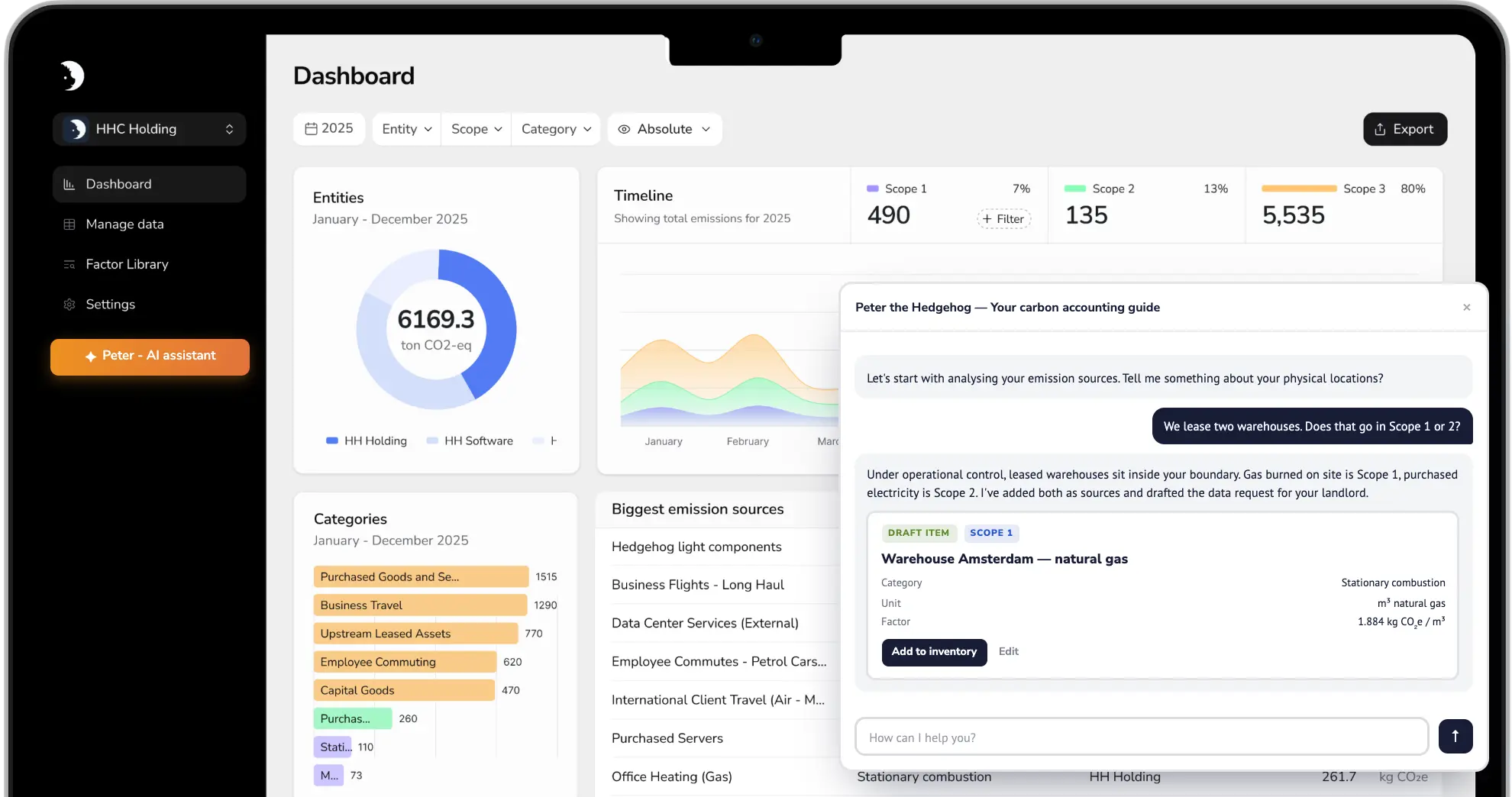
We are the second thing. The platform calculates emissions and outputs the emissions-specific formats, with consulting for boundary setting and Scope 3 where judgement is required.
If your requirement is genuinely full CSRD disclosure across all ESRS topics, we will tell you that an ESG platform is the right tool and that we are not it.

