
In short
- Internal staff time is usually the largest line and never appears in any quote.
- Ask what is billed separately, in writing, before you compare two prices.
- Factor updates and restatements are a recurring cost nobody budgets for in year one.
The licence is rarely the largest number in a carbon accounting programme. The two vendors in this market who publish an entry price at all sit around GBP 990 and EUR 1,200 a year, and the costs that sit underneath either figure, onboarding, data cleaning, internal staff time, assurance, factor updates, extra seats and eventually exit, routinely total several times that. Most vendors will not publish a licence price at all because the deal is partly services and partly a sizing exercise, which also means the non-licence lines are the ones nobody itemises for you. Budget the software last and the people first.
We sell one of these platforms, so treat the section about us accordingly. Every line below is one you should be asking every vendor about, including us.
Why does the quote only show you one number?
Because the quote is for the part the vendor can price mechanically. Seats and entities are countable. Your data is not.
There is a second reason, and it is not sinister. A large share of what buyers spend in this market is people: implementation consultants, a data analyst, an internal project owner and eventually an assurance provider. Vendors cannot quote for your staff, and they will not quote for work whose size depends on records they have not seen.
So the honest way to read any carbon accounting quote is as a floor, not a total. The question that matters is not what is the price. It is: what is included in that price, and what is billed separately?
What does onboarding really cost?
Two things, and only one of them shows up on an invoice.
The billable part is implementation: boundary setting, configuring entities and reporting periods, mapping your chart of accounts to spend categories, and training. Some vendors bundle this, some price it as a one-off fee, and some sell it as a multi-week project. Ask which, and ask for the number of hours behind it.
The unbilled part is your side of the same work. Somebody in your organisation has to decide the organisational boundary, chase the data owners, answer the vendor's questions and check the output. That person exists whether or not the vendor charges for onboarding, and their time is real money.
The reliable question is: how many hours of our time did your last three customers of our size actually spend in the first quarter? A vendor who cannot answer that has not measured it.
Who pays for cleaning the data?
You do, in almost every arrangement, and this is the line that surprises people most.
Carbon data arrives as PDF invoices, meter readings in three formats, a fleet spreadsheet maintained by somebody who left, and a travel booking export with no distances in it. Getting that into a shape a platform can consume is not a software feature. It is a project.
A Hedgehog customer put it plainly on G2 in August 2026: it requires a lot of manual labour to load data, and once the data is there it works perfectly, but getting it loaded is the challenging part. That is a fair description of this market, not just of one product. Any vendor promising otherwise is describing the second year, not the first.
Price it the way you would price any data migration. Count your sources, estimate hours per source, and add half again for the sources you have not thought of.
What is the full list of non-licence costs?
| Cost line | Who charges it | When it hits | Usually forgotten? |
|---|---|---|---|
| Implementation and onboarding | Vendor | Year one | No |
| Data collection and cleaning | You, internally | Every year | Yes |
| Internal project owner time | You, internally | Every year | Yes |
| Additional user seats | Vendor | When you scale | Sometimes |
| Additional entities | Vendor | When you acquire | Sometimes |
| Emission factor updates and restatement | Both | Every year | Yes |
| Third party assurance | Assurance provider | Before publication | No, but underestimated |
| Product footprints, LCA or EPD | Consultancy | Per product | Yes |
| Data export and migration on exit | Vendor | Year three or four | Almost always |
The four lines marked as forgotten are, in our experience of these conversations, where first-year budgets break.
What happens when the emission factors change?
Factor libraries are updated, usually annually, and when a factor moves your historical numbers move with it. That produces two costs.
The first is restatement. If your base year figure changes because the underlying factor changed rather than because your emissions changed, you have to explain that to whoever relies on the number: a certification body, a tender evaluator, a customer or a board. Explaining it takes time and sometimes takes a note in your report.
The second is method drift. If you switch a category from spend-based to activity-based factors as your data improves, your year on year comparison breaks unless you recalculate the earlier year on the new method. That is the right thing to do and it is not free.
Ask a vendor three specific things: how often factors are updated, whether historical periods are recalculated automatically or frozen, and whether you can see which factor version produced a given figure. The third one matters for audit and is not universally available.
What does assurance add, and is it in the licence?
It is almost never in the licence, and it is frequently the larger line.
Limited assurance on a first organisational footprint is a separate engagement with a separate provider, priced on your entity count, the number of data sources and how traceable your inputs are. The traceability point is the one you can control: an inventory where every figure links to a source document assures far more cheaply than one where the auditor has to reconstruct your working.
That is worth remembering when you compare a cheap tool against a slightly better one. A platform that saves your assurance provider a week has already paid for the difference.
What does it cost to leave?
Ask before you join, because the answer is rarely on the website.
Three questions settle it. Can you export your full inventory, including inputs, factors applied and calculated results, in a machine-readable format, at any time and without asking? Does that export survive the end of the contract, and for how long? Does the export include enough detail for a different platform, or an auditor, to reproduce your numbers?
A vendor who exports a PDF dashboard is holding your history. A vendor who exports the underlying rows is not. This is a five-minute question that saves a five-figure migration later.
Where does Hedgehog add cost you might not expect?
Three places, stated plainly.
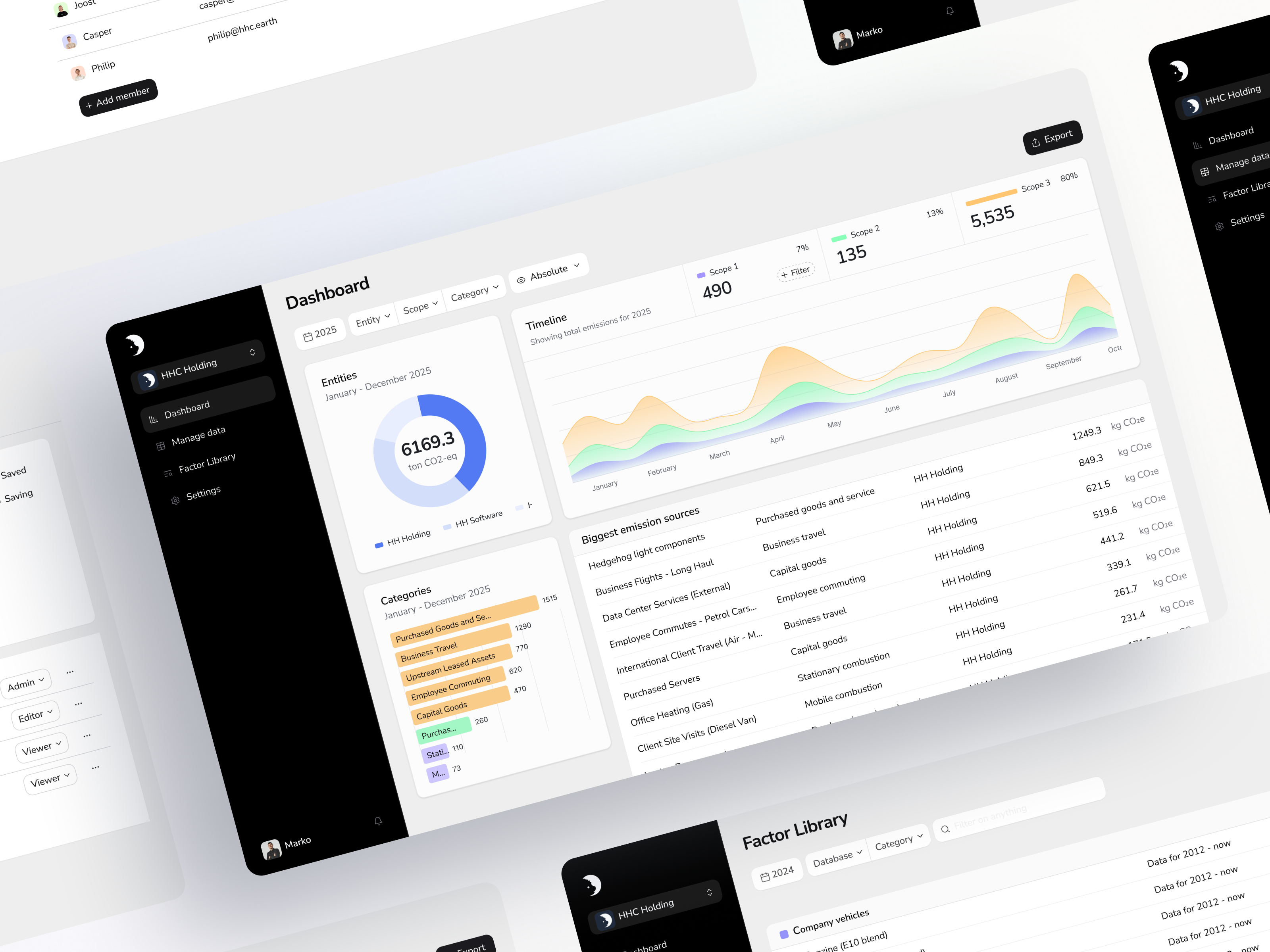
Your time on data loading. Same as everyone. Setup is self-serve, the AI assistant guides GHG protocol setup and inventory building, and the slow part is still your records. Budget the hours.
Anything outside the organisational footprint. Product footprints, LCA, EPD, MKI and PCF work is delivered as a service with its own scope and quote. The platform does organisational footprints. If your customers are asking for product level numbers, that is a separate line in your budget, not a plan upgrade.
Work you might have expected the tool to absorb. A customer rated us 3.5 out of 5 on G2 in June 2026 and said that as a broader ESG data and reporting platform this one is less complete, with no data source management feature and no decarbonisation target monitoring. A customer also named more integrations with other software as the thing they would change, on G2 in June 2026. If you need either of those, that work lands somewhere, and somewhere means a person or another tool. The distinction between an ESG suite and a carbon platform is worth settling before you shortlist.
What is not hidden: Pro starts at EUR 1,200 a year on published pricing, and a free account requires no sales call, which lets you test the data loading cost before spending anything.
What should you do first?
Build the total, not the licence. Take your quote, add an estimate of internal hours at your own loaded cost, add an assurance quote if you will need one, add a restatement allowance, and look at the three year figure rather than the first year figure.
Then send the vendor one email asking what is billed separately, what happens at renewal and what the exit export contains. Their willingness to answer those three in writing tells you more about the real cost than any price on a page. Our guide to choosing carbon accounting software for an SME covers the selection criteria that sit alongside cost.
If you want to size your own data problem before committing anything, start a free account and load one messy category. If you would rather work through the budget with someone, book a call.
Method: the pricing page of eleven carbon accounting vendors was read on 27 August 2026 and checked for a numeric price. Only EcoHedge published figures on its own pricing page. Vendors change pricing often, so re-check before relying on anything here. Sources: Hedgehog platform, Hedgehog on G2. Verified 27 August 2026.
Facts on this page were last verified on 2026-09-17.

