

Let’s start with the basics: what is ISO 14001 exactly? It is one of the most important internationally recognised standards for an Environmental Management System (EMS). It helps companies systematically manage their environmental impact, reduce risks, and comply with laws and regulations.
Furthermore, this certification builds trust with larger clients within the supply chain. A major advantage for SMEs (Small and Medium-sized Enterprises) is that the standard provides a structured framework to make sustainability part of daily operations. This often leads to cost savings through more efficient use of raw materials and energy. Additionally, an increasing number of banks and insurers request ISO 14001 certification when assessing financing applications. It’s certainly a wise move to get started with it.
Why is ISO 14001 being revised?
The world of sustainability reporting is changing faster than ever. The previous version of the standard (from 2015) dates back to a time when climate change was often viewed as a 'future risk'. Today, the focus has shifted from non-binding sustainability ambitions to hard data and transparency. This is driven by stricter regulations and increased pressure from customers.
ISO is revising the standard to better align with these global trends. There is an urgent need for harmonisation: the language of ISO must match that of other reporting frameworks, such as the CSRD and the Science-Based Targets initiative (SBTi). The primary motivation is that climate change should no longer be seen merely as a potential environmental effect, but must be integrated as a fundamental part of every company’s strategy.
Timeline – Key Milestones
The adaptation of the standard followed a strict process. Below are the key dates that SME entrepreneurs should keep in mind:
- Autumn 2023: Initial drafts were prepared by the technical committee (ISO/TC 207/SC 1).
- 2024: Development and review of the Committee Draft (CD).
- Note: The climate change amendment (ISO 14001:2015/Amd 1:2024) has already been published and is immediately in force.
- Summer 2025: Release of the Draft International Standard (DIS). This is when the final direction becomes clear.
- 5 January 2026: Publication of the Final Draft International Standard (FDIS).
- 15 April 2026: Publication of the new ISO 14001:2026, officially replacing the 2015 version.
- 2027–2028: Certification bodies will be accredited to perform audits according to the new standard.
- May 2029: The final transition deadline. From this point, all certificates must be converted to the 2026 edition to remain valid.
What is Changing?
A Summary per Clause.
For SMEs, the most important changes lie in how you view your data and your environment. We highlight the most relevant clauses:
Clause 4: Context of the Organisation
The previous version required insight into how your business activities affect climate change. In the revised version, the focus extends beyond climate change to other environmental aspects, such as the use of natural resources, pollution, and biodiversity.
Furthermore, your approach to sustainability within your production chain must adopt a “life cycle perspective”. This means looking at sustainability from raw material extraction to the waste phase of your product. This ensures that the entire impact in the chain—both upstream (suppliers) and downstream (customers)—that you can control or influence is not overlooked.
Clause 5: Leadership
Another adjustment has been made regarding leadership. The new standard places more emphasis on the active role of management. Auditors will more frequently ask how climate goals are integrated into the long-term strategy and how management allocates resources for CO2 reduction. It is therefore essential to update your environmental policy, job descriptions, and communications to demonstrate responsibility and leadership in climate and environmental matters.
Clause 6: Planning
In the planning phase, you must now explicitly look at climate risks, such as physical threats or transition costs, with a solid carbon footprint serving as the basis for your action plans. The new standard tightens requirements regarding environmental aspects by demanding a stricter life cycle perspective and assessing emergencies separately from daily operations (6.1.2). Additionally, the link between risks, legislation, and actions has been strengthened (6.1.4–6.1.5), requiring an update of your risk registers. A significant new addition is clause 6.3, which obliges organisations to methodically plan and manage changes within the environmental management system.
Clause 8: Operational Planning and Control
The 2026 update significantly expands your responsibility across the value chain, making Scope 3 emissions a central focus. The standard now requires rigorous control or influence over externally provided processes, products, and services.
This means you must:
1. Map the Footprint: Move beyond your operations to map the environmental impact of your suppliers and subcontractors.
2. Life Cycle Control: Account for how your products perform once they reach the customer, ensuring sustainability from "cradle to grave".
3. Procurement Integration: Treat carbon accounting as a procurement tool, using data to scrutinize and select suppliers based on their verifiable environmental performance.
Clause 9: Performance Evaluation
Measuring your environmental performance becomes stricter. Instead of "we estimate our consumption," auditors will look for verifiable data. This is where audit-ready carbon accounting becomes essential.
The role of Carbon Footprinting
The "golden thread" connecting all these updated clauses (from defining your organisational context to operational control) is the Carbon Footprint calculation. It acts as the quantitative engine that drives the Plan-Do-Check-Act (PDCA) cycle within the ISO 14001 framework. Under the 2026 update, a rigorous footprint is no longer a "nice-to-have" sustainability report; it is the primary source of objective evidence required to satisfy Clause 9.
By calculating your footprint with precision, you translate abstract environmental “aspects” into manageable data points. This allows you to set science-based targets that an auditor can verify and ensures that your management of change (Clause 6.3) is based on reality rather than estimates. Essentially, the carbon footprint turns your EMS from a static document into a dynamic performance tool. Now that we have decoded the technical shifts in the standard, the question changes from what has changed to how you should respond.
I want my carbon accounting to be ISO14001-ready. What should I do?
An auditor looks for three things: accuracy, completeness, and traceability. To prepare your carbon accounting for the new ISO standard, follow these steps:
- Define your boundaries: Clearly define what you do and do not measure. Ensure this aligns with the 'Context of the Organisation' in Clause 4.
- Collect source data: Stop using separate spreadsheets with manual entry. Use direct data from invoices, smart meters, or ERP systems.
- Document your methodology: An auditor wants to know which emission factors you use and why. By using the Hedgehog Carbon platform, these factors are already predefined and scientifically substantiated, significantly accelerating the audit process.
- Focus on Scope 3: The new standard requires a broader perspective. Begin by mapping your most important procurement categories. You don’t need to know everything to the gram immediately, but you must have a plan to increase this insight.
- Internal control: Conduct a mock audit. For every claim, you make (e.g., “we have reduced our emissions by 10%”), can you show the underlying evidence within a few minutes?
How does Hedgehog help SMEs with this update?
At Hedgehog, we believe compliance doesn’t have to be complicated if you have the right tools and partners. We support SMEs in three ways to be ready for ISO 14001:2026:
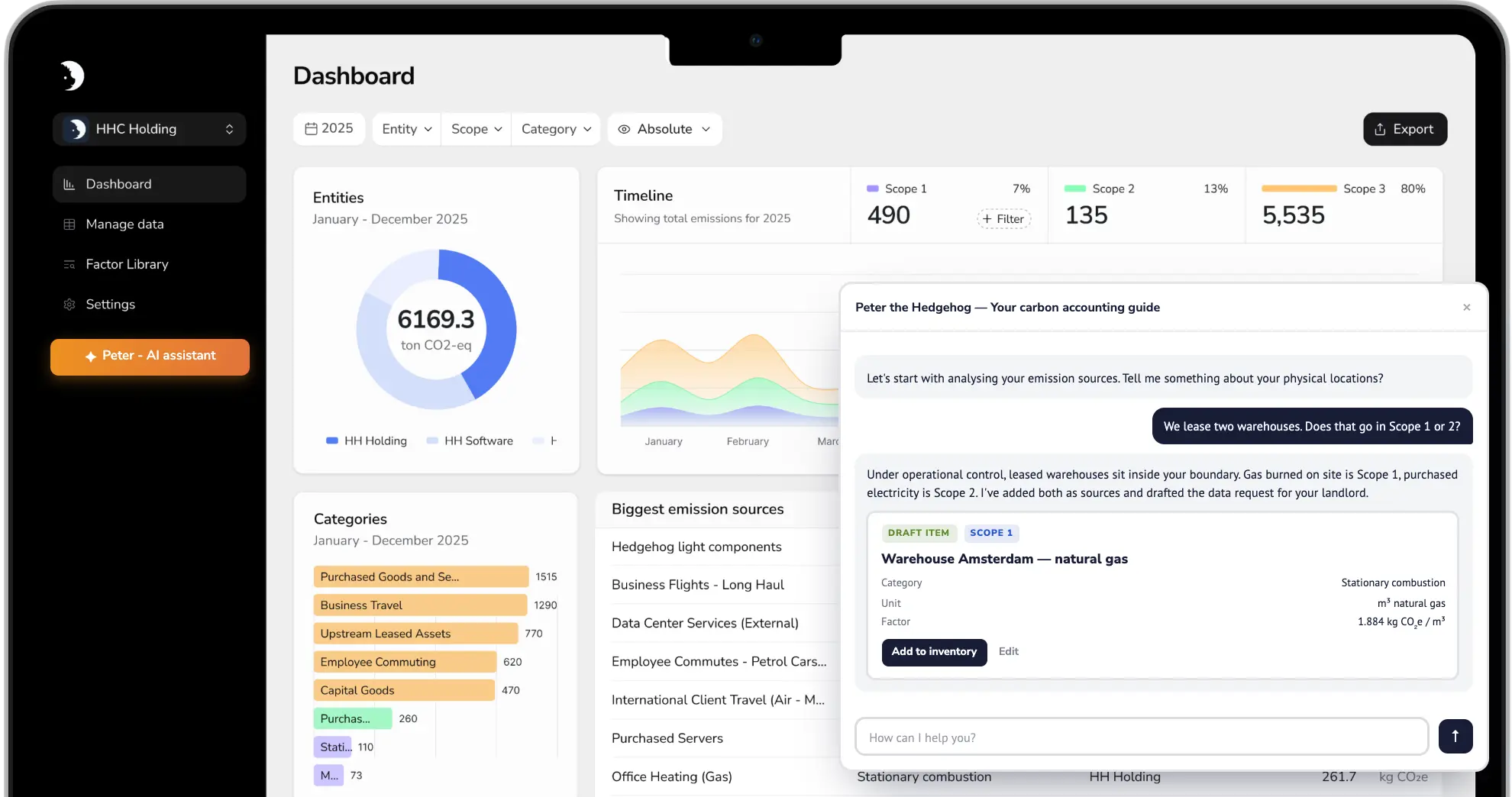
- Hedgehog Carbon Platform: Our intuitive software is designed to streamline carbon footprinting and data collection. The platform automates the calculation of Scope 1, 2, and 3 emissions according to the latest standards, ensuring you always have an audit-ready dashboard.
- Insight Services: Our experts help you conduct a detailed Life Cycle Assessment (LCA) or a carbon footprint consulting project. This provides the depth required for Clauses 8 and 9 of the new ISO standard.
- Compliance Services: We offer specific CSRD and ISO-readiness support. We take a critical look at your current management system and help you bridge the gap to the new requirements of the 2026 edition.
The revision of ISO 14001 is no reason for panic. By starting now to professionalise your CO2 registration, you ensure that your sustainability reporting never causes issues in the future.
Wondering if your CO2 registration is ready for the new audit requirements? Let’s take a look together. Contact us for a complimentary scan of your current processes.


.jpg)
