
In short
- AI shortens the learning curve and the classification work. It does not collect your data for you.
- An AI-assisted entry still has to be traceable, or an assurance provider will not accept it.
- The useful test is not whether the assistant is impressive. It is whether it hands back cleanly when it should.
In a carbon accounting platform, AI does three jobs. It walks you through setup so you do not have to learn the GHG Protocol before you start, it suggests how to classify the data you upload, and it lets you ask questions of your own numbers in ordinary language. It does not collect the data, it does not decide your reporting boundary, and it does not remove the need for someone to sign off the result. The people it helps most are the ones doing this alone, without a sustainability team. If that is you, build one inventory and watch where the assistant helps and where it hands back.
Almost every vendor now says the word, and very little marketing separates the three jobs above. They carry different amounts of risk.
What are the three jobs AI is actually doing?
Strip the branding away and there are three distinct functions hiding under one label.
Guidance. The assistant asks what your business does, which sites you operate and which financial year you are reporting, then produces the shape of an inventory and a data collection plan. This is the job that replaces reading a standard.
Classification. You upload a purchase ledger, a fuel card export or an energy bill, and the model proposes which activity each line is and which emission factor should apply. This is the job that replaces the tedious part.
Interrogation. Once the inventory exists you ask it questions: which site grew, what drove the increase, which category is missing data. This replaces building a pivot table.
- Job: Guidance through setup
What it replaces: Reading the standard first
Who still has to check: Whoever owns the reporting boundary - Job: Classification of uploads
What it replaces: Manual line-by-line coding
Who still has to check: Whoever signs the figure - Job: Questions about your own data
What it replaces: Analysis in a spreadsheet
Who still has to check: Anyone acting on the answer - Job: Collecting the data
What it replaces: Nothing. It does not do this
Who still has to check: You, every time
Note the last row. The hardest part of carbon accounting is getting numbers out of finance systems, fuel cards, landlords and suppliers, and no assistant does that for you.
Who actually benefits from it?
The benefit is concentrated in a specific reader: the person who inherited carbon reporting on top of another job and has no colleague to ask.
For that person, guidance is worth more than analysis. Two Hedgehog customers on G2 described this directly. A Small Business reviewer in August 2026 called the onboarding AI agent "really helpfull," and another Small Business reviewer the same month wrote that being able to "chat with my data" made the dashboard more interactive and gave greater insights.
The benefit is much smaller for a company that already has an experienced sustainability lead. They do not need the standard explained. What they need is throughput on classification and a clean handover to an assurance provider, and those are different tests.
If you are starting from nothing at all, the sequence matters more than the tooling. We set out the order of operations in carbon accounting from scratch.
What can AI not do in this category?
Four things, and every one of them is a place where buyers get surprised.
It cannot reach into a system it has no connection to. If a platform has few integrations, an assistant does not change that. A Mid-Market Hedgehog customer raised exactly this on G2 in June 2026, asking for more integrations with other software. That is a connector problem, not a model problem.
It cannot decide your boundary. Which entities are consolidated, whether you use operational or financial control, whether a leased site is yours: these are accounting judgements with consequences for every future year. A model can explain the options. It should not pick for you.
It cannot produce a product footprint. An LCA, an EPD, an MKI or a product carbon footprint needs a defined functional unit, a bill of materials and modelling choices that get reviewed by a person. At Hedgehog the platform does organisational footprints, and product-level work is delivered as a service.
It cannot forecast for you today, at least here. A Small Business reviewer on G2 in August 2026 noted that forecasting would be nice and that Hedgehog had told them it was on the development list. That is an honest statement of where the product is rather than where the marketing is.
Does AI make your number harder to defend?
Only if the platform hides its working, and this is the single most important question to ask a vendor.
An assurance provider does not care whether a line was coded by a person or by a model. They care whether you can show how an input became a reported figure: which factor was applied, from which library, at which version, and who accepted it.
That is a live limitation worth stating plainly. A Mid-Market Hedgehog customer rated us 4 out of 5 on G2 in July 2026 and said the conversion applied between an original input file and the entry in the platform is not visible enough. They wanted to see the conversion factor and the distance calculator used. That is a fair criticism and it applies to AI-assisted classification more than to anything else, because a suggestion you accepted without seeing the reasoning is exactly the entry an auditor will pull.
The rule of thumb: an assistant that suggests and logs is an asset. An assistant that decides silently is a liability.
What should you test before you rely on it?
Five tests, each of which takes under an hour on a free account.
Upload something genuinely messy. Not the clean sample file. A real ledger with inconsistent supplier names and a few rows in another currency. Classification quality on tidy data tells you nothing.
Ask it to explain one entry. Pick a line it classified and ask which factor was used and why. If the answer is a name without a source, note that.
Ask it something it should refuse. For example, whether you can call a product carbon neutral. A well-built assistant declines to make a claim on your behalf.
Check that you can override it. Every suggestion should be editable, and the override should be recorded as an override.
Ask the same question twice. Materially different answers about the same dataset are a reporting problem, not a quirk.
What does Hedgehog's assistant actually do?
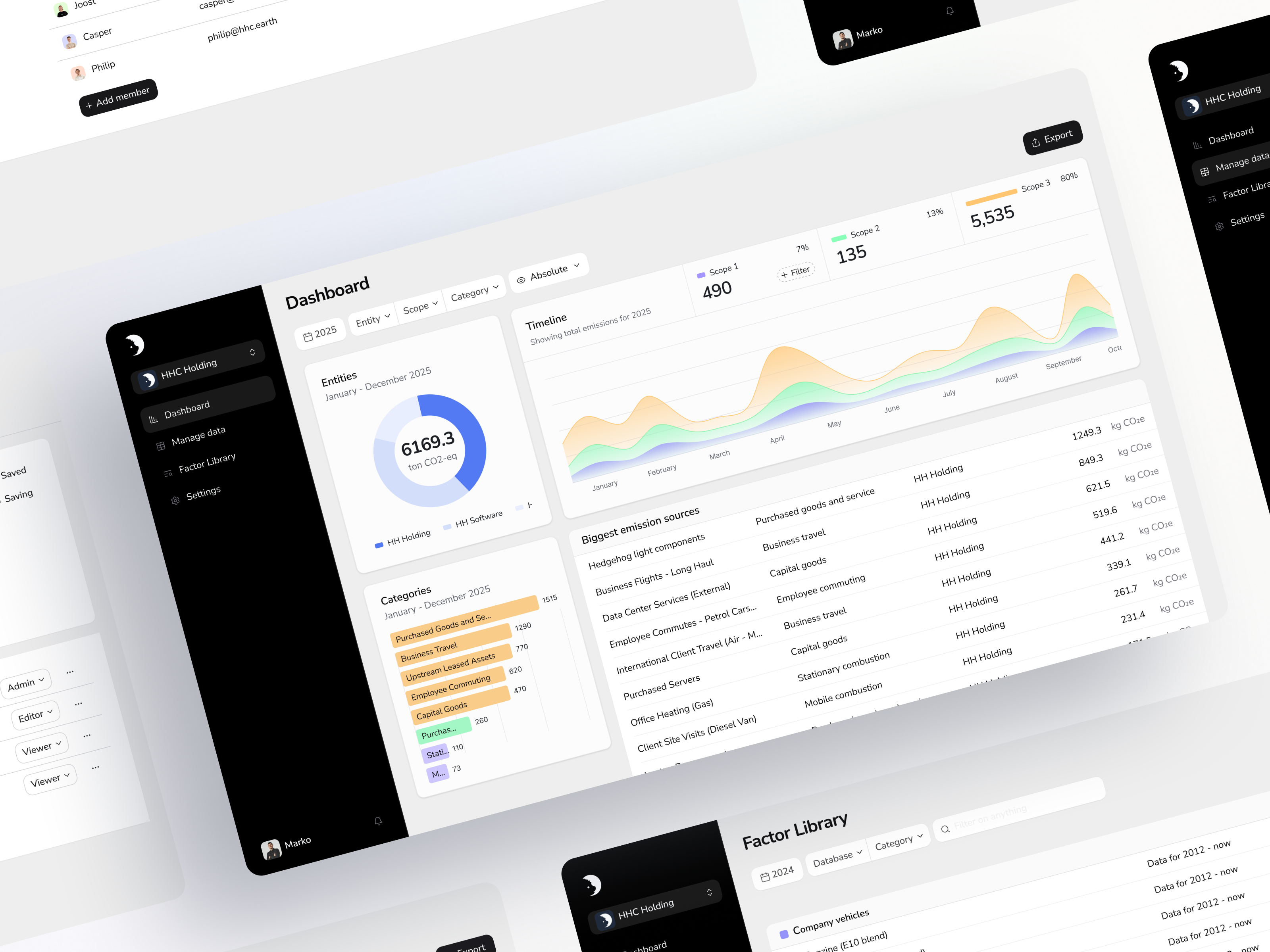
The platform uses an AI assistant to guide you through GHG Protocol setup, building the inventory, uploading data and producing reports, with human GHG experts reachable in the product when the assistant is not the right answer. It covers over 20,000 spend-based and activity-based factors and lets you add organisation-specific or supplier-specific data. Reporting outputs include the GHG Protocol, PPN 006 and the CO2-Prestatieladder, and the product supports English, French and Dutch. There is a free account with no sales call, and Pro starts at EUR 1,200 per year.
Two limits to hold alongside that.
The assistant does not load the data. A Small Business reviewer on G2 in August 2026 put it exactly: it takes a lot of manual labour to load data, and once the data is there it works perfectly, but getting it loaded is the challenging part. That is the honest shape of the work, and no vendor in this market has removed it.
It is not a broad ESG suite. A Mid-Market reviewer rated Hedgehog 3.5 out of 5 on G2 in June 2026 and said that for a broader ESG data and reporting platform it is less complete, with no data source management feature and no decarbonisation target monitoring. If your requirement is really an ESG suite, the distinction is worth reading in ESG reporting software versus carbon accounting.
What should you do next?
Do not evaluate the assistant in a demo. Demos run on clean data and the whole question is what happens to dirty data.
Take one month of one real cost centre, load it yourself, and see how far the assistant carries you before you have to think. That exercise also tells you how big your data problem is, which is the number you actually need for planning. For a wider comparison framework, see choosing carbon accounting software.
You can do all of that on a free account without speaking to anyone.
Sources: Hedgehog platform, Hedgehog on G2, GHG Protocol Corporate Standard. Verified 27 August 2026.
Facts on this page were last verified on 2026-08-27.

