
In short
- Rejections are usually about missing evidence or an unstable boundary, not a wrong multiplication.
- Ask for the finding in writing per line item before you touch a single number.
- The permanent fix is a collection change, and it only takes effect from the next period.
A rejection almost never means your maths is wrong. It means the assurance provider could not get from a reported figure back to a source they trust, or the boundary moved between years, or an estimate was used where they expected measured data. This week, get the findings in writing, line by line, and separate the ones that are evidence problems from the ones that are method problems. The evidence ones can often be closed in days. What stops it recurring is a change to how data is collected, and that change only takes effect from the next period, so it has to be decided now.
The instinct is to go straight back into the spreadsheet and start recalculating. Resist it. You do not yet know which number is being challenged or why.
Why do auditors actually reject emissions figures?
Six reasons cover nearly all of it, and only one of them is a calculation error.
- Finding: Cannot trace an entry to a source
What it really means: The number was retyped or the file is gone
Typical fix time: Days, if the file exists - Finding: Boundary changed between years
What it really means: An entity or site was added or dropped silently
Typical fix time: Weeks, needs a restatement - Finding: Estimate used where data exists
What it really means: A proxy was applied to something meterable
Typical fix time: One collection cycle - Finding: Factor source unclear
What it really means: Factor named but no library, version or value
Typical fix time: Days, if the tool records it - Finding: No segregation of duties
What it really means: Preparer and approver are the same login
Typical fix time: Immediate, then permanent - Finding: Scope 3 category incomplete
What it really means: A material category was omitted with no rationale
Typical fix time: Weeks, and a documented rationale
Read your finding letter against that table before you do anything else. The categorisation determines the response, and treating a boundary problem as an evidence problem wastes the week you have.
What do you actually do in the first week?
Five moves, in order.
Get the finding in writing, per line item. Not a summary email. You need to know which entries were sampled, which failed and on what basis. Assurance providers expect this request and it is not confrontational.
Freeze the current version. Take a copy of the inventory exactly as submitted. Whatever you rebuild, you will need to show what changed and why, and you cannot do that if the original has been edited over.
Sort findings into evidence, method and boundary. Evidence findings are administrative and fast. Method findings need a documented rationale. Boundary findings usually require restating a comparative, which needs a decision from whoever owns the reporting.
Find out whether the deadline is real. A qualified opinion, a delayed opinion and a re-performed sample are three different outcomes with three different timelines. Ask which one you are heading for.
Name one owner. Rejections that drag on are almost always the ones where three people each own a third of the response.
How do you rebuild a figure without starting over?
You rebuild the challenged categories, not the inventory. This is the part people get wrong and it costs months.
Start from the sampled entries. For each one, pull the original document and record four things next to it: the quantity, the unit, the factor with its library and version, and the date it was entered. If the document exists, most of these close immediately.
Where the document does not exist, you have three honest options and you should say which one you took. Re-request it from the supplier or the landlord. Substitute a defensible estimation method and document the method. Or exclude the item and disclose the exclusion with a materiality rationale. Auditors accept all three. What they do not accept is an unexplained number.
If your boundary moved, restate the comparative year on the new boundary and keep the original alongside it. A restatement that is labelled and explained is a sign of control. A quiet change is the thing that triggered the finding in the first place.
For anyone who has inherited this and is rebuilding from a standing start, the order of operations in carbon accounting from scratch will save you a false start.
What if the data genuinely does not exist?
Then say so, precisely, and stop treating it as a failure to be hidden.
The disclosure that survives scrutiny has four parts: what is missing, why it is missing, what you did instead, and what you will do differently next period. A landlord who will not release sub-metered electricity is a real constraint. An estimate based on floor area with the method stated is a defensible response to it. An estimate presented as measured data is not.
The same logic applies to scope 3 categories. Omitting a category is allowed when you can justify it. Omitting it silently is what gets challenged. Where the missing category sits in your value chain and how far to go with it is a scoping question, and it is the substance of scope 3 work.
What stops it happening again next year?
Four structural changes, none of which are software purchases on their own.
Collect at source, not at report time. Every retyped figure is a future finding. Upload the file, keep the file, link the entry to the file.
Separate preparer, reviewer and approver. Three named roles with three logins. This is the cheapest control in the entire exercise and it closes a whole class of finding.
Freeze the boundary in writing. Which entities, which sites, which consolidation approach, which exclusions. One page. Revisit it deliberately, and restate when you change it.
Book a dry run before the real engagement. Sample ten of your own entries in the month before assurance starts and try to substantiate them. Every failure you find yourself is a finding you do not receive.
Where does software help, and where does it not?
It helps with three of the six findings in the table above: factor provenance, segregation of duties and traceability from entry to upload. Those are exactly the things a spreadsheet cannot do, because a spreadsheet has no memory of who changed what.
It does not help with a boundary decision, a materiality rationale or a landlord who will not send you a meter reading. Those are governance and relationship problems and no tool solves them.
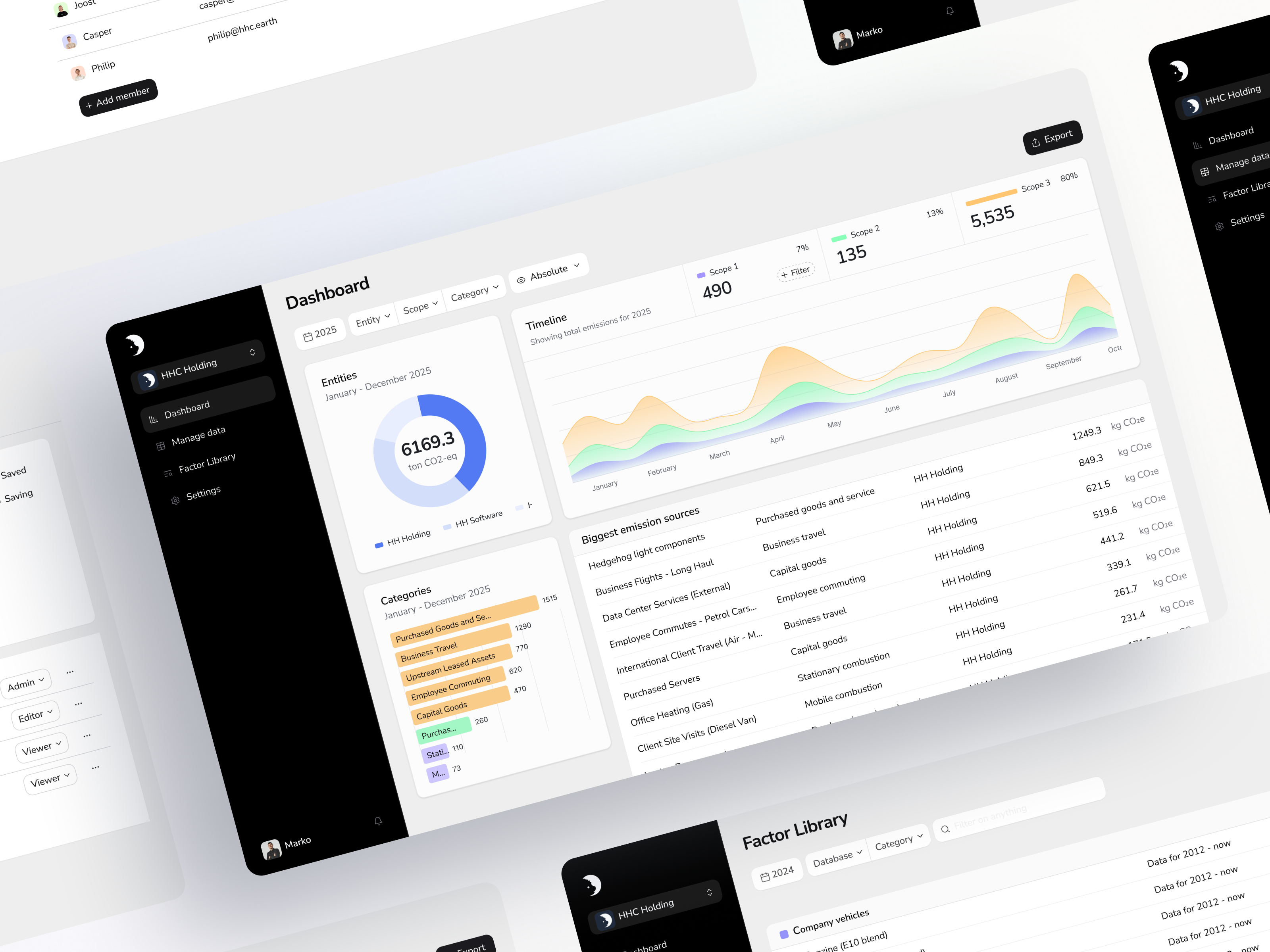
The Hedgehog platform covers the software half: a GHG Protocol inventory built from a data collection plan, over 20,000 spend-based and activity-based factors plus your own organisation-specific and supplier-specific data, entity management across locations and sites, and distinct user roles for data owners, auditors and managers. Reporting outputs include the GHG Protocol, PPN 006 and the CO2-Prestatieladder. There is a free account with no sales call, and Pro from EUR 1,200 per year.
Two limits you should know before you assume a migration fixes a rejection.
Applied conversions are not fully exposed. A Mid-Market customer rated Hedgehog 4 out of 5 on G2 in July 2026 and asked to see the conversion factor used between an original input file and the platform entry, and which calculator produced a distance figure. If your finding is specifically about traceability of a conversion, raise it with us directly rather than assuming it is closed.
Getting the data in is the work. A Small Business reviewer wrote on G2 in August 2026 that it takes a lot of manual labour to load data, and that once the data is there it works perfectly, but getting it loaded is the challenging part. A rejection year is a bad year to underestimate that line.
What should you do next?
Do the first-week list before you do anything technical. Findings in writing, original frozen, findings sorted into three buckets, one owner, one honest conversation about the deadline.
Then pick the single finding that will recur every year if you leave it, which is nearly always the collection method, and fix that one first. Everything else in the letter is this year's problem. That one is every year's problem.
If you want to walk the findings through with someone who has rebuilt an inventory under a deadline, book a call. If you would rather rebuild the challenged categories yourself first, start on a free account.
Sources: Hedgehog platform, Hedgehog on G2, GHG Protocol Corporate Standard. Verified 27 August 2026.
Facts on this page were last verified on 2026-08-27.

