In short
- Nothing in this category solves tier 2 and tier 3 supplier data for you. Judge tools on how gracefully they handle its absence.
- Only two of the seven tools here publish a price at all, checked on 27 August 2026.
- A garment-level number is a project, not a subscription. Buy the two separately.
Seven tools are realistically in scope for an apparel brand or a private label supplier: Hedgehog, EcoHedge, Coolset, Greenly, Watershed, Persefoni and Seedling. On the facts you can actually verify, they split on two things, price transparency and how much of your footprint sits outside your own four walls. On 27 August 2026 we could find a published price for exactly two of them. Which one fits depends on whether your problem is a customer questionnaire, a broad ESG report or a claim you want to print on a swing tag.
We make one of these tools. It is listed on the same terms as the others, with the same dated sources, and the section on where it is the wrong choice is not decorative.
Why is apparel different from every other sector on this list?
Because almost none of the emissions are yours.
In apparel the footprint is dominated by tier 2 and tier 3 suppliers, and wet processing is the hotspot. That is dyeing, finishing and the mill energy behind them, which sits two or three commercial relationships away from the brand placing the order. Your own offices, your own stores and your own freight are visible, countable and comparatively small.
That single fact reorders every buying criterion. A tool with a beautiful scope 1 and 2 dashboard is solving the easy 5 percent. What actually matters is whether it can hold supplier lists by tier, material composition and production volumes, and whether it degrades sensibly when the mill will not send you energy data, which is most of the time.
The data you can realistically start from is your supplier list, your material composition per style and your production volumes. The data you would like, mill-level energy, arrives later or never.
What separates the seven on facts you can check?
We read each vendor's public pricing page and G2 profile on 27 August 2026. This is what was there.
| Tool | G2 rating and reviews | Price published on 27 August 2026 | Verified that day |
|---|---|---|---|
| Hedgehog | 4.7 from 9 reviews | Yes, free account and Pro from EUR 1,200 a year | Free account requires no sales call |
| EcoHedge | Not listed on G2 | Yes, Lite free forever and Express Growth at GBP 990 a year | Claims 277,000+ emission factors |
| Coolset | 4.7 from 18 reviews | No numeric price on the pricing page | Mid-Market in 14 of its 18 reviews |
| Greenly | 4.7 from 27 reviews | No numeric price on the pricing page | Quote only |
| Watershed | 4.5 from 25 reviews | No numeric price on the pricing page | Quote only |
| Persefoni | 4.8 from 11 reviews | No numeric price on the pricing page | Persefoni Pro offered free, add-ons unpriced |
| Seedling | 5.0 from 11 reviews | No numeric price on the pricing page | A Start for Free link, but no plan published |
Two honest readings of that table. First, review counts here are small enough that a single review moves a rating, so treat a 5.0 from 11 and a 4.5 from 25 as roughly the same signal. Second, price opacity is the norm rather than a red flag, but it does mean any apparel brand comparing this market has to run a procurement process to get numbers at all.
EcoHedge's own comparison material, read on 27 August 2026, states native one-click integration with Xero, QuickBooks and Sage, a library of 277,000+ emission factors, and SECR, PPN 006 and HMRC categories built in. For a UK brand doing spend-based scope 3 from an accounting system, that combination is genuinely relevant and we concede the factor count outright: theirs is larger than ours.
Does a bigger factor library help an apparel brand?
Less than it looks, and this is worth arguing rather than asserting.
A large spend-based library helps most when your emissions are spread across many small purchase categories, which is the profile of a professional services firm or an office-heavy business. Apparel is the opposite shape: a small number of very large material and processing lines, each of which deserves better than a spend proxy.
Spend-based factors on fabric tell you that you bought EUR 400,000 of woven cotton. They cannot tell you whether it was dyed in a mill running on coal or on grid electricity, and that difference is larger than anything else you will change this year. So the library question for apparel is not how many factors, it is whether you can add your own supplier-specific figures and keep them straight over time.
That is the criterion to weigh: can the tool hold a supplier-specific factor, dated and sourced, alongside a generic one, and show you which entries used which. If it cannot, a bigger generic library is a bigger set of averages.
What does EmpCo change for an apparel software decision?
It moves the burden of proof onto whoever prints the claim, and in apparel the claim is usually on the product.
Environmental claims on garments are directly in scope from 27 September 2026. In practice that means anything on a swing tag, a care label, a product page or a campaign has to be substantiated on request, and the substantiation has to be about that product rather than about the company.
Alongside the claims rules there is a second dated rule that has already started. Since 19 July 2026 large enterprises may not destroy unsold apparel, clothing accessories or footwear, under Article 25 of the Ecodesign for Sustainable Products Regulation. Micro and small enterprises are excluded and medium-sized brands come into scope on 19 July 2030. The same regulation requires the businesses it covers to publish annually, on their own website, how many unsold products they discarded, by weight and by type, why, and where those products went. Behind that, mandatory extended producer responsibility for textiles arrives through national law: Member States must transpose the revised Waste Framework Directive by 17 June 2027 and have schemes running by 17 April 2028.
The EU strategy for sustainable and circular textiles is worth naming only to set it aside. It is a Commission policy document from 2022. It sets direction and it produced the rules above, but it does not itself require anything of your business.
This has a blunt software consequence. A company-level organisational footprint, however well built, does not substantiate a garment-level claim. The two are different exercises with different boundaries. Buying a platform in the belief that it will underwrite your product marketing is the most expensive mistake available in this category.
What the software should do is keep the company number clean, dated and traceable, so that the claims you make about the business hold up. For claims about a specific product, you need product-level work. Our working list of what a defensible claim needs is in the EmpCo claims checklist.
Do you need a company footprint or a product footprint?
Both, eventually, and almost nobody needs them at the same moment.
Company footprint first if the pressure is a customer questionnaire, a retailer's supplier programme, a lender or an investor. They want an organisational number with scope 3 category 1 filled in credibly.
Product footprint first if the pressure is a claim, a customer demanding a per-garment figure, or a tender that scores product data. That is an LCA or a PCF, scoped per functional unit, and it is a project with a start and an end rather than a subscription. At Hedgehog that work is delivered as a service and the platform does organisational footprints.
Brands that try to get a product number out of an organisational platform end up with an allocation of company emissions across units sold, which is arithmetic rather than a footprint, and which no serious reviewer accepts.
Which tool fits which apparel situation?
Sorted by the problem rather than ranked one to seven.
A private label supplier answering brand questionnaires. You need a repeatable organisational footprint, cheap, with a clean export. Published pricing matters here because your margin will not absorb an enterprise quote. Hedgehog and EcoHedge are the two with numbers on the table.
A UK brand running spend-based scope 3 out of Xero or QuickBooks. EcoHedge's published accounting integrations, read on 27 August 2026, are a real advantage and we do not have an equivalent today.
A mid-market EU brand with a full CSRD-shaped reporting obligation. You are buying an ESG reporting platform, not a carbon calculator. Coolset is aimed squarely at European mid-market companies and 14 of its 18 G2 reviews are Mid-Market, which tells you where it lands.
A large brand with a global supplier base and an investor audience. Watershed and Persefoni sit in that enterprise conversation. Expect a quote and expect services attached.
A brand whose real deliverable is a garment number. Buy the LCA work first and the platform second. Reversing that order wastes a year.
If none of those describe you, the general selection framework in choosing carbon accounting software is a better starting point than any shortlist.
Where does Hedgehog fit, and where does it not?
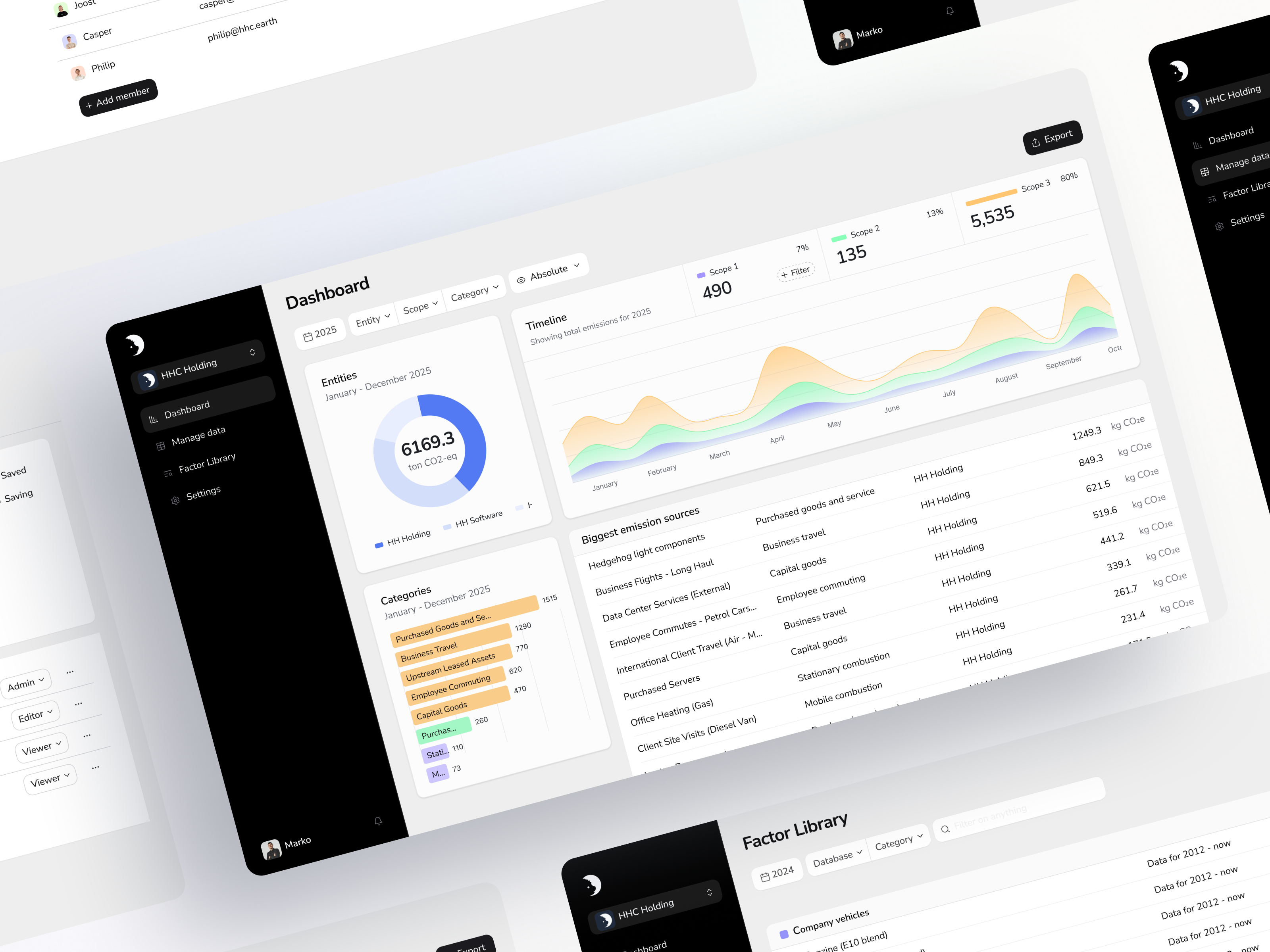
The platform guides you through GHG Protocol setup, a data collection plan and inventory building with an AI assistant, covers over 20,000 spend-based and activity-based factors, and lets you add organisation-specific or supplier-specific CO2 data, which is the part that matters for mill-level figures. It handles multiple entities across locations and sites with roles for data owners, auditors and managers, reports to the GHG Protocol, PPN 006 and the CO2-Prestatieladder, names CSRD, SECR and SB253 as supported legislation, and runs in English, French and Dutch. Free account, no sales call, Pro from EUR 1,200 a year, rated 4.7 from nine reviews on G2 when we read the profile on 27 August 2026.
Where it is the wrong tool.
If you want a broad ESG suite. A Mid-Market customer rated Hedgehog 3.5 out of 5 on G2 in June 2026 and said that for broader ESG data and reporting the platform is less complete, with no data source management feature and no decarbonisation target monitoring. If that is your requirement, buy for it.
If you expect the data to arrive by itself. A Small Business reviewer wrote on G2 in August 2026 that it takes a lot of manual labour to load data, and that once the data is there it works perfectly, but getting it loaded is the challenging part. In apparel that loading is mostly supplier chasing, and no tool in this table removes it.
If your deliverable is per garment. Organisational platform, product service. Keep them separate.
What should you do first?
Build the company footprint on data you already hold, which is offices, freight and purchased goods by material category. Do it once, quickly, on a free tier so it costs you nothing but time.
Then use the gap it exposes as your supplier engagement plan. You will finish that exercise knowing exactly which three mills account for most of your uncertainty, and that list is worth more than the number itself.
You can start on a free account without a sales call, and decide about product-level work once you can see where the mass actually sits.
Sources: vendor pricing pages and G2 profiles for Hedgehog, EcoHedge, Coolset, Greenly, Watershed, Persefoni and Seedling, each read on 27 August 2026. Hedgehog platform, Hedgehog on G2. Vendors change pricing pages often, so re-check any figure before relying on it. Verified 27 August 2026.
Facts on this page were last verified on 2026-08-27.