
In short
- Logistics is one of the few sectors where scope 1 is the hard part, because fuel dominates.
- The buying trigger is usually a shipper asking for their scope 3 category 4 number, not a regulator.
- Almost no vendor in this market publishes a price, so budget comparison takes calls.
For a haulier, a forwarder or a 3PL, the useful shortlist is shorter than the category looks. Fuel is most of your footprint, it sits in scope 1, and it is already in your fuel card exports and your telematics. So the deciding question is not how many emission factors a tool ships with. It is whether it takes activity data at tonne-kilometre level and turns it into the per-customer answer a shipper asked for. Here is who is in scope, what separates them on evidence you can check yourself, and where we are the wrong fit.
We build one of the platforms named below. It appears with the same caveats as everything else, and the section on where we do not fit is not decoration.
Which tools are actually in scope for a logistics operator?
Three groups, and mixing them up is how procurement ends up with the wrong tool.
General carbon accounting platforms. Coolset, Greenly, Watershed, Persefoni, Seedling, EcoHedge and Hedgehog all build an organisational inventory across scopes 1, 2 and 3. They are not transport products, but transport is mostly fuel, and fuel is the easiest thing any of them ingest.
Sector-specific transport tools. Our competitor census, read on 27 August 2026, lists BigMile as a Dutch vendor focused on transport and logistics emissions. If your entire requirement is consignment-level freight modelling for Dutch shippers, a sector tool is a fair thing to look at alongside a general platform.
The incumbent, which is a spreadsheet. The same census names Excel as a real competitor in its own right, not a joke option. For a single depot with one fuel supplier, a spreadsheet genuinely works until the second customer asks for a different cut of the same data.
What separates them on facts you can check?
Ratings, review volumes and whether a price is visible. Everything else in this market is a vendor claim.
| Vendor | Positioning | G2 on 27 August 2026 | Price published |
|---|---|---|---|
| Greenly | Broad EU platform, largest content footprint measured | 4.7 from 27 reviews | No |
| Watershed | Enterprise, complex operations | 4.5 from 25 reviews | No |
| Coolset | EU mid-market, regulation depth | 4.7 from 18 reviews | No |
| Persefoni | Enterprise and financial services | 4.8 from 11 reviews | No |
| Seedling | UK, adviser included | 5.0 from 11 reviews | No |
| Hedgehog | Organisational footprint, self-serve | 4.7 from 9 reviews | Yes, EUR 1,200 per year |
| EcoHedge | UK SME, accounting integrations | Not listed on G2 | Yes, GBP 990 per year |
Every figure above was read on 27 August 2026 from the G2 profile or the vendor pricing page. Ratings move, so open the profile before you rely on a row. Note the review counts honestly: Greenly, Watershed and Coolset each have a larger evidence base than we do.
Only two of the twelve vendor pricing pages checked on that date, ours included, carried a number at all. If a visible budget matters to your finance director, that single column narrows the field faster than any feature list.
Why is fuel data the whole game here?
Because your emissions profile is unusual. In most sectors the footprint hides in purchased goods. In logistics and transport, fuel is nearly everything and scope 1 carries the weight, which makes this one of the few markets where the direct emissions are the difficult part rather than the easy formality.
That flips the evaluation. The data you need already exists in fuel cards, telematics, tonne-kilometre records and subcontracted haulage invoices. None of it needs a supplier survey. What it needs is a tool that will accept it in the shape it already has, month after month, without a person retyping a fuel report into a web form.
Watch the boundary carefully. Diesel you buy and burn is yours directly. Haulage you buy from a subcontractor is purchased transport, which lands in your value chain rather than your tailpipe, and the invoice is usually the only record you will get. Any tool you shortlist has to hold both without you keeping a parallel spreadsheet to reconcile them.
Which one fits which situation?
You run your own fleet and one shipper is asking. A general platform with a free entry point is enough. Load fuel and energy, produce a scope 1 and 2 figure, add the category the customer actually asked about. Do not buy an enterprise suite for one questionnaire.
You subcontract most of your movements. Your footprint is mostly other people's fuel, reported to you as invoice lines. That is a value chain problem, and it is worth reading how far the requests can reasonably go before you build a data collection programme around them. Our note on what a large customer may actually demand covers the limits.
You have depots in several countries and multiple legal entities. Entity structure becomes the deciding feature, not factors. Ask to see roles, permissions and consolidation on a live account.
You need consignment-level numbers per customer, every month. This is the case where a general platform strains and a transport-specific tool earns its place. Ask both types for a sample output for one real lane before signing anything.
You are answering a shipper's scope 3 request for the first time. Start with the request itself. Shippers need upstream transport emissions and ask their carriers for them, and the format they want is usually more specific than any dashboard produces. If the requests are already multiplying, scope 3 support is a faster route than a tool selection process.
What does Hedgehog do for a transport business?
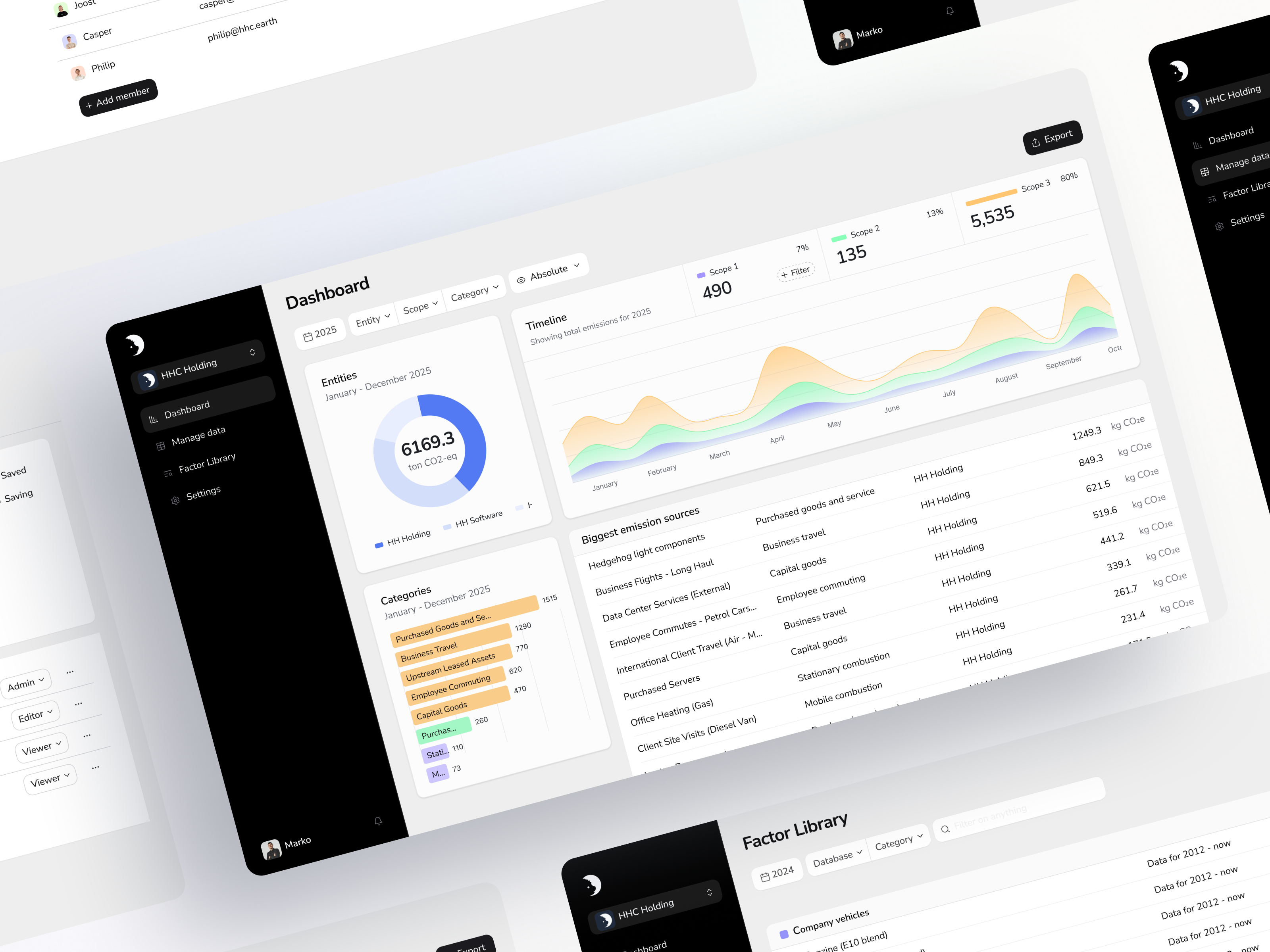
The platform walks you through GHG Protocol setup, data collection planning and inventory building with an AI guide, and reporting outputs include the GHG Protocol, PPN 006 and the CO2-Prestatieladder. It carries over 20,000 spend-based and activity-based factors, and you can add your own organisation-specific or supplier-specific CO2 data, which matters when you have a measured figure for a lane and do not want a generic average overwriting it. Multi-entity management covers locations and sites, with separate roles for data owners, auditors and managers. A free account needs no sales call. Pro starts at EUR 1,200 per year.
Where is Hedgehog the wrong answer for a carrier?
Three places, all of them raised by paying customers on our public G2 profile.
If you want a telematics or TMS integration today, we do not have one. A mid-market reviewer on G2 in June 2026 asked for more integrations with other software, and that is a fair description of where we are. For a fleet operator, this is the most relevant of our limits, because it means fuel and mileage arrive by export and upload rather than by pipe.
Loading the data is the slow part. A small business reviewer said on G2 in August 2026 that once the data is loaded everything works perfectly, and that getting it loaded is the challenging part. Budget for that. It is true of every tool here, and the vendors promising a same-day report are usually describing a smaller dataset than yours.
If you want a broad ESG suite, we are less complete. A mid-market reviewer rated us 3.5 out of 5 on G2 in June 2026 and said exactly that, noting no data source management feature and no decarbonisation target monitoring. If your obligation spans ESG data and supply chain due diligence rather than emissions, buy breadth from someone who sells breadth.
What should you ask a vendor before you sign?
Four questions, in this order.
Bring one month of real fuel card data and one subcontracted haulage invoice to the demo, and ask them to load both in front of you. Ask what happens when factors update mid-year and whether last year's published figure survives it. Ask for the actual output document your customer wants, not the dashboard. And ask what year two costs, because carbon reporting is an annual routine and a first-year discount that resets changes the maths.
If your operation is small enough that this is one person's side project, our guide on choosing a tool as a smaller company is a shorter path than a formal RFP. If you would rather talk it through with someone who has done it, you can book a meeting.
Sources: Hedgehog platform, Hedgehog on G2, Coolset on G2, Greenly on G2, Watershed on G2, Persefoni on G2, Seedling on G2, vendor pricing pages and an internal census of 26 competitor domains. All read 27 August 2026.
Facts on this page were last verified on 2026-09-17.

