
In short
- For a services firm the effort goes into proving the number, not reducing it.
- Your dataset is a travel booking system, office energy and procurement spend, so integrations matter more than factor libraries.
- Per-employee intensity is the figure clients compare, so headcount definitions need to be stable year on year.
A consultancy, agency or law firm has an unusual profile: a small absolute footprint under heavy scrutiny. Travel, offices, purchased services and IT are the whole picture, and the data lives in a travel booking system, some energy bills and a procurement ledger. So the work is proving the number rather than reducing it, and the deciding features are spend handling, export flexibility and price, not factor library size. Below: who is worth shortlisting, what you can verify about each, and the cases where we would send you elsewhere.
We publish one of the products discussed. It is held to the same evidence standard, and the honest limits come from our own customers rather than from a marketing review.
Why is the questionnaire harder than the footprint?
Because the calculation is small and the proving is not. Most firms in this sector can build a credible scope 1 and 2 figure in an afternoon: there is usually no fleet, no process, and one or two leases.
The pressure comes from clients instead. Large clients ask professional service suppliers for carbon data in tenders, and UK central government consultancy contracts above the threshold can bring PPN 006 with them, which is a prescribed plan format refreshed every 12 months rather than a number in a spreadsheet. We cover that format in the PPN 006 checklist.
So the person who inherited this, usually in operations or marketing, is not solving an emissions problem. They are solving a documentation and repeatability problem, on a deadline set by someone else's procurement calendar. That should change what you look for in a tool.
Which tools should a consultancy or agency look at?
Four options, honestly ranked by how much firm you have.
Spreadsheet plus a published factor set. For a ten-person firm with one office, this is defensible and free. It stops working the moment two clients want the same data in two formats, or when you need last year's method to still be readable.
SME carbon platforms. Seedling, EcoHedge, Hedgehog. Built for organisations of your size, with pricing and onboarding to match.
Broad ESG platforms. Coolset and Greenly sit here. More product than most services firms need, but the right answer if your obligation spans ESG and due diligence rather than emissions.
A consultant and a certificate. If the real goal is B Corp or an EcoVadis rating rather than an annual inventory, the tool is a supporting act. Buy the assessment support first.
What can you check before a single demo?
| Vendor | Free tier | Published price on 27 August 2026 | G2 on 27 August 2026 | Publishes accounting integrations |
|---|---|---|---|---|
| Hedgehog | Yes | Yes, EUR 1,200 per year | 4.7 from 9 reviews | No |
| EcoHedge | Yes, Lite | Yes, GBP 990 per year | Not listed | Yes, Xero, QuickBooks and Sage |
| Seedling | Start for Free signup, no confirmed tier | No | 5.0 from 11 reviews | Not stated |
| Coolset | No | No | 4.7 from 18 reviews | Not stated |
| Greenly | No | No | 4.7 from 27 reviews | Not stated |
Every cell was read on 27 August 2026 from the vendor pricing page, the named G2 profile, or in EcoHedge's case from their own published comparison page, where the integration claim is theirs rather than ours. Recheck before you quote any of it, and read the review counts as evidence weight: Greenly and Coolset both have larger samples than we do.
The integration column deserves more attention in this sector than in any other. Your emissions are mostly purchased services and travel, which means most of your activity data is already sitting in your accounting system as transactions. A native ledger connection is not a luxury here, it is the difference between an afternoon and a fortnight.
Does spend-based accounting get you into trouble?
Not by itself, but it needs handling.
Spend-based factors convert money spent in a category into an emissions estimate. For a firm whose footprint is purchased services, IT and travel, this is often the only practical method, and it is a legitimate one. Two things follow.
First, your general ledger coding becomes your emissions method. If everything from software licences to catering sits in one miscellaneous account, your footprint inherits that vagueness. Tidying the chart of accounts is usually the highest-value hour in the whole project.
Second, spend-based results move when your prices move, not only when your behaviour does. A year of inflation can raise your reported footprint while your actual activity falls. That is worth stating in the report before a client points it out. Where you have better data, use it: our fact base for the platform records that customers can add organisation-specific or supplier-specific CO2 data over the general factors.
Per-employee intensity is the figure clients actually compare between suppliers, so pin down your headcount definition, full time equivalents at what date, and keep it identical every year. Changing that definition quietly is the fastest way to make a comparison meaningless.
Which option fits which firm?
Under 25 people, one office, no tenders yet. A spreadsheet and a beginner's method. Our carbon accounting from scratch guide is enough to produce something defensible.
Answering client questionnaires two or three times a year. A platform with a free tier. The value is in reusing one dataset across every format rather than in the calculation.
Bidding for UK central government work. Buy for the prescribed output and the 12 month refresh, and ask to see the plan document itself.
Offices in more than one country. Check entity handling and language support early. Our own platform's published language coverage is English, French and Dutch, which is either sufficient or disqualifying depending on where your people sit.
Chasing B Corp, EcoVadis or a science-based target. The workflow matters more than the dashboard. If a validated target is the goal, science-based targets support is a different piece of work from annual accounting.
Where would we tell you to buy something else?
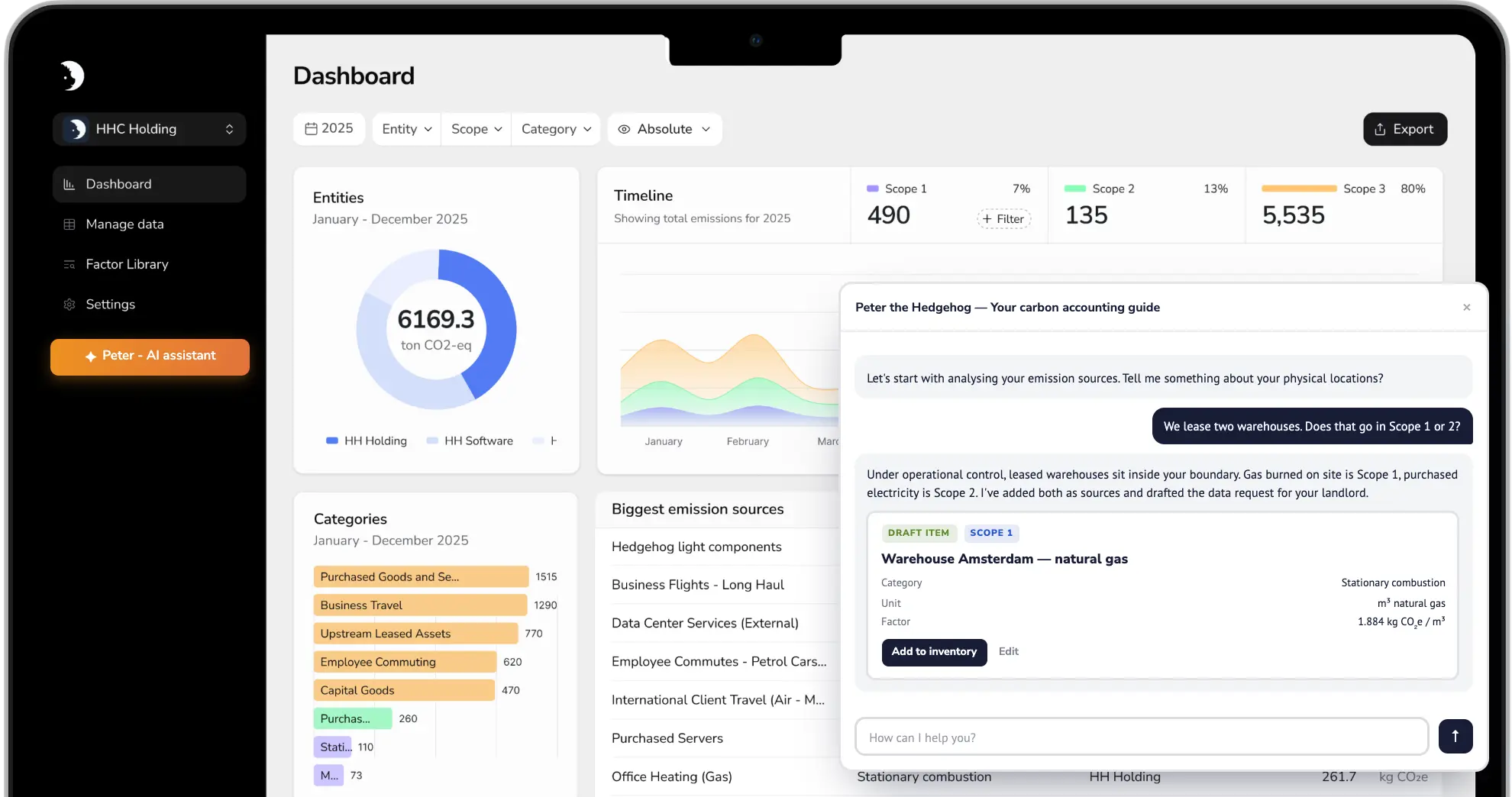
The platform guides you through GHG Protocol setup and inventory building with an AI assistant, supports SBTi, B-Corp and EcoVadis workflows, names CSRD, SECR and SB253 under legislation, carries over 20,000 spend-based and activity-based factors, and handles multiple entities with roles for data owners, auditors and managers. Free account, no sales call. Pro from EUR 1,200 per year.
Three reasons a services firm might reasonably pick someone else, all sourced from our public G2 reviews.
We publish no accounting integrations today. A mid-market customer asked for more integrations with other software on G2 in June 2026. In a sector where the ledger is the dataset, a competitor with a native Xero or QuickBooks connection has a real advantage over us on day one, and pretending otherwise would be silly.
Loading data takes effort. A small business customer said on G2 in August 2026 that once the data is loaded everything works perfectly, and that getting it loaded is the hard part. That is the honest first-year cost.
If you want a full ESG suite, we are thinner. A mid-market customer rated us 3.5 out of 5 on G2 in June 2026 and said the platform is less complete as a broader ESG and CSRD reporting tool, with no data source management and no decarbonisation target monitoring.
What is worth doing this quarter?
Pull last year's travel export and last year's trial balance. Between them they contain most of your footprint, and whether they are usable tells you more about your real timeline than any vendor demo will.
Then decide whether you are building an annual routine or answering a single tender, because those buy different products. If it is the routine, our guide to choosing a tool as a smaller organisation lists the questions worth asking, and you can open a free account on the platform to see how far your existing exports get you.
Sources: Hedgehog platform, Hedgehog on G2, Coolset on G2, Greenly on G2, Seedling on G2, EcoHedge pricing and their published comparison page. All read 27 August 2026.
Facts on this page were last verified on 2026-09-17.