
In short
- Entity count is the main multiplier in this market, and vendors define entity differently.
- Get the definition in writing before you compare two quotes, or you are comparing nothing.
- Dormant and shared-service entities are where group quotes quietly inflate.
Carbon accounting is usually priced on two multipliers, entities and user seats, and the entity count is the one that moves the number. A group with fourteen legal entities and one sustainability manager will pay far more than a single company with fourteen users. Before you compare two quotes, get each vendor to write down what they count as an entity, because there is no shared definition in this market.
Hedgehog prices this way too, from EUR 1,200 a year per user seats and business entities, so read the section about us with that in mind.
What does a vendor actually mean by an entity?
Four definitions are in circulation, and they produce very different bills for the same group.
| Definition | What gets counted | Who it suits |
|---|---|---|
| Legal entity | Every company in the group structure | Vendors selling to groups |
| Reporting entity | Every unit that needs its own published figure | Buyers with few reporting obligations |
| Site or location | Every physical site | Manufacturers, hospitality, retail |
| Consolidated organisation | One, whatever the structure | Single-company buyers |
A holding company with twelve dormant subsidiaries is one reporting entity and thirteen legal entities. A hotel group with four legal entities and sixty properties is four or sixty depending on the vendor. Neither vendor is being dishonest. They are answering different questions.
So the first question in any pricing conversation is not what does it cost. It is: what do you count, and can I have that in writing?
Why do so many vendors price this way at all?
Because it tracks their cost and, unusually, it tracks your value reasonably well too.
Every additional entity means another boundary to define, another set of data owners, another consolidation step and another place where the numbers have to reconcile. That is real product surface and real support. It also tracks what you get: an entity you can report on separately is an entity you can be asked about separately, which is the whole point for a group.
Where it goes wrong is at the edges. Dormant entities carry no emissions and no data work, but they often carry a licence line. Shared-service entities, holding companies and intra-group financing vehicles are the same story. If a quote counts your full Chamber of Commerce list, ask for the dormant ones to be excluded or priced differently, and be ready to say which they are.
What is the actual range?
The honest answer is that most of this market will not tell you, so a per-entity figure has to be reasoned rather than looked up.
We opened the pricing page of eleven competing carbon accounting vendors on 27 August 2026 and looked for a currency figure attached to a plan. Exactly one had it. EcoHedge publishes a free tier and Express Growth at GBP 990 a year, read on that date. We publish ours as well, a free account and Pro from EUR 1,200 a year, on our G2 profile, so across the twelve vendors including us the count is two. Everyone else was quote-only. Our buying guide, choosing carbon accounting software, goes through what to do about that.
What two prices give you is an anchor rather than a price list. Those two published entry points are GBP 990 and EUR 1,200 a year, so on any recent rate the visible floor for a single-entity paid plan sits somewhere around EUR 1,100 to EUR 1,200. Convert at your own rate rather than ours. For groups, work from that anchor and expect a curve rather than a multiple.
Expect volume tiers, but make the vendor show you them. It would be surprising if a vendor charged fourteen times the single-entity price for fourteen entities, and in our experience they do not. We cannot source that: neither of the two vendors who publish a price publishes a per-entity tier table, and the other ten publish nothing at all. So treat it as the thing to confirm rather than the thing you know. What you should establish is where the tiers break, because a group at fifteen entities negotiating against a tier that breaks at twenty has a different conversation from one that has just crossed it.
How should you model this for your own group?
Build the number from four inputs before you talk to anyone. It takes an hour and it changes the conversation.
Count your reporting entities, not your legal entities. Which units genuinely need a separately defensible figure? Usually it is the ones with their own customers, their own tenders or their own regulator. That is your real requirement.
Count seats honestly. Not everyone needs a licence. Most groups need one or two people who build the inventory, a handful of data owners who upload their own numbers, and read-only access for finance and the auditor. Ask whether data owners and auditors are billable seats, because in some products they are and in some they are not.
Add the consolidation requirement. Do you need a group total, a per-entity split, or both, and does it have to reconcile to the statutory consolidation? That last requirement is the one that pushes buyers from the SME tier into the mid-market tier.
Add the currency and country count. Multi-currency conversion and country-specific electricity factors are usually where a cheap tool stops working for a group.
What questions get you a real number?
Ask these in the first email. They compress two calls into one.
- What do you count as an entity, in writing?
- What is the price for our exact structure: this many entities, this many seats, one year, no services?
- Where do the volume tiers break?
- Are dormant entities billable, and can they be excluded?
- Are data owners, auditors and read-only users billable seats?
- What changes the price other than entities and seats: emissions volume, suppliers engaged, data sources?
- What is included in onboarding, and what is billed separately?
- What is the year two price for the same shape?
That last one matters more than people expect. Carbon reporting is an annual routine, and a first-year discount that resets changes the total materially over three years, which is the horizon most groups should be budgeting on.
What is the cost that is not in the licence?
For a multi-entity group, the licence is usually not the largest line. Three others compete with it.
Data collection across entities. Every entity has its own data owner, its own systems and its own idea of what a complete year looks like. Loading it is the work. A customer said so on G2 in August 2026: once the data is loaded everything works perfectly, and getting it loaded is the challenging part. That is true across this market and it scales with entity count.
Consolidation and reconciliation. Making fourteen entity footprints add up to one group figure that survives a question is a real exercise, particularly in the first year and particularly where entities were acquired rather than founded.
Assurance. If your group figure gets assured, budget that separately. It is rarely in the software price and it is frequently the larger line.
Where does Hedgehog sit?
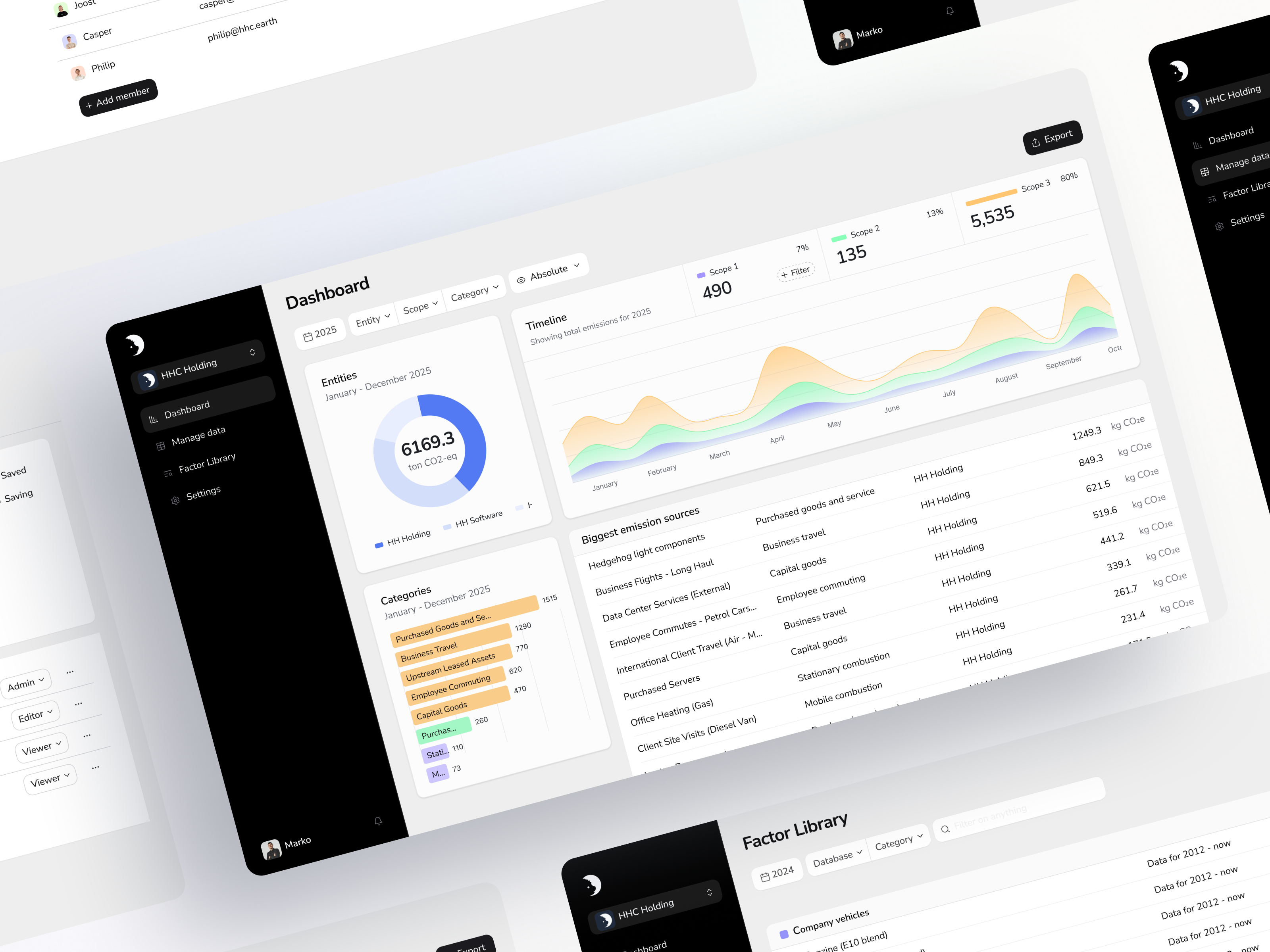
Pro pricing starts at EUR 1,200 a year and is built on user seats and business entities, published on our G2 profile rather than quoted privately. The platform does entity management across locations and sites, with user roles for data owners, auditors and managers, which is the structure a group needs to spread data entry without spreading edit rights.
Two limits to weigh if you are a group.
Few integrations today. A customer named more integrations with other software as the thing they would change, on G2 in June 2026. If your plan depends on pulling entity data automatically out of fourteen ERPs, test that specifically before you buy.
Not a broad ESG suite. A customer rated us 3.5 out of 5 in June 2026 and said that if you want a broader ESG data and reporting platform, this one is less complete, with no data source management feature and no decarbonisation target monitoring. If your group needs one system for all of ESG, that is a fair reason to look elsewhere.
What should you do first?
Write down your reporting entity count and your seat count before you take a single call. Those two numbers are what every quote in this market is built from, and having them settled turns a vague discovery call into a price.
Then build one entity for free and see how the data actually behaves. You can start an account without a sales call, and one real entity tells you more about the total cost than any quote will.
Method: the pricing page of each named vendor was read on 27 August 2026 and checked for a numeric price. Vendors change pricing often, so re-check before relying on any figure here. Sources: Hedgehog platform, Hedgehog on G2, ecohedge.com/pricing.
Facts on this page were last verified on 2026-09-16.

