
In short
- This is a staffing decision more than a software decision. Price the person, not the licence.
- The recurring job is maintaining the method, not running the calculation.
- Outsourcing entirely creates a key-supplier risk that mirrors the key-person risk you were avoiding.
Build, hire or outsource is a staffing question wearing a software costume. Somebody has to own the boundary decisions, keep the method stable across years, answer an auditor and absorb a methodology change. The only real question is whether that somebody is on your payroll, on a vendor's, or on a consultancy's retainer. Companies with an unusual boundary and a real data team can justify owning it end to end. Almost everyone else is choosing between hiring a person and buying a system that a smaller person can run.
This page is about who does the work. The separate question of which tool that person uses is a different argument.
What does "in-house" actually mean here?
Three different things get called in-house, and they cost very different amounts.
Building your own system. Your own data model, your own factor library, your own reporting logic. This is a software project with an indefinite maintenance tail, because emission factors and reporting standards both move.
Hiring the capability. A sustainability analyst or manager who owns the method and uses a bought tool. This is what most mid-market companies mean when they say in-house, and it is a hiring decision.
Keeping it in an existing role. Someone in finance, quality or operations picks it up alongside their job. Extremely common, and workable for a single-entity scope 1 and 2 inventory. It stops being workable when scope 3 and an auditor arrive together.
The alternative to all three is buying: a platform, a consultancy, or the two together. Which is why the honest comparison is not two columns but four.
What is the recurring job, exactly?
Not the calculation. The calculation is the easy part and it takes days a year once the structure exists.
The recurring job is maintenance, and it has four components.
Boundary decisions. Which entities are consolidated, what happens to a joint venture, how a leased site is treated. These change whenever the company changes shape, and they need someone who can defend the answer.
Method stability. Keeping this year comparable to last year, and knowing when a change in the number is a real change rather than a factor revision or a scope change.
Factor upkeep. Knowing which factor set you are on and what happens when it updates.
Answering questions. Auditors, customers, certification schemes and increasingly your own board. This is a communication job as much as a technical one.
Whoever you choose has to cover all four. A tool covers two of them at best.
What does each option actually cost you per year?
Not in currency, because your salaries and quotes are not ours, but in the things that are comparable.
| Option | Recurring cost driver | Time to first credible number | Main risk |
|---|---|---|---|
| Build your own system | Engineering time, forever | Longest | You now maintain a factor library |
| Hire an analyst, buy a tool | One salary plus a licence | Medium | Key-person risk |
| Existing employee, buy a tool | Part of one role plus a licence | Medium | The role gets busy and the data slips |
| Outsource to a consultancy | Annual engagement fee | Shortest | The knowledge leaves with the contract |
The row people underestimate is the first one. Building your own carbon system means signing up to track emission factor releases, reporting standard revisions and scheme handbook updates indefinitely. That is not a one-off build cost, it is a permanent team commitment, and it is why companies that do it well are usually companies whose product depends on it.
When is building it yourself the right answer?
There are real cases. Three of them.
Your boundary is genuinely unusual and no vendor models it. Complex joint venture structures, unusual asset ownership, or an operational model that off-the-shelf entity management cannot represent without lying.
Carbon data is part of your product. If you sell carbon intensity to your own customers as a feature, you probably need to own the pipeline.
You already have the data engineering team and the data is already centralised. If a warehouse with clean, complete activity data already exists, the marginal cost of building on top of it is much lower than it looks from outside.
Note what is not on that list: being large, being technical, or disliking vendors. Those produce build decisions that are abandoned in year three, usually after the person who built it leaves.
What is the key-person risk you are keeping or transferring?
Every option has one. Pick the version you can live with.
Hire in-house and the risk is that the method lives in one head. Mitigate it by insisting the method is documented in the tool rather than in the analyst's own files, and by making sure a second person can produce the report.
Outsource entirely and the risk moves to the contract. When the engagement ends, does the model come with you, or does next year start from scratch with a new supplier? Ask that in the first meeting and get the answer in writing. This is the most common unpleasant surprise in the outsourced route.
Buy a tool and run it internally and the risk is that nobody owns it. A licence with no named owner produces a partial inventory and a missed deadline. Name the owner in the budget.
A reasonable middle path is common and worth naming: buy the platform, run it internally, and buy a few consulting days a year for the decisions that need a specialist. Scope 3 boundary setting and a pre-audit methodology review are the two that pay for themselves most often, which is what carbon footprint consulting and scope 3 consulting exist for.
Where does a vendor still leave you doing the work?
Two places, and being clear about them is the point of this section.
Getting the data in. No purchase decision removes this. On G2 in August 2026, a Small-Business reviewer named exactly that: everything works perfectly once the data is loaded, and loading it is the challenge. That effort is yours whichever route you take, because the data lives in your systems and your suppliers' inboxes. Buying changes who builds the structure, not who finds the numbers.
Product-level work. An organisational carbon platform does organisational footprints. If a customer asks for an LCA, an EPD, an ECI (MKI in Dutch) or a product carbon footprint, that is a project with a specialist, not a feature you switch on. At Hedgehog it is delivered as a service through LCA consulting, and knowing which of the two you have been asked for should happen before any build or buy decision.
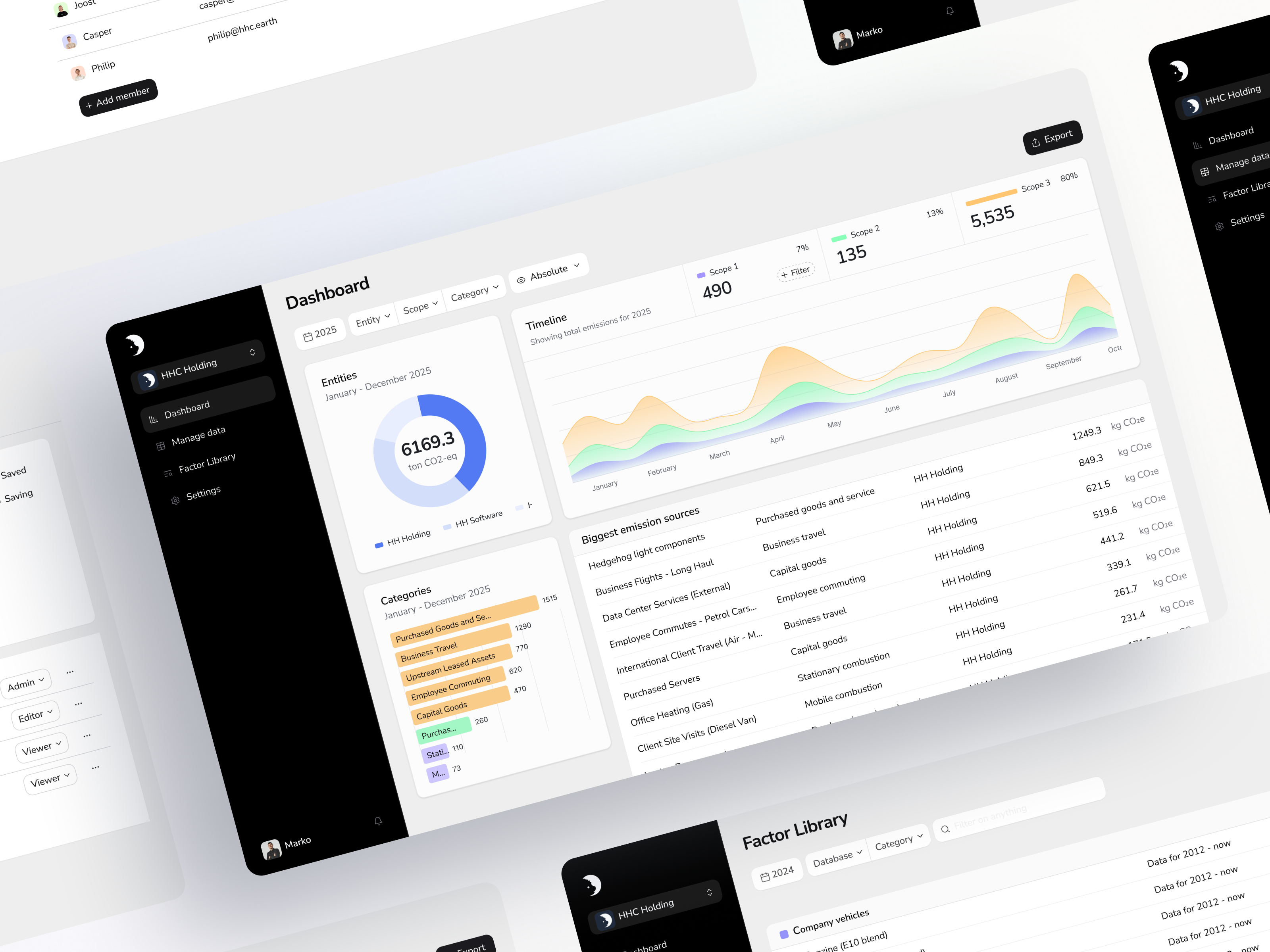
For completeness, what the bought side looks like on our end: the platform covers GHG Protocol setup, inventory building, data upload and reporting with an AI assistant and human GHG experts reachable in-app, over 20,000 spend-based and activity-based factors, customer-added supplier-specific data, and multi-entity management with roles for data owners, auditors and managers. Pricing is a free account requiring no sales call, with Pro from EUR 1,200 a year.
The limit that belongs in a build-versus-buy discussion specifically: it is not a broad ESG suite. A Mid-Market customer rated us 3.5 out of 5 on G2 in June 2026 and said the platform is less complete for broader ESG data and reporting, with no data source management feature and no decarbonisation target monitoring. If your build case was really about owning an ESG data layer rather than a carbon calculation, that is a different scope and you should price it as one.
How do you decide this in a week?
Answer four questions honestly and the decision usually makes itself.
- Who will still own this in three years? If you cannot name the role, do not build.
- Does any vendor model your entity structure correctly? If several do, building is hard to justify.
- What is the deadline, and does it survive a build? Tender and certification dates do not move for internal projects.
- What happens if the owner leaves in month eight? Whichever option survives that answer is your answer.
If you want to test the buy side cheaply before committing to a hire, start a free account and have your candidate owner build a first inventory. It is the fastest way to find out how much of this job is really about the tool. Our guide to choosing carbon accounting software covers the tool side, and you can book a call if you would rather discuss the staffing shape first.
Sources: the Hedgehog platform page and the Hedgehog G2 profile, each read on 27 August 2026. Boundary and consolidation terminology follows the GHG Protocol Corporate Accounting and Reporting Standard, Revised Edition, chapter 3. Salary and consultancy figures are yours to supply; this page deliberately quotes none. Page verified 17 September 2026.
Facts on this page were last verified on 2026-09-17.

