
In short
- B Corp is an assessment, not a filing. The evidence has to be retrievable, not just calculated.
- Build the inventory as a repeatable routine, because recertification asks again.
- The same inventory feeds SBTi, EcoVadis and customer questionnaires. Build it once.
B Corp certification asks you to measure your environmental impact and evidence it, which for most companies means producing a greenhouse gas inventory covering scope 1 and scope 2 at minimum, with the scope 3 categories that are material to your business. It is an assessment rather than a filing, so what you need is not a formatted report but a number you can stand behind, with the working retrievable when someone asks. Anyone certifying or recertifying needs this. The first step is picking a complete twelve month period and pulling the energy and fuel data for it.
We are describing what a carbon tool has to do for this use case. For what the certification itself currently requires, read B Lab's own materials, because the standard is theirs and it moves.
What does a B Corp assessment need from your carbon data?
Four qualities, and none of them is a specific document format.
A defined boundary. Which legal entities, which sites, which period. A number without a boundary is not assessable.
Scope 1 and scope 2 as the floor. Fuel you burn, vehicles you run, electricity and heat you purchase. This is the part every company can produce and the part with no excuses attached.
The scope 3 categories that are material to you. A professional services firm and a manufacturer have different answers. The judgement about which categories matter is itself part of what you are demonstrating.
Evidence that can be retrieved. The distinguishing feature of an assessment, as opposed to a self-published report, is that someone may ask you to show the underlying record. A figure you can produce but not trace is a weak answer.
That last point is where spreadsheets and one-off consultancy engagements tend to disappoint. The calculation was fine. The trail back to the invoice was never built.
Who actually needs a tool for this, and who does not?
Not everyone. Be honest about which group you are in.
You probably do not need a platform if you are a single-entity company under a few dozen people, your emissions are an office and some travel, and you are certifying for the first time. A careful spreadsheet with dated factor sources will get you there.
You probably do need one if any two of the following are true: you have more than one entity or site, you have material scope 3 in purchased goods, several people will enter data, you are also answering customer questionnaires, or you intend to set a reduction target and show progress against it.
You certainly need something repeatable if you are recertifying. The second time round, the questions are about trajectory as well as level, and a trajectory needs two comparable years. Rebuilding the calculation from scratch produces a second number that cannot be compared to the first, which is the most common self-inflicted wound in this whole exercise.
What should the software produce?
Five outputs, and it is worth testing each of them in a trial rather than in a demo.
- What you need: Scope 1 and 2 from ordinary business data
Why it matters for B Corp: This is the floor, and it must not require new metering
How to test it: Load one year of energy and fuel bills - What you need: Selective scope 3 categories
Why it matters for B Corp: You want the material ones, not all fifteen
How to test it: Add one category and see what it asks for - What you need: A stable base year
Why it matters for B Corp: Recertification compares you to yourself
How to test it: Ask what happens when factors update - What you need: A retrievable audit trail
Why it matters for B Corp: The evidence question
How to test it: Export the trail for one line item - What you need: Export into someone else's template
Why it matters for B Corp: You will be asked in several formats
How to test it: Try it with a real questionnaire
The row that catches people is the third. Emission factors update, and when they do, your prior year moves. A tool that silently restates history leaves you unable to explain why last year's published number changed, which is a worse conversation than the one about the emissions themselves.
Where do companies actually lose time?
Three places, consistently.
Deciding the boundary too late. Teams collect data for months and then discover a subsidiary or a leased site was in or out of scope all along. Decide first, write it down, then collect.
Treating scope 3 as all or nothing. Attempting all fifteen categories in year one is how a certification project misses its deadline. Take the material ones, document why the others were excluded, and expand next year. The documented exclusion is itself good practice.
Building the number without building the routine. A one-off figure gets you certified once. Certification recurs, customer questionnaires recur, and any target you set requires annual measurement. Building a routine takes marginally more effort than building a number and saves the whole exercise the second time.
How does this fit with the other things you already owe?
Better than most people expect, because it is the same inventory underneath.
The platform names B Corp alongside SBTi and EcoVadis as supported compliance workflows, which reflects a simple reality: they draw on one greenhouse gas inventory presented in different ways. If you are also considering a formal reduction target, science based targets is the natural next step from the same data, and it is worth knowing that before you build, because a target has implications for how you set your base year.
The general principle applies well beyond B Corp. Build the inventory once, keep the boundary and method stable, and treat every certification, questionnaire and tender as an export of the same underlying numbers. Companies that do this spend a fraction of the time of companies that answer each request as a fresh project.
What does Hedgehog do here, and where is it thin?
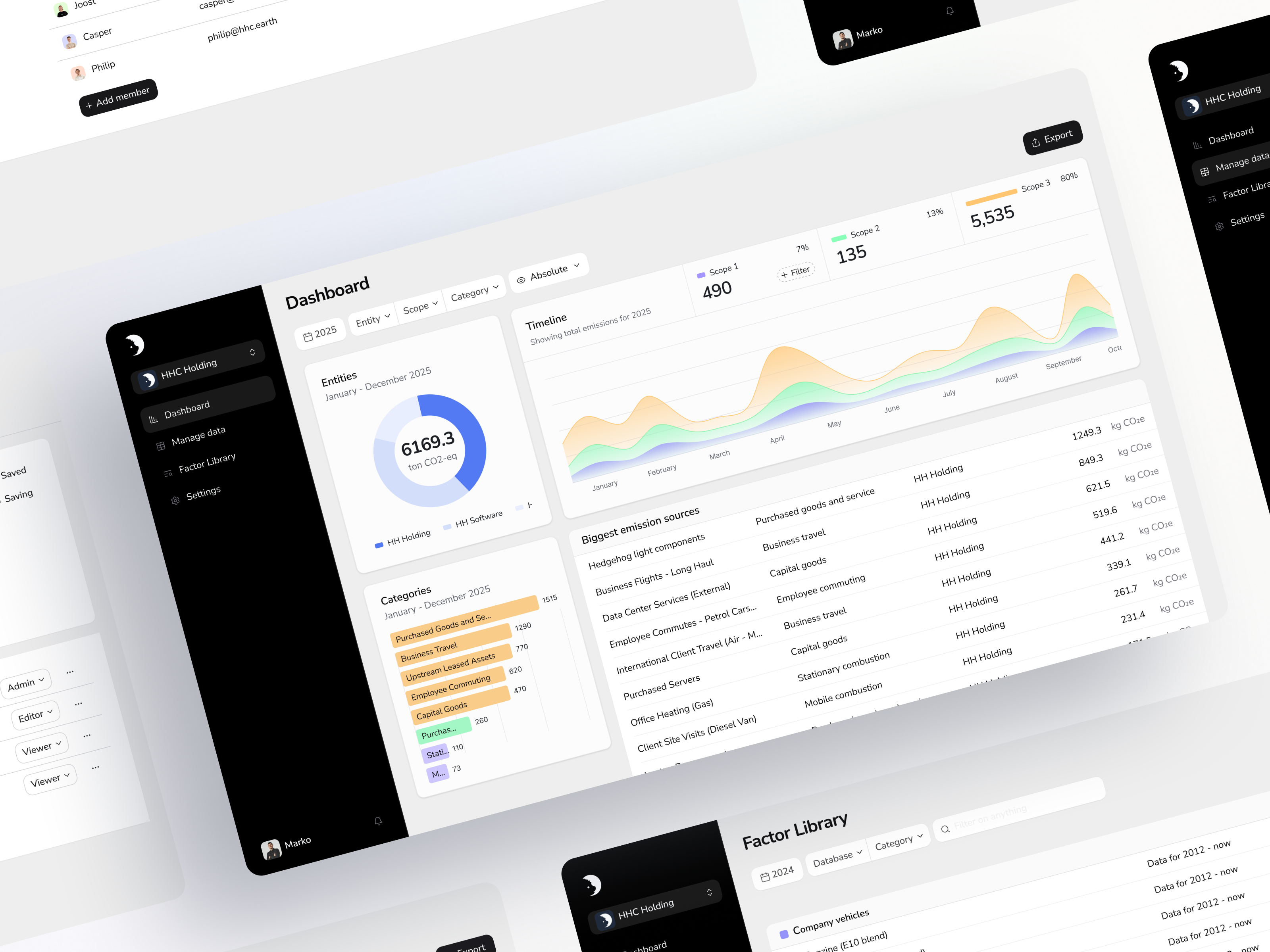
The platform guides you through GHG Protocol setup, building a data collection plan and a GHG inventory, with an AI assistant for setup and human GHG experts reachable in-app. It holds over 20,000 spend-based and activity-based emission factors, lets you add organisation-specific or supplier-specific data, supports multiple entities with roles for data owners, auditors and managers, and names B Corp, SBTi and EcoVadis among its supported workflows. There is a free account that needs no sales call, and Pro from EUR 1,200 a year.
Two limits, stated because a certification about accountability deserves them.
Loading the data is the effort. In an August 2026 G2 review, a Small-Business customer said the platform works perfectly once the data is loaded, and that loading it is where the difficulty lies. Budget the first inventory as weeks of data gathering rather than a software setup task. That is true of every tool in this market and it is the line most certification timelines get wrong.
Product-level work is bought as a service. If your assessment work leads you toward a per-product figure, an LCA or an EPD, that is project work delivered through LCA consulting rather than something the platform outputs. The platform handles the organisational footprint, which is what a company-level certification exercise needs.
What is the right first move?
Pick a complete twelve month period and write down the boundary in one paragraph: entities, sites, period. Do that before you open a spreadsheet or a trial account, because everything downstream depends on it.
Then collect scope 1 and 2 only, and get to a real number. It is achievable in days rather than months, it tells you how good your data actually is, and it gives you a concrete basis for deciding which scope 3 categories are worth the effort.
You can start a free account and do exactly that without a sales call. If you have never built an inventory before, carbon accounting from scratch walks through the basics, and choosing carbon accounting software covers what to compare if you are shortlisting tools.
Sources: our platform page and our G2 profile, read on 27 August 2026. Certification requirements are set by B Lab, change over time, and should be checked against their current published standard rather than against this page.

