In short
- Three different obligations, three different outputs. A single number satisfies none of them.
- Scope 3 purchased materials dominate. Concrete and steel usually lead.
- BPM 2.0 has been in force since 1 July 2026 and gives utility buildings an MPG requirement for the first time.
Construction has three separate carbon obligations that ask for different things, and a single company footprint satisfies none of them on its own. The CO2-Prestatieladder wants an audited organisational inventory. MPG and BPM 2.0 want building-level material data. PPN 006 wants a carbon reduction plan in a prescribed UK format.
Your emissions sit overwhelmingly in purchased materials, and the tender date is your real deadline. Here is what that means for the software you buy.
Which rules actually apply, and when?
The CO2-Prestatieladder, if you bid on Dutch public work. It is not new: ProRail has awarded on it since 1 December 2010, and Rijkswaterstaat moved to version 4.0 on 1 July 2026 applying 2, 4 and 6 percent. ProRail switches to 4.0 on 1 January 2027 with a proposed 4, 7 and 10 percent it calls provisional. From 14 January 2027 authorities can no longer tender with 3.1 and you must switch by your first audit after that date, so everyone certified is migrating now.
MPG and BPM 2.0, if you build in the Netherlands. BPM 2.0 has been in force since 1 July 2026. It aligns to EN 15804+A2 and expands impact categories from 11 to 19. Offices are 15 percent tighter, and utility buildings such as schools, shops, healthcare institutions and industrial buildings get an MPG requirement for the first time. We cover what shifted in the MPG score and BPM 2.0.
PPN 006, if you bid on UK central government work above GBP 5 million a year. It needs a carbon reduction plan covering scope 1, scope 2 and five named scope 3 categories, refreshed every twelve months. Our PPN 006 checklist walks through it.
These are genuinely different artefacts. The ladder is a certification of your organisation. MPG is a calculation about a building. PPN 006 is a document about your reduction plan. Any vendor telling you one output covers all three has not read all three.
Where do construction emissions actually sit?
Scope 3 dominates, and within it purchased materials dominate. Concrete and steel usually lead by a wide margin.
That has a practical consequence most contractors discover late: your fuel and plant data, which is the part you can measure precisely, is a small share of your total. Your material purchases, which sit in the purchase ledger as line items in euros with no carbon attached, are most of it.
So the work is not metering. The work is getting your purchase ledger into a shape where materials can be matched to emission factors, and then progressively replacing generic factors with real supplier EPDs where they exist.
That progression is the whole game. Starting spend-based is fine and is what everyone does. Staying spend-based means you can never demonstrate a reduction, because buying the same tonnage of lower-carbon concrete at the same price shows no change at all.
Where does the data come from?
Four places, in rough order of how much work they are.
Purchase ledger, split by material. The biggest job and the biggest payoff. Needs category mapping before anything else works.
Subcontractor invoices. Frequently the largest single line and frequently the least documented. Decide early whether you treat subcontractors as purchased services or ask them for their own figures.
Plant and equipment fuel. Fuel cards, site tanks, hired plant. Precise and comparatively easy.
Supplier EPDs and, for Dutch work, the NMD. This is what moves you from generic to specific and is what makes a reduction claim defensible.
What should a contractor's tool actually do?
Five things worth testing before you commit.
Handle multiple entities and projects. Most contractors run several legal entities and want project-level views that roll up to a company figure without double counting.
Show its working. The ladder is audited. Every figure needs a route back to a source record and a factor version. Ask for an audit trail export on a single line item and see what you get.
Let you replace factors as better data arrives. When a supplier gives you an EPD, you need to swap it in for that material and, ideally, restate prior years while keeping the original.
Survive a methodology change. Handbook 4.0 is a live example. Ask directly what happens to your base year.
Produce the actual document. Not a dashboard. The ladder submission, the PPN 006 plan. Ask to see a real example output.
What does Hedgehog do for construction firms?
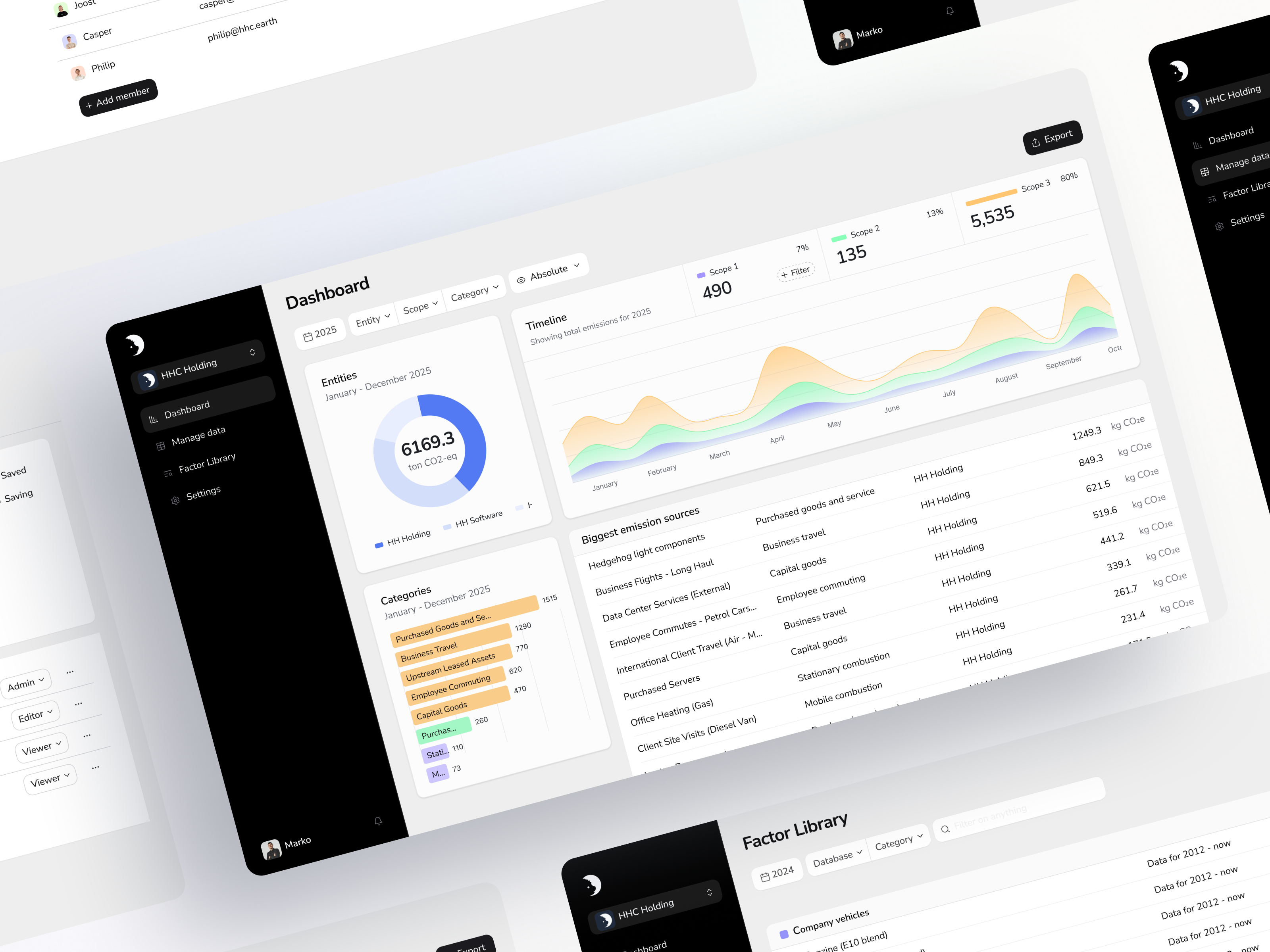
The platform names both the CO2-Prestatieladder and PPN 006 as reporting outputs. It guides you through the GHG Protocol and building a data collection plan, holds over 20,000 spend-based and activity-based factors, and lets you add supplier-specific CO2 data, which is the mechanism for bringing EPDs in as you collect them. Multi-entity management covers the several-companies problem. Human GHG experts are reachable in-app.
Free account, no sales call. Pro from EUR 1,200 per year.
Two limits to weigh, both from our own customers on G2.
Getting data in is the hard part. A reviewer said in August 2026 that once the data is loaded it works perfectly, and loading it is the challenge. In construction, with a purchase ledger of thousands of material lines, that is the honest shape of the first project. Anyone promising a same-day construction footprint from a ledger import has not tried it.
Product-level work is a service, not a feature. An MPG calculation, an EPD for a product, or a building-level assessment is consultancy work rather than something the platform does. The platform handles the organisational footprint, which is what the ladder and PPN 006 need. If you need both, you can buy both from us, and you should know which is which before you sign anything.
What should you do first?
Work out which of the three obligations has the nearest deadline for you. For most Dutch contractors that is the Handbook 4.0 migration, because 14 January 2027 is fixed and applies to everyone certified.
Then run the tier arithmetic. Find out what tier your regular competitors hold, what the fictitious reduction is worth against your typical bid, and compare it to the cost of getting there. For contractors bidding regularly on public work, that calculation usually settles the question quickly.
You can start a free account and get a first organisational footprint out of your fuel and energy data before touching the purchase ledger, which is a reasonable way to find out how much work the ledger will be.
Sources: SKAO, Dutch Besluit bouwwerken leefomgeving (Bbl) and BPM 2.0 documentation, UK Cabinet Office PPN 006, Hedgehog platform, Hedgehog on G2. Regulatory dates verified 27 August 2026 and due for re-check before any 2027 refresh.
Facts on this page were last verified on 2026-09-17.