In short
- EcoVadis assesses documented evidence. An unevidenced carbon claim scores no better than saying nothing.
- The assessment is periodic, so the real requirement is a footprint you can reproduce and improve, not a one-off calculation.
- Coverage beats precision. Emissions data earns nothing unless it covers 95 percent of the assessed scope.
EcoVadis is a supplier sustainability assessment that your customer asks you to complete, and it is scored on documented evidence rather than on stated intentions. If a large customer has sent you a request, this is yours, and the environment section is where a real carbon calculation is needed rather than a policy statement. The next step is concrete: work out whether you can produce a current-year scope 1 and 2 footprint with a document behind every figure, because that is the difference between an answer that scores and an answer that does not.
What does an EcoVadis assessment actually ask for on carbon?
Less than people fear, and more evidence than people expect.
The environment section wants to know what you measure, how you measure it, what you are doing about it, and whether any of that is documented in a way a third party can check. A carbon footprint is one input among several, but it is the one that cannot be written from memory the night before the deadline.
In practice you need four things in a folder.
A current footprint. Scope 1 and scope 2 at minimum, for a stated reporting year, with a stated boundary.
The method behind it. Which standard, which factors, which activities were included and which were left out and why.
Evidence for the inputs. The energy bills, the fuel data, the mileage records that sit behind the total.
Something that shows direction. A prior year, a target, or a documented action. A single year with no context is a data point rather than a management system.
Why does evidence matter more than the number itself?
Because the assessment is not benchmarking your emissions against other suppliers. It is assessing whether you manage them.
This trips up good companies. A firm with a genuinely small footprint and no documentation scores worse than a larger emitter with a policy, a measured baseline and an action log. That feels unfair for about a day, until you realise the customer sending the request is trying to establish whether you are a supply chain risk, not whether you are virtuous.
Two consequences follow for how you should approach the work.
Do not overstate. Every claim you make becomes a claim you have to evidence, and an unevidenced claim is worse than a modest one. It is also worth remembering that environmental claims in commercial communication are separately regulated, which we cover in the EmpCo claims checklist.
Do not treat it as a one-off. Assessments repeat. A footprint that took three weeks of heroics and cannot be reproduced leaves you doing three weeks of heroics again, from a colder start.
What should the software produce for an EcoVadis file?
Documents, not dashboards. Here is the mapping worth checking against any tool you are considering.
| What the file needs | What the tool has to do |
|---|---|
| Current year scope 1 and 2 | Calculate from bills, fuel and mileage you already hold |
| A stated boundary | Record entities and sites, and hold the boundary stable |
| A stated method | Name the standard applied and the factor set used |
| Input evidence | Keep the source records attached and retrievable |
| Prior year comparison | Hold last year on the same basis, not recalculated silently |
| Selected scope 3 categories | Add categories one at a time, where the customer asks |
| An export your customer can read | Produce a file, not a login |
The last row matters more than it looks. Nobody assessing you will log in to your carbon platform. Everything has to leave the tool as a document.
Where do most EcoVadis carbon answers fall down?
Five places, and none of them is the arithmetic.
The boundary does not cover enough of the business. This is the one worth knowing, because it is published and it is absolute. Reporting evidence generally has to cover at least 80 percent of the assessed scope, but greenhouse gas and energy data has to cover 95 percent to be credited at all. Below that it earns nothing, however good it is. Coverage beats precision here: a rough number covering every site in scope outperforms a careful number covering three sites out of five.
The reporting year is stale. Recency does real work in how this is read, though less than people assume. Reporting KPIs stay valid for two annual cycles, so your last complete financial year is comfortably current. What reads badly is a figure with no successor, because it suggests a company that measured once.
The boundary is vague. "Our operations" is not a boundary. Which legal entities, which sites, which countries.
Scope 3 is claimed but not calculated. Saying you have addressed value chain emissions and then producing nothing is the worst of both. Either calculate a category properly or say plainly that you have not yet.
Nobody can find the evidence. The number exists, the spreadsheet behind it left with a colleague. This is the failure that repeats every cycle.
If your customers are pushing further into value chain data than the assessment itself does, scope 3 consulting is where that conversation usually goes next.
What does Hedgehog do for an EcoVadis assessment?
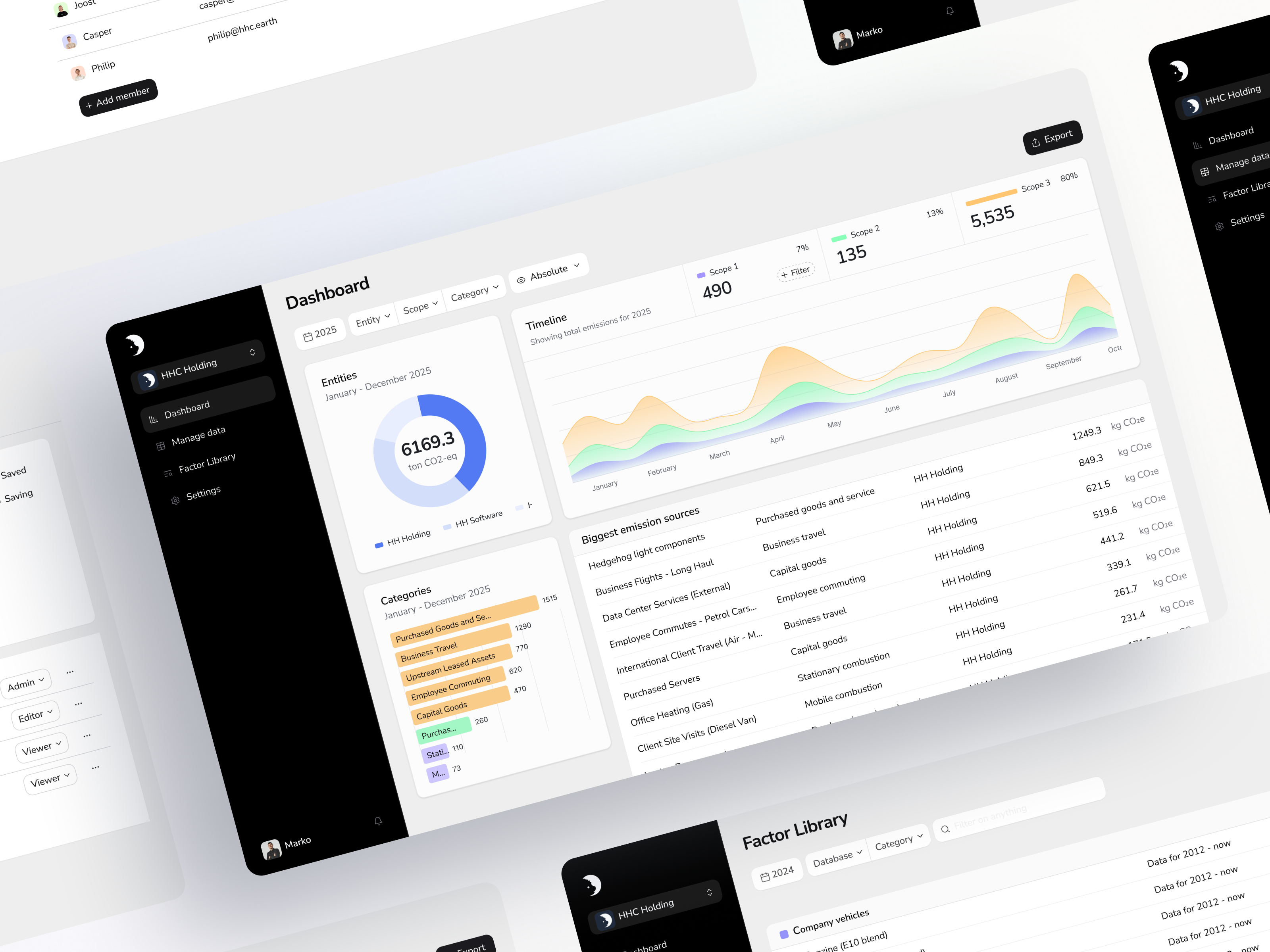
The platform states support for EcoVadis compliance workflows alongside SBTi and B-Corp. It guides you through GHG Protocol setup, a data collection plan and inventory building, with an AI guide and human GHG experts reachable in-app. It holds over 20,000 spend-based and activity-based factors, lets you add your own organisation-specific or supplier-specific CO2 data, and manages multiple entities and sites with roles for data owners, auditors and managers. It runs in English, French and Dutch, which matters when the person assembling the evidence and the person who owns the customer relationship are in different countries.
Free account with no sales call. Pro from EUR 1,200 per year.
Three limits worth knowing before you buy for this specifically.
Loading the data takes real effort. A small business customer said on G2 in August 2026 that once the data is loaded everything works perfectly, and getting it loaded is the challenging part. If your assessment deadline is three weeks away, that is the constraint to plan around, not the calculation.
This is an emissions platform, not a full ESG system. EcoVadis covers labour and human rights, ethics and sustainable procurement as well as environment, across 21 criteria. A mid-market reviewer rated us 3.5 out of 5 on G2 in June 2026 and said that as a broader ESG and CSRD reporting platform this one is less complete, with no data source management feature and no decarbonisation target monitoring. We cover the carbon section. The rest of the file is yours.
Product footprints are a service. LCA, EPD, MKI and PCF work is delivered by our people rather than by the subscription. The platform does organisational footprints, which is the level an assessment asks about.
What should you do first?
Check the deadline and the reporting year you can actually evidence. If your last complete financial year is the one you can document, use it and say so explicitly.
Then build scope 1 and 2 first and completely, and keep the source files attached to the entries as you go. Adding evidence later is roughly three times the work of attaching it at the time.
You can start a free account and get a defensible current-year number without a sales call, or book a meeting if the deadline is tight enough that you want a person involved.
Sources: Hedgehog platform, Hedgehog on G2, GHG Protocol Corporate Standard. Verified 27 August 2026.
Facts on this page were last verified on 2026-09-17.