In short
- The request comes from your customer, not a regulator. Retail and foodservice push CSRD value chain questions down the chain.
- Agricultural inputs dominate the footprint. Land use and refrigerants matter more here than in almost any other sector.
- A company footprint does not answer a per product question. Those are two different pieces of work.
For most food and drink producers the pressure arrives as a customer questionnaire rather than a regulator's letter. Retail and foodservice buyers in CSRD scope have to report on their value chain, so they ask their suppliers, and the questions cluster around the ingredients you purchase. That is also where the emissions genuinely sit: agricultural inputs dominate, with land use and refrigerants carrying more weight than in most industries. What the software has to produce is an annual scope 1, 2 and 3 inventory you can hand to several customers in several formats without recalculating it each time.
Which rule actually applies to food and beverage, and when?
The one that reliably bites is CSRD value chain reporting, and it reaches you indirectly. Your retail and foodservice customers report on their own value chain, which means asking the businesses in it for data. Nothing obliges you to answer. Losing a listing is the enforcement mechanism, and it is a more effective one than a fine.
One regulation with a hard date is worth separating from the customer questionnaires, and it is worth stating the current date because most of what you will read is out of date. The EU Deforestation Regulation applies from 30 December 2026, and from 30 June 2027 for micro and small operators established as such by 31 December 2024. That date has moved twice: it was 30 December 2024, then 30 December 2025, and the December 2025 amendment moved it again. The Commission's May 2026 review declined to move it a third time.
It covers cattle, cocoa, coffee, oil palm, rubber, soya and wood, so most food and drink producers touch it somewhere. What matters commercially is which side of the line you sit on. If you are the party first placing the product on the EU market, you carry full due diligence and file a due diligence statement. If you buy inputs a supplier has already covered and make something from them, the December 2025 amendment made you a downstream operator, and downstream operators do not file due diligence statements at all. Either way it is not a carbon rule: it asks for the geolocation of plots and proof of legal production, not for an emissions figure. It lands on the same ingredient data as your scope 3, which is the only real reason the two get talked about together.
If you put product on shelf in the EU, the Packaging and Packaging Waste Regulation has applied since 12 August 2026. The obligation that started immediately and reaches food directly is the PFAS limit on food-contact packaging. Recycled content and labelling requirements come later, in 2028 and 2030.
Two consequences follow.
The deadline is commercial, not statutory. It is whenever a category buyer sends the form, which in practice clusters in the first quarter after annual reports are published.
The format is theirs, not yours. Every customer has a different spreadsheet, and the questions rarely line up. This is why the underlying inventory has to be reusable. The VSME standard exists precisely to let a smaller supplier report once and point everybody at the same figures, and it also caps what a large customer may reasonably demand. That cap is worth reading before you agree to a bespoke data collection exercise, and we go through it in which ESG questions you can decline.
One separate regime worth flagging: if you put an environmental claim on the pack or in marketing, that sits under the EmpCo rules on environmental claims from 27 September 2026, which is a different exercise from an inventory. Our claims checklist covers what has to sit behind a claim.
Where do food and beverage emissions actually sit?
Overwhelmingly upstream, in agricultural inputs. The milk, grain, cocoa, meat, oil or produce you buy carries a footprint set on a farm long before it reaches your gate, and it usually dwarfs everything happening inside your own site.
That is uncomfortable for a producer, because your own operations are the part you can measure precisely and the part you can change quickly, and they are a minority of the total. Two features of this sector make it harder than the average scope 3 problem.
Land use is part of the number. For agricultural commodities, emissions associated with land are material rather than a rounding error, and generic factors handle them inconsistently. Where a supplier can give you primary data, it changes the answer rather than refining it.
Refrigerants are a real scope 1 line. Cold chains leak. In a sector where most of the footprint is bought in, refrigerant loss is one of the few large numbers you own outright, and it is often missing entirely from a first inventory because nobody thinks to ask the maintenance contractor for the log.
Where does the data come from?
Four sources, in rough order of effort.
| Source | What it covers | Effort |
|---|---|---|
| Ingredient purchase data | The bulk of scope 3, category by category | High. Needs mapping before it calculates |
| Cold chain and site energy | Scope 1 and 2, chillers, freezers, processing | Low. Meters and invoices |
| Refrigerant logs | Scope 1 leakage, often overlooked | Low, once you find who holds them |
| Supplier data | Replaces generic factors with real ones | Ongoing. Worth doing for your largest lines only |
Start with purchase data by ingredient category and accept spend-based factors for the first pass. Everyone starts there. The thing to avoid is staying there permanently, because a spend-based inventory cannot show a reduction: switching to a lower-carbon supplier at the same price produces an identical figure.
What does the software actually have to produce?
Five outputs, and only the first is universal.
A complete annual inventory across scopes 1, 2 and 3, on a boundary you can describe in one sentence.
Category-level detail on purchased goods, because a customer asking about dairy does not want a company total.
Supplier-specific factors alongside generic ones, so primary data replaces proxies as you collect it, on your biggest lines first.
Exports into somebody else's template. Test this with a real customer form before you buy, not with a demo file.
A stable method year on year. If your factors and boundary shift, your reduction claim is a methodology change with a marketing headline on it.
Is a company footprint enough for a customer asking about one product?
No, and this is the most common mismatch in the sector.
A category buyer asking for the footprint of a specific SKU is asking for a product carbon footprint, which is a life cycle calculation with its own boundary, its own allocation rules and its own evidence trail. An organisational inventory cannot be divided by units sold to produce it credibly.
They are separate pieces of work, and it is cheaper to know that before you buy than after you promise a number. In our case the platform does organisational footprints, and product footprints, meaning LCA, EPD, MKI and PCF, are delivered as consultancy.
What does Hedgehog do for food and drink producers?
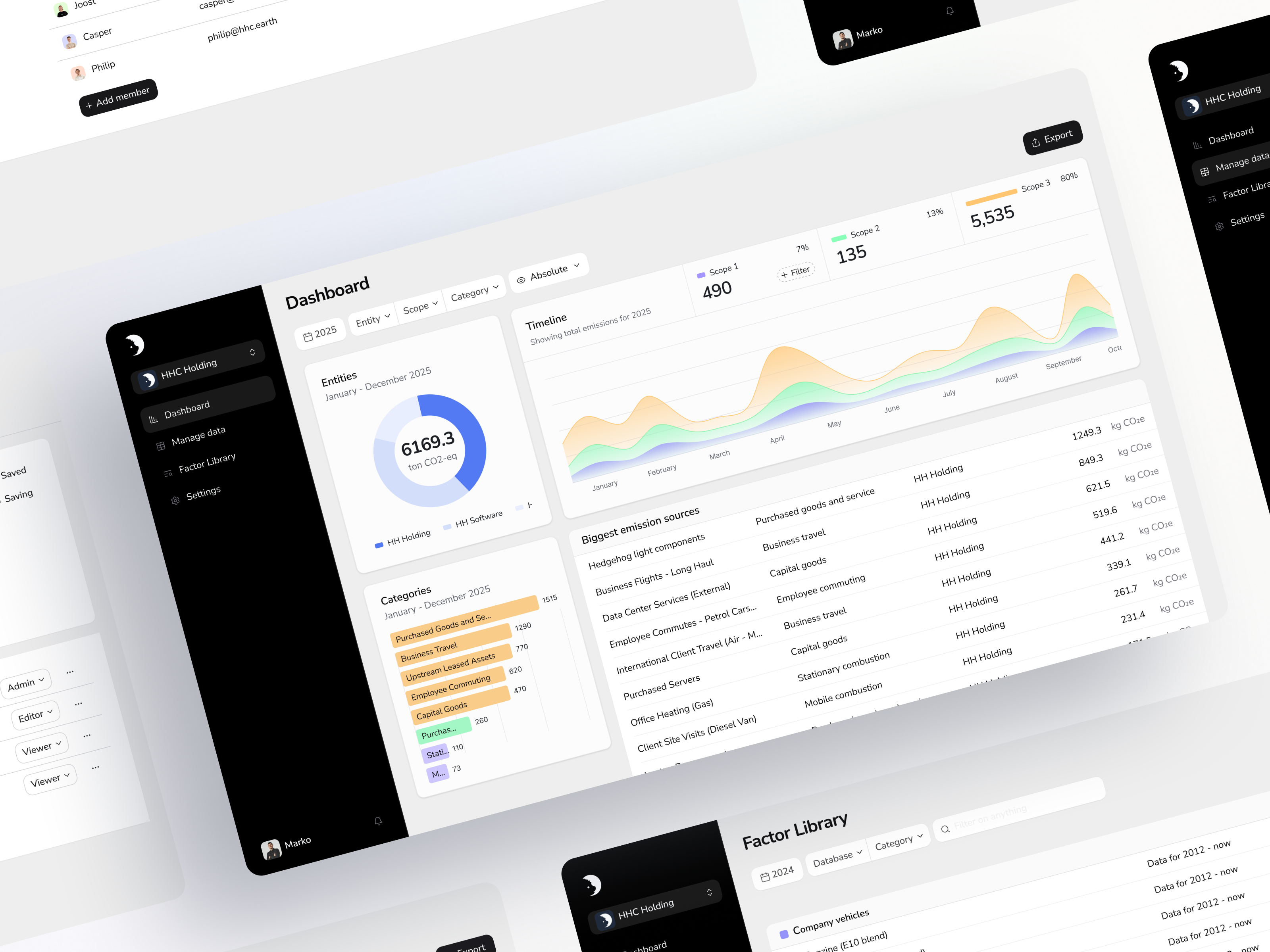
The platform guides you through GHG Protocol setup, inventory building, data upload and reporting with an AI assistant. It holds more than 20,000 spend-based and activity-based factors and lets you add organisation-specific or supplier-specific CO2 data, which is the route from generic ingredient proxies to real supplier figures. Entity management handles several sites or legal entities with roles for data owners, auditors and managers. Named legislation support covers CSRD, SECR and SB253, and the platform supports EcoVadis, B Corp and SBTi workflows, which is what most food category buyers actually reference in their questionnaires.
A free account needs no sales call. Pro starts at EUR 1,200 per year, priced on user seats and business entities.
Two honest limits.
Getting the data in is the slow part. A small business customer said on G2 in August 2026 that once the data is loaded everything works perfectly, and that loading it is the challenging part. With a purchase ledger of several thousand ingredient lines, that is the real shape of the first project.
Product footprints are a service, not a feature. The platform gives you the organisational number. A per-SKU figure for a retail customer is LCA work. You can buy both from us, and you should know which one your customer is asking for before you sign anything.
What should you do first?
Pull the last twelve months of ingredient purchasing and group it into ten or fifteen categories by spend. The top three or four will be most of your footprint, and that ranking alone tells you which suppliers are worth a primary data conversation.
While that is in progress, ask whoever services your refrigeration for the gas log. It takes an afternoon and it closes a scope 1 gap that most first inventories miss.
You can build a first inventory on a free account, or start with carbon footprint consulting if a customer deadline is already on the calendar.
Sources: Hedgehog platform, Hedgehog on G2, Hedgehog industry fact base. Verified 27 August 2026 and due for re-check before any 2027 refresh.
Facts on this page were last verified on 2026-09-17.