
In short
- A franchise network is a consent problem before it is a data problem. You cannot instruct an outlet you do not own.
- Get the network to report on one identical template, or model outlets from a measured sample. Mixing the two silently ruins comparability.
- Franchisee turnover breaks a year-on-year series unless the boundary and the base year are written down.
Carbon accounting software for a franchise network has to produce one credible group figure out of outlets that are separate businesses, run by people you cannot instruct. The franchisor owns the brand, the standards and the supply agreements. It does not own the energy contract, the payroll or the waste bin at most of its sites. Franchisors need this when a lender, a landlord, a large customer or their own reduction target asks for a network number. The practical first step is to fix the reporting boundary in writing, then pilot a data request with five franchisees before rolling anything out.
Who counts what when nobody owns anybody?
Under the GHG Protocol, a franchisor that does not have operational or financial control of a franchised outlet does not put that outlet in scope 1 and 2. It sits in scope 3, in the franchises category. Company-operated sites do go in scope 1 and 2, which is why a network with both models has a split inventory before it has any data at all.
The first practical job is therefore an entity list with a control flag against every site: company operated, franchised, joint venture, master franchise. This is dull and it is the single highest-value hour in the project, because every later argument about what counts traces back to it.
The mirror image is worth stating too. A franchisee is a small business in somebody else's scope 3, and the request lands on them exactly the way a customer questionnaire lands on any supplier. For a single owner-operator, the honest answer is usually a simple inventory built from energy bills, fleet fuel and purchasing, which our guide to building a footprint from scratch walks through.
Why is franchise data a consent problem before it is a software problem?
Because you have no authority to compel it. A multi-site retailer emails its own regional managers and gets data. A franchisor emails independent business owners and gets a reply rate.
Three levers actually work, and they are commercial rather than technical.
The agreement. New and renewing franchise agreements can require an annual data submission in a set format. This is slow, because it only reaches outlets at renewal, and it is the only durable fix.
The exchange. Give something back per outlet: an energy benchmark against comparable sites, a bill check, a simple certificate they can show customers. Franchisees answer a request that has something in it for them at a far higher rate than one that does not.
The default. Where the group negotiates energy, waste or distribution centrally, the data arrives from the counterparty rather than from the franchisee. This is by far the cheapest route and it is chronically underused.
How do you get numbers out of outlets you do not control?
Three methods, and most networks end up running two of them at once.
| Method | What it gives you | What it costs | Where it fails |
|---|---|---|---|
| Full submission per outlet | The defensible answer, outlet level | High effort, needs chasing every year | Response rates below about 70 percent make the total unusable |
| Central contract data | Energy, waste or logistics for the whole network at once | Very low, one conversation per counterparty | Only covers what is centrally bought |
| Modelled from a sample | A network total early, at low cost | Medium. Needs a measured sample and an honest driver | A weak driver, or a sample that is not representative |
Modelling deserves a word, because it is where credibility is won or lost. If you measure thirty representative outlets properly and scale by a driver such as floor area, trading hours or covers served, you have a defensible estimate and you should label it as one. If you measure the eight most efficient outlets and scale by store count, you have a number that will not survive a single competent question.
Whichever you choose, write down the method and keep it stable. The most common failure in franchise reporting is a network that models year one, collects real data for half the outlets in year two, and reports a reduction that is entirely a change in method.
What breaks a franchise inventory in year two?
Churn. Outlets open, close, change hands and convert between company operated and franchised, and every one of those events moves your boundary.
Write a policy in year one covering four cases: an outlet that opens mid-year, an outlet that closes, an outlet that converts from company operated to franchised, and a franchisee who simply does not respond. Decide whether a converted site restates the base year or is treated as a transfer between scopes. Decide what you do with a non-responder, whether that is a modelled estimate, an exclusion with a stated coverage percentage, or a gap.
Coverage percentage is the honest disclosure here. A network total that says it covers 82 percent of outlets by floor area is worth more than one that quietly implies full coverage.
What should a franchise network tool actually do?
Five things worth testing on a real network, not a demo.
Entity management at the scale you have. Hundreds of small entities, each with a control flag, rolling up to a group total without double counting centrally bought energy that outlets also report.
Per-outlet roles and visibility. A franchisee should be able to enter their own data and see their own outlet, and should not see the outlet down the road.
A submission format that a busy operator can complete. If it takes an hour, most will not.
Coverage reporting. How many outlets reported, weighted by size, expressed as a number you can publish.
Pricing you can predict as the network grows. Ask how the price behaves when you add fifty entities, because per-entity pricing is normal in this market and it compounds.
What does Hedgehog do for franchise networks?
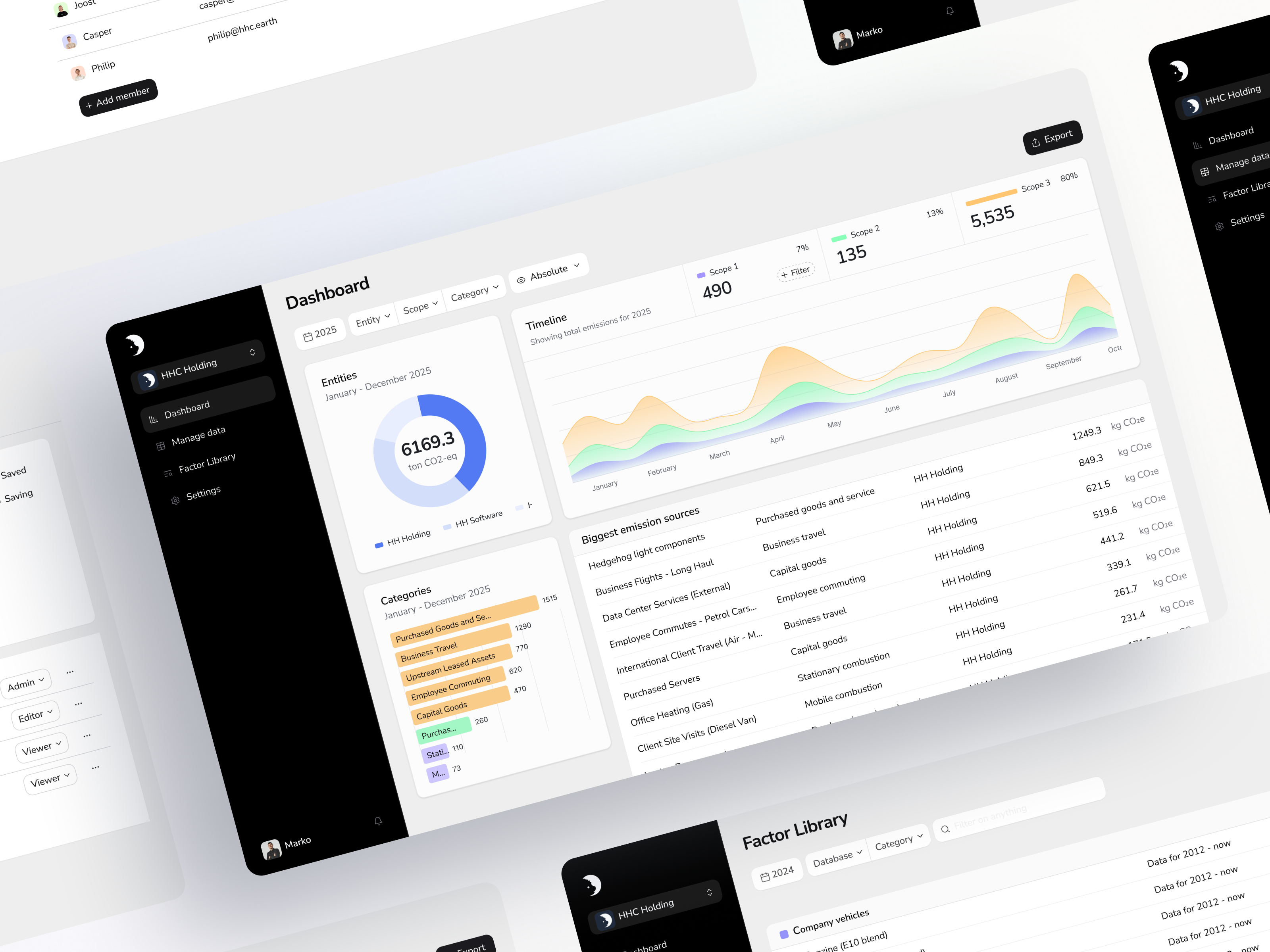
The platform supports entity management across locations and sites with user roles for data owners, auditors and managers, which is the mechanism for letting each outlet own its own data without seeing anybody else's. It guides you through GHG Protocol setup, inventory building, data upload and reporting with an AI assistant, holds more than 20,000 spend-based and activity-based factors, and lets you add organisation-specific or supplier-specific data, which is how a central energy or logistics contract gets applied consistently across the network. It is available in English, French and Dutch, which matters for a network that crosses borders.
A free account needs no sales call. Pro starts at EUR 1,200 per year, priced on user seats and business entities, so a large network should model the entity count before budgeting.
Two limits to weigh.
Loading data is manual work. A small business customer said on G2 in August 2026 that once the data is loaded everything works perfectly, and getting it loaded is the challenging part. Across a hundred outlets that is the dominant cost of year one, and it is the argument for central contract data wherever you can get it.
Integrations are limited today. A mid-market customer on G2 in June 2026 asked for more integrations with other software. If your plan depends on pulling outlet data automatically out of a point-of-sale or energy portal, ask about that specific system before you buy rather than assuming it.
One scope note: the platform produces organisational footprints. Product-level work, meaning LCA, EPD, MKI and PCF, is consultancy rather than a platform feature.
What should you do first?
Build the entity list with a control flag on every site, and count how many outlets sit under centrally negotiated energy, waste or distribution contracts. That number tells you how much of your network footprint you can get without asking a single franchisee.
Then pilot the submission with five willing franchisees before you design the rollout. You will learn more about what your operators will actually fill in from those five than from any amount of internal design.
You can set up the entity structure and test a submission on a free account, or bring in carbon footprint consulting if the modelling approach is the part you want a second opinion on.
Sources: GHG Protocol Corporate Standard and Corporate Value Chain (Scope 3) Standard (read 17 September 2026), Hedgehog platform, Hedgehog on G2. Hedgehog and G2 facts verified 27 August 2026.
Facts on this page were last verified on 2026-09-17.

