In short
- EmpCo applies to sustainability claims made to guests from 27 September 2026. A generic claim such as the towel card's 'for the planet' is banned unless you can demonstrate recognised excellent environmental performance.
- Energy, food purchasing, laundry and waste are the whole story. Three of the four are already in somebody's invoice pile.
- Per guest night is the number that travels, but it is only credible if the occupancy denominator is defined once and left alone.
For hotels and restaurants the rule with a date on it is EmpCo: from 27 September 2026 it bans specific sustainability claims to guests outright, which puts the linen card, the website banner and the menu footnote at risk if they use the wrong wording. The emissions themselves sit in four places: energy, food purchasing, laundry and waste. What the software has to produce is an annual footprint built from utility bills, food purchasing and occupancy data, expressed both as a total and as an intensity per guest night, on a method you can repeat next year without changing the answer.
Which rule applies to hotels and restaurants, and when?
EmpCo, Directive (EU) 2024/825, applies from 27 September 2026. It amends the Unfair Commercial Practices Directive, and it does not create a general duty to substantiate every claim on request. Instead it prohibits four specific practices outright, regardless of whether a business thinks it can back them up.
The four that matter for a guest-facing property: a generic environmental claim the trader cannot demonstrate recognised excellent environmental performance for (a towel card asking guests to reuse linen "for the planet", with nothing behind it, is the textbook case); a neutrality, reduction or positive-impact claim based on offsetting greenhouse gas emissions, banned outright regardless of the offset's quality; a sustainability label not based on a real certification scheme or established by a public authority (an "eco" badge on the room rate that a property invented itself, rather than one issued by a recognised scheme); and an environmental claim about future performance, such as a net-zero pledge or a reduction target, made without a detailed, realistic, publicly available and verifiable implementation plan behind it.
That is a different obligation from a reporting duty, and it catches hospitality harder than most sectors because the industry has always marketed its environmental effort directly at the customer. Our claims checklist sets out what has to sit behind a claim before you publish it.
Two practical rules follow. A vague, generic claim is the risk, not a specific number: "we care about the planet" is exposed, "we cut emissions per guest night by X% against a stated baseline" is not, provided the figure is real. And a measured footprint is the cheapest way to get out from under the generic-claims and future-performance bans, because it is what turns a vague sentiment into a claim with a method and, where you make one, a real implementation plan behind it.
Where do hospitality emissions actually sit?
In four places, and the balance shifts depending on whether you serve food and where your electricity comes from.
Energy. Heating, cooling, hot water, kitchens, pools and spas. This is your scope 1 and 2, it is metered, and it is the fastest part to get right.
Food purchasing. For any property with meaningful food and beverage, this is usually the largest single line and it is scope 3. It behaves like a food producer's problem: what you buy matters far more than how you cook it.
Laundry. Linen and towels are energy and water intensive, and in most hotels the laundry is outsourced, which means it is a purchased service in scope 3 rather than a meter you can read.
Waste. Small in tonnes of CO2 relative to the others, highly visible to guests, and the source of most of the claims that get a property into trouble.
Where does the data come from?
Three sources cover most of it, and you already receive two of them by email every month.
| Source | What it covers | Effort |
|---|---|---|
| Utility bills and meter readings | Scope 1 and 2, per property | Low. Twelve invoices per utility |
| Food and beverage purchasing | The largest scope 3 line for full service properties | Medium. Needs category mapping |
| Laundry and outsourced services | Scope 3 purchased services | Low to medium. Ask the contractor for volumes |
| Occupancy and covers | The denominator for every intensity figure | Low. Already in the property management system |
The one to chase early is the laundry contract. Kilograms of linen processed per month is a number your supplier already holds, and it converts far better than an estimate built from room counts.
Why is per guest night the number that travels, and how do you keep it honest?
Because it is the only figure a guest, an owner, a corporate travel buyer and a general manager can all interpret. A total in tonnes tells a 40 room property nothing about how it compares to a 300 room property. An intensity figure does.
It is also the easiest number in this sector to get quietly wrong, in three ways.
The denominator moves. Guest nights, occupied room nights and covers served are three different divisors. Pick one per metric, define it in writing, and use the same definition every year.
Function and event business gets ignored. A property with a large banqueting operation is serving thousands of people who never sleep there. Their food, energy and waste are in the numerator while they are absent from the denominator, which flatters or distorts the figure depending on the mix.
Occupancy moves the figure. Low occupancy raises energy per guest night because the base load does not fall with the occupancy. High occupancy lowers it. Report the total alongside the intensity so a reader can see which one moved.
Say what the figure includes when you publish it. An unqualified intensity claim reads as the kind of generic claim EmpCo prohibits outright unless you can show real performance behind it; a qualified one, with its denominator and method stated, is a specific claim instead, and qualifying it costs a sentence.
What does the software have to produce?
Four things for a single property, and a fifth once you have several.
A total across scopes 1, 2 and 3, on a boundary you can state in a sentence.
Intensity metrics with a defined denominator, calculated the same way each year.
Category detail on food and beverage purchasing, because that is where the reduction levers are.
Evidence you can point at behind a public claim, which in practice means being able to show the source data and the method for any number you put on your website.
Property by property comparison for a group, with each general manager able to see their own property and the group able to see all of them.
What does Hedgehog do for hospitality operators?
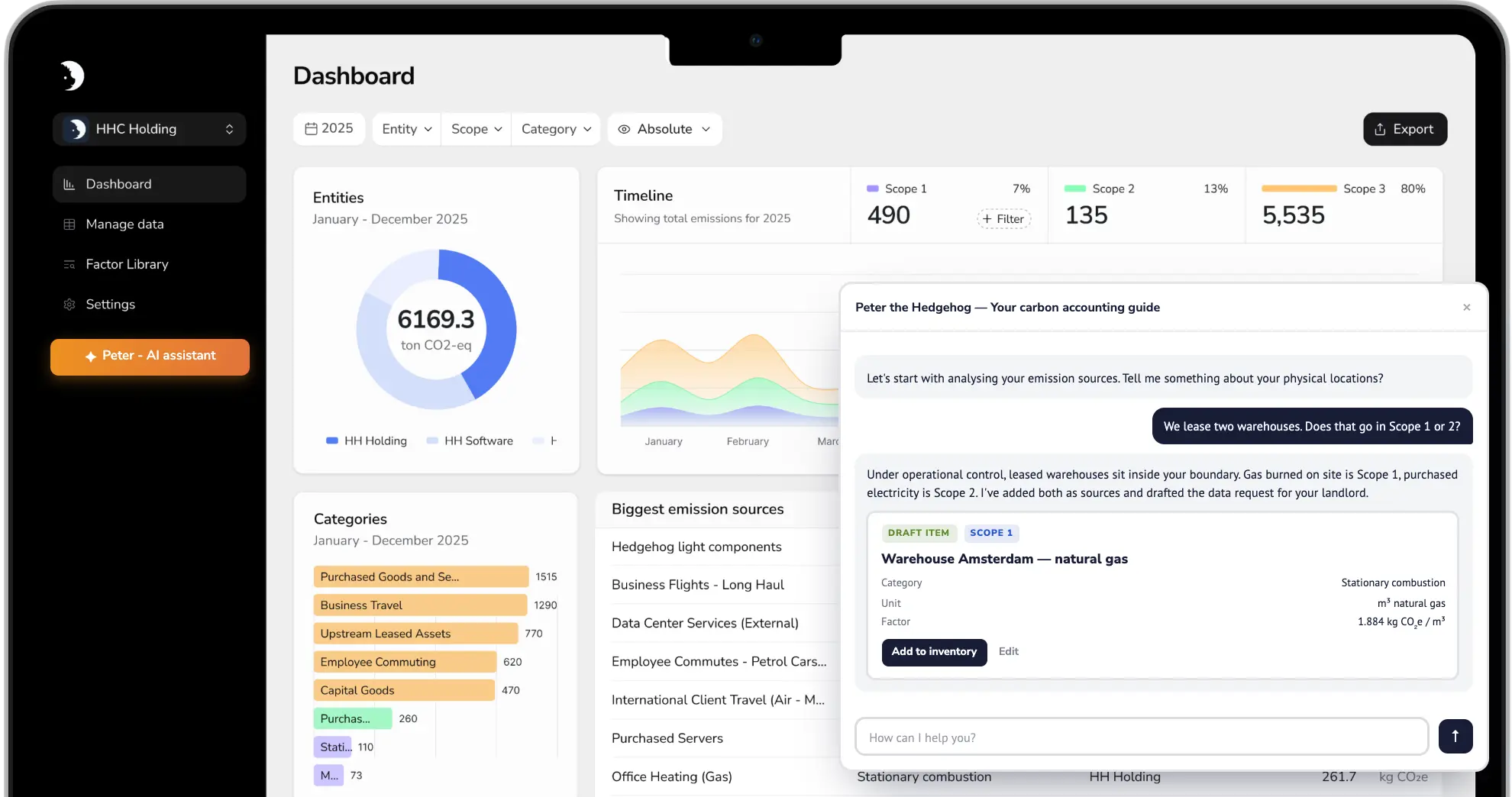
The platform guides you through GHG Protocol setup, inventory building, data upload and reporting with an AI assistant. It holds more than 20,000 spend-based and activity-based factors and lets you add organisation-specific or supplier-specific data, so a laundry contractor's real figures can replace a generic assumption. Entity management across locations and sites with roles for data owners, auditors and managers covers the multi property case, and the product is available in English, French and Dutch.
A free account needs no sales call. Pro starts at EUR 1,200 per year, priced on user seats and business entities, which for a hotel group means the number of properties drives the price.
Two honest limits.
There is no forecasting. A small business customer noted on G2 in August 2026 that forecasting would be a welcome addition and that Hedgehog had told them it was on the development list. If you want to model what a heat pump or a menu change would do before you commit to it, that modelling happens outside the platform today.
Loading the data is the work. A small business customer said on G2 in August 2026 that once the data is loaded everything works perfectly, and getting it loaded is the challenging part. For a property with twelve months of purchasing to categorise, that is the honest shape of the first cycle.
One scope note. The platform produces organisational and property level footprints. A footprint for a specific dish, product or packaging item is LCA or PCF work, delivered as consultancy rather than as a platform feature.
What should you do first?
Audit your own claims before you calculate anything. Walk the property and open your website, and list every environmental statement a guest can see. That list is your EmpCo exposure and it takes an afternoon.
Then pull twelve months of utility bills for one property and the laundry volumes from your contractor. Those two datasets give you a defensible scope 1 and 2 figure and a large part of your service emissions, which is enough to know whether any of your existing claims are safe.
You can build that first property footprint on a free account, or bring in carbon footprint consulting if the claims review is the part you would rather not do alone.
Sources: Directive (EU) 2024/825 (EmpCo), verified against EUR-Lex on 17 September 2026, Hedgehog platform, Hedgehog on G2, Hedgehog industry fact base. Other facts verified 27 August 2026.
Facts on this page were last verified on 2026-09-17.