
In short
- The mid-market problem is not complexity, it is ownership. The work is real and nobody is assigned to it.
- Buy for the second year, not the first. The value is in a repeatable method, not in one number.
- Test the export against a real customer template before you sign anything.
Mid-market carbon accounting software is a tool for companies of roughly 51 to 1000 employees that have to produce a greenhouse gas figure but have no sustainability department to produce it. That is the defining condition of the segment: the obligations look like a large company's, the resourcing looks like a small company's, and the work usually lands on a finance, QHSE or operations manager on top of their existing job. The next step is not a vendor shortlist. It is deciding who owns the number, then choosing a tool that person can run without a consultant on retainer.
What actually counts as mid-market here?
The 51 to 1000 employee band is the one used by the review platforms, and it is a useful boundary because it maps to a real operational shift rather than to a regulatory threshold.
Below it, one person can hold the whole company in their head and a spreadsheet genuinely works. Above it, there is a sustainability team with a budget and a mandate. In between sits the awkward middle: several sites, more than one legal entity, a purchase ledger too big to read line by line, an auditor who has started asking questions, and no job description with the word carbon in it.
When we read our G2 profile on 27 August 2026, six of its nine reviews came from the mid-market segment, which is a fair reflection of where this kind of platform gets bought.
Who is actually going to do the work?
This is the question that decides everything else, and it is usually answered by default rather than by decision.
| Owner | What they are good at | Where it breaks |
|---|---|---|
| Finance manager | Ledger access, discipline, audit instinct | Treats it as a reporting exercise, stalls on scope 3 method |
| QHSE manager | Comfortable with standards and evidence | Rarely has the ERP access to pull purchase data |
| Operations manager | Knows where the data physically lives | No time, and it is nobody's objective |
| External consultant | Fast, correct, delivers a report | The knowledge leaves with them, and year two starts over |
| Nobody, formally | Nothing | The request sits until a tender forces it |
The last row is more common than any of the others. If your honest answer is that nobody owns it, fix that before you buy anything, because software does not create ownership, it only makes an owner faster.
The consultant row deserves a note too. A one-off engagement is a perfectly reasonable way to get a defensible first number, and plenty of mid-market companies should start there. The problem is what happens twelve months later when the customer asks again and the method lives in somebody else's spreadsheet.
Why does the spreadsheet stop working at this size?
Not because it calculates wrongly. Because of what happens around it.
Multiple contributors. Once four people at three sites are entering data, a shared workbook becomes a version control problem with a carbon figure attached.
Factor updates. Emission factors change. A spreadsheet keeps the numbers you pasted in, so year two is not comparable to year one and nobody notices until an auditor does.
Traceability. When somebody asks how a figure was derived, you need a route from the reported total back to a source record. A spreadsheet either has that or it does not, and by year two it usually does not.
The person leaves. Every mid-market carbon spreadsheet is a single point of failure with a notice period.
Our guide to carbon accounting from scratch is a fair starting point if you are still at the stage of deciding whether a spreadsheet is enough.
What should a mid-market buyer actually test?
Five things, and none of them is the dashboard.
Can somebody who is not you use it? The person who owns this will go on holiday and may leave. Have a colleague enter a month of data during the trial without your help.
Does it handle more than one entity and site cleanly? Most mid-market companies have several, and the roll-up should not be a manual addition.
Can it export into a customer's own template? Every large customer sends its own spreadsheet. Try it with a real one before you buy.
What is the year two price for the same shape? Carbon reporting is an annual routine. A first-year discount that resets changes the three-year total materially.
How much of the first load can you actually do yourself? Ask the vendor for an honest estimate in days, then double it. There is more on the selection criteria in choosing the right carbon accounting software.
What does the first year actually look like?
Roughly in this shape, whichever tool you pick.
Weeks one to two: boundary. Which entities, which sites, which year. Boring, and it decides whether the number holds up.
Weeks two to six: scope 1 and 2. Fuel, energy, fleet. This is the quick win and it comes out of bills you already receive.
Weeks six onward: scope 3, selectively. Take the categories your customers ask about, not all fifteen. Purchased goods is usually the largest and the slowest.
Then: the request itself. A questionnaire, a tender annex or a customer template. The number is the input, the format is the deliverable, and people underestimate the second one.
If a specific standard is driving this, CSRD support or a footprint engagement can carry the first cycle while your own person learns the method alongside it.
What does Hedgehog do for mid-market companies?
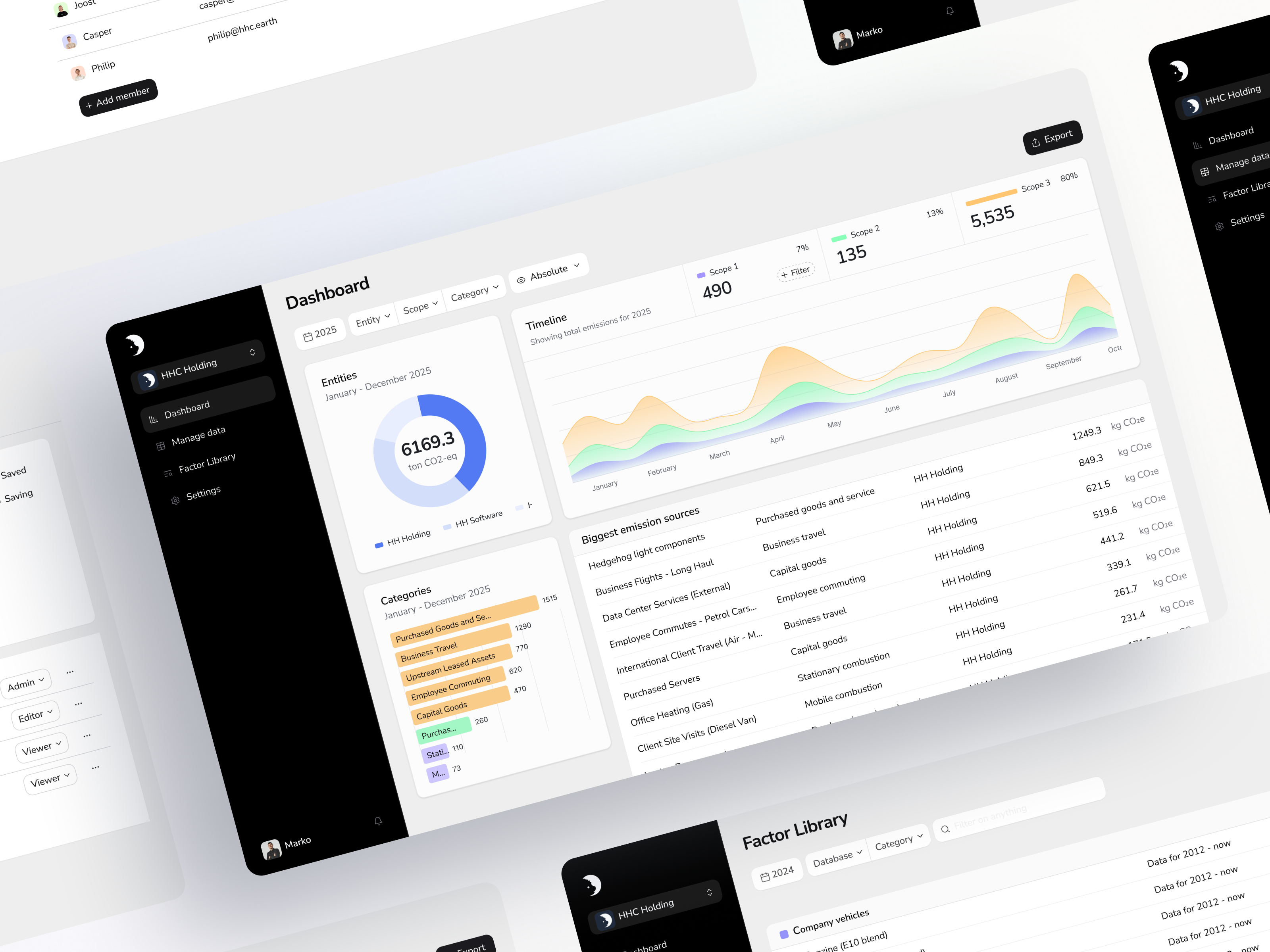
The platform guides you through GHG Protocol setup, data collection planning and inventory building, with an AI assistant for setup and human GHG experts reachable in the product. It carries more than 20,000 spend-based and activity-based factors, supports entity management across locations and sites with roles for data owners, auditors and managers, and works in English, French and Dutch. Named legislation support covers CSRD, SECR and SB253, plus SBTi, B Corp and EcoVadis workflows. Reporting outputs include the GHG Protocol, PPN 006 and the CO2-Prestatieladder. It was rated 4.7 on G2 from nine reviews when we read the profile on 27 August 2026. Free account with no sales call, Pro from EUR 1,200 a year, priced on user seats and business entities.
Three limits to weigh, all from customers on a public page.
Loading the data is the work. A reviewer on G2, small business segment, said in August 2026 that once the data is in it works perfectly and getting it loaded is the challenging part. Budget for that in days of somebody's time, not in licence cost.
It is not a broad ESG suite. A reviewer on G2, mid-market segment, rated us 3.5 out of 5 in June 2026 and said that for a broader ESG data and reporting platform this one is less complete, with no data source management feature and no decarbonisation target monitoring. If your requirement is all of ESG in one system, look wider.
No forecasting yet. A reviewer on G2, small business segment, said in August 2026 that forecasting would be welcome and that we had told them it is on the development list. If scenario modelling is central to your case, ask about it directly.
Product footprints are a service. LCA, EPD, MKI and PCF work is delivered as consultancy. The platform does organisational footprints.
What should you do first?
Write one sentence naming the person who owns the number and the hours a month they get for it. If you cannot write that sentence, no purchase will fix the problem.
Then take one month of energy and fuel data and build a real figure from it. A single month tells you how clean your data is, which is the only unknown that matters at this stage. You can start a free account to do that, or book a call if the request on your desk has a date on it.
Sources: Hedgehog platform, Hedgehog on G2. Verified 27 August 2026.
Facts on this page were last verified on 2026-08-27.

