
In short
- The hard part of group carbon reporting is consolidation, not calculation. Each entity is easy on its own.
- Set the consolidation approach first. The GHG Protocol gives you equity share or control, and control splits into a financial and an operational criterion.
- Intercompany transactions are where a group figure quietly double counts itself.
Multi-entity carbon accounting software is built for groups that have to publish one greenhouse gas figure assembled from several legal entities, sites or country operations. Each entity on its own is an ordinary calculation. The difficulty is everything between them: which entities are inside the boundary, how you avoid counting an intercompany transaction twice, who is allowed to enter data against a subsidiary and who is allowed to change it, and what happens to last year's number when the group buys or sells a company. Start by fixing the consolidation approach in writing, before you look at a single product.
What does a group actually have to solve?
Four problems that a single-entity company never meets, listed in the order they usually surface.
Boundary. Which entities are in, on what basis, and who decided. Dormant companies, minority holdings and joint ventures all need an answer, and the answer needs to survive being asked again next year.
Double counting. Group A sells services to group B, both inside the boundary. Counted naively, that transaction appears in B's scope 3 and in A's scope 1 and 2 and inflates the group total.
Distributed data entry. Fourteen entities means fourteen people who know where their own data is, and none of them works for you.
Change. Acquisitions, disposals and restructures all break comparability with last year, and somebody will ask why the number moved.
None of these is a calculation problem. All of them are consolidation problems, which is why groups often find that a tool which worked beautifully for one company falls apart at five.
Which consolidation approach should you set, and when?
Set it first, before any data is loaded, and write it down.
Start with what the GHG Protocol Corporate Standard actually says, because it is usually described loosely. It defines two approaches, equity share and control, and a company choosing control must then pick between a financial control and an operational control criterion. So you have three options to choose from, but they are not three peers, and the difference matters below.
| Option | What the group counts | Where it bites |
|---|---|---|
| Equity share | A share of each operation proportional to economic interest, which is normally the ownership percentage | Minority holdings pull in data you have no authority to demand |
| Control, financial criterion | 100 percent of operations fully consolidated in the financial accounts | Joint ventures under joint financial control fall back to equity share, so you end up running both methods |
| Control, operational criterion | 100 percent of operations where the group or a subsidiary has full authority to set operating policy | Leased and jointly operated sites need an explicit ruling on who holds that authority |
Two corrections to the version of this that circulates.
The two control criteria usually agree. The standard says that in most cases whether an operation is controlled does not vary with which criterion you use, and names the oil and gas industry as the notable exception, because ownership and operatorship come apart there. Do not expect the choice of criterion to move your number. Expect joint operations to move it.
If you wholly own everything, the choice changes nothing. The standard is explicit that a company that wholly owns all its operations gets the same organisational boundary whichever approach it uses. A group of fourteen fully owned subsidiaries can record the decision in a sentence and move on. The question only earns a meeting when there are joint operations in the structure.
The pragmatic choice for most groups with joint operations is operational control, because it matches the entities you can actually compel to give you data. What matters more than which one you pick is that it is fixed, documented and applied identically at every level: the standard is blunt that consolidated data is only consistent if the whole organisation follows the same consolidation policy. Record the decision, the date and who made it. When an auditor questions the group figure two years later, that record is the answer.
One thing to know before you file that record. On 29 July 2026 the GHG Protocol announced that it is consolidating the Corporate Standard, the Scope 2 Guidance, the Scope 3 Standard and its Actions and Market Instruments workstream with ISO 14064-1 into a single standard, with public consultation planned for the second quarter of 2027 and publication planned for the fourth quarter of 2028. Nothing you report under the current standards is invalidated, and nothing about the decision above changes today. It does mean the method note you write this year should be a document you expect to revisit, rather than one you write once and file.
Where do group numbers stop adding up?
Five places, and four of them are avoidable with a rule set at the start.
Intercompany transactions. The classic. A shared services entity bills the operating companies, and the same emissions land in two places. Decide early whether internal spend is excluded from category 1 of scope 3, purchased goods and services in the GHG Protocol's 2011 Scope 3 Standard, or netted at consolidation, and apply it everywhere.
Shared sites. Two entities in one building with one electricity meter. Somebody has to allocate, and the allocation basis has to be the same next year.
Different reporting periods. A subsidiary on a different financial year is a real problem, not a rounding one. Align, or state it in the method.
Different currencies and countries. Spend-based factors are currency sensitive and electricity factors are country specific. A group that converts everything to one currency before applying factors gets a different, and worse, answer than one that applies local factors first.
Different levels of effort. One subsidiary sends activity data, another sends a spend total. The group report should say which is which rather than presenting a uniform-looking number built on uneven inputs.
Who should be allowed to enter data, and who should be allowed to change it?
Separate those two rights, because at group scale they are different jobs.
You want local data owners who can upload their own entity's figures and cannot touch anybody else's, a small group team that can set method, adjust factors and close a period, read-only access for finance and for whoever assures the number, and a log showing who changed what.
This is also the answer to the biggest hidden cost in group reporting. If the group team collects data by emailing fourteen spreadsheets and re-keying the returns, the work scales linearly with entity count. If entities enter their own data against a fixed template, it does not.
What happens when the group structure changes?
It will, and the tool has to cope with three specific events.
An acquisition. Decide whether to restate the base year, and check the platform can hold both the original and the restated series without deleting one.
A disposal. The more awkward case, because the disposed entity's historical data still belongs in the record.
A restructure with no economic change. Entities merge, numbers move, nothing changed physically. The reported series should not lurch.
Ask a vendor to demonstrate a base year restatement on real data during the trial. It is the most revealing test in group carbon software and the one most rarely run before signing.
What should you test before you buy?
Six things, in an order that will save you a second procurement round.
- Create three entities, load different data types into each, and produce both the individual and the consolidated view.
- Run an intercompany transaction through and see whether the platform helps you avoid counting it twice or leaves it to you.
- Give a colleague data owner access and confirm they cannot see or edit another entity.
- Change an emission factor and see what happens to prior years.
- Export the group figure and one entity figure into a customer template.
- Ask what happens to the price when entity fifteen is added.
If your group is in scope for a specific regime rather than answering customer requests, CSRD support and scope 3 support are where the method work sits.
What does Hedgehog do for groups?
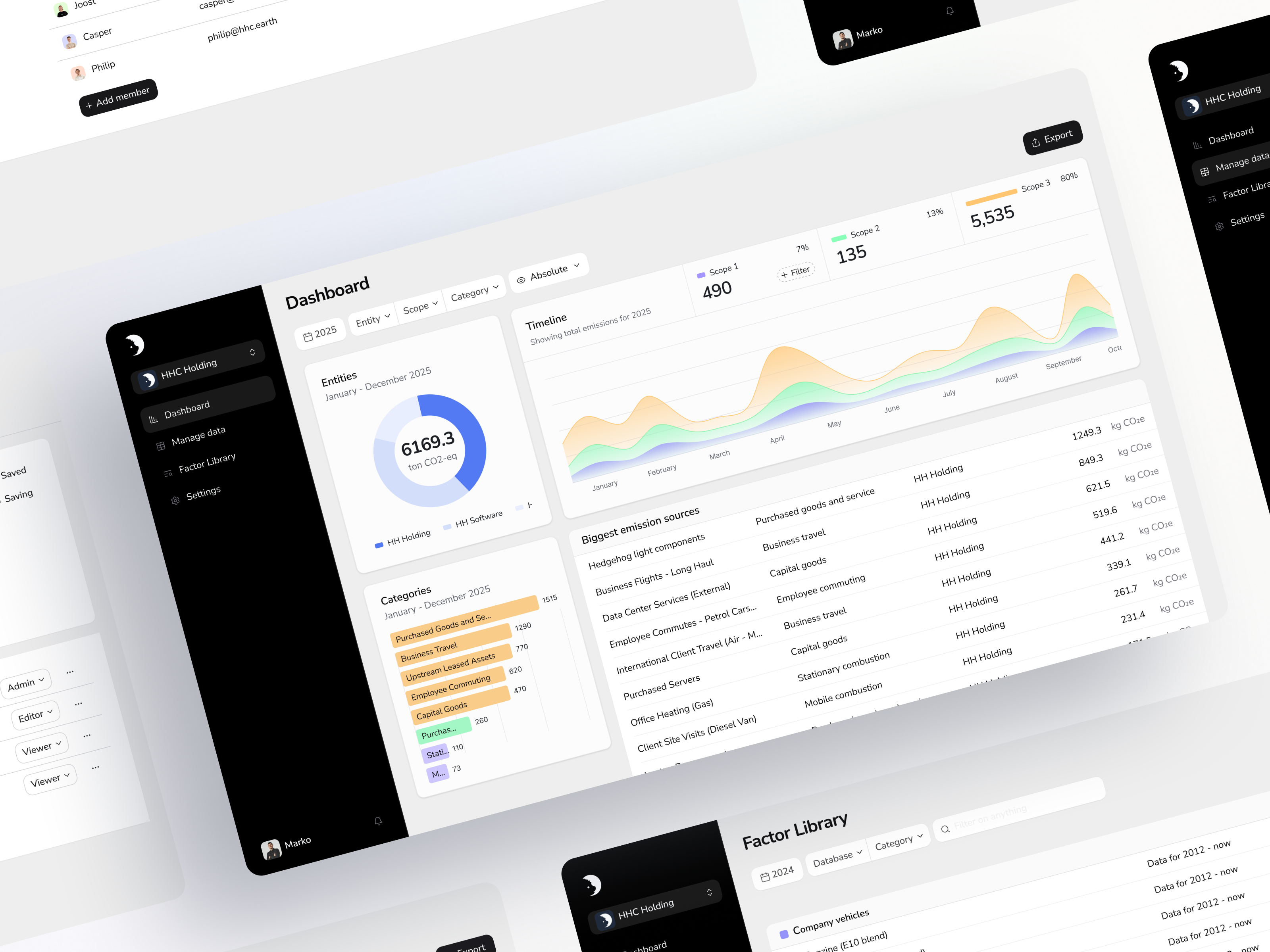
The platform does entity management across locations and sites, with user roles for data owners, auditors and managers, which is the structure that lets a group spread data entry without spreading edit rights. It guides you through GHG Protocol setup and inventory building, and the guide works with you to identify your data sources, data owners and documents, with an AI assistant for setup and human GHG experts reachable in the product. It carries more than 20,000 spend-based and activity-based factors, accepts organisation-specific and supplier-specific data, and works in English, French and Dutch. Reporting outputs include the GHG Protocol, PPN 006 and the CO2-Prestatieladder. Free account with no sales call, Pro from EUR 1,200 a year, built on user seats and business entities.
Three limits that matter more to a group than to a single company, all from customers on a public page.
Few integrations today. A reviewer on G2, mid-market segment, named more integrations with other software as the thing they would change, in June 2026. If your plan depends on pulling data automatically out of fourteen finance systems, test that before you buy rather than after.
Applied conversions are not fully exposed. A reviewer on G2, mid-market segment, said in July 2026 that they wanted to see which conversion factor and which distance calculator had been applied to their inputs. In a group with multiple currencies, that is worth checking against your own case.
Loading the data takes real effort, multiplied by entity count. A reviewer on G2, small business segment, said in August 2026 that once the data is in it works perfectly and getting it in is the challenging part. That cost scales with the number of entities, which is the line groups underestimate most.
Product footprints are a service. LCA, EPD, ECI (MKI in Dutch) and product carbon footprint work is delivered as consultancy. The platform does organisational footprints.
What should you do first?
List your entities and mark each one as reporting, dormant or out of boundary. That list, not a vendor demo, is the real start of a group project, and it usually shortens the count.
Then model your two most awkward entities first, the acquired one and the shared-site one. If a tool handles those, the easy twelve follow. You can start a free account and build one entity end to end, or book a call to walk the consolidation question through against your structure.
Sources: the GHG Protocol Corporate Accounting and Reporting Standard, Revised Edition for the consolidation approaches and the scope definitions, and GHG Protocol's announcement of 29 July 2026 for the consolidation with ISO, both read on 16 September 2026. Hedgehog platform and Hedgehog on G2, read on 27 August 2026. Verified 16 September 2026.
Facts on this page were last verified on 2026-09-16.

