
In short
- The trigger is a funding round or an enterprise deal, and both arrive with someone else's deadline.
- A startup footprint is almost entirely scope 3 purchased services. Scope 1 is often zero, and that is a real answer.
- Buy for the next two years, not the next ten. You will change shape before then.
In a startup the carbon question almost never comes from a regulator. It arrives in one of two places: an investor's diligence pack, or a vendor onboarding questionnaire from the first enterprise customer big enough to have a procurement process. Both come with a deadline you did not set. Carbon accounting software gets you a defensible company footprint in weeks rather than a consultant's quarter, and the honest answer is that most startups need far less of it than they expect.
Why is a startup being asked about emissions?
Two routes, and they feel completely different from the inside.
The enterprise deal. You are in procurement at a large company. Somewhere between the security review and the master services agreement, a supplier sustainability form appears. It is often the last unblocked item, which is why it turns into a fire drill in a week that was already bad.
The funding round. Investors with their own reporting obligations pass them down to portfolio companies. The ask is usually modest at seed and grows with each round, and it arrives with a template that was designed for a much larger business.
Neither is optional in practice, and neither is as large a job as the form suggests. What both actually want is a real number with a stated method, produced by someone who understands it, not a sustainability strategy.
Where does a startup's footprint actually sit?
Almost entirely in scope 3, and specifically in things you buy rather than things you burn.
Most software and services startups have no scope 1 at all. No boilers, no fleet, no on-site combustion. Reporting zero for scope 1 is a correct answer and you should not let a questionnaire talk you out of it.
Scope 2 is small and often not yours either. If you are in a serviced office or coworking space, your electricity sits inside a service charge and has to be apportioned rather than metered. If your team is remote, most of your energy use happens in homes you do not control.
What is left is the real footprint: cloud and software subscriptions, hardware for the team, professional services, travel, and commuting where an office exists. That is a purchase ledger question, and a spend-based first pass over your ledger will get you a credible total in days. Where a customer starts pressing on the detail behind those categories, that is scope 3 territory.
The consequence is counterintuitive and worth saying plainly. For a startup, the expensive, precise, meter-level part of carbon accounting is the part that barely matters, and the cheap, approximate part is where nearly all the tonnes are.
What does an investor want, and what does an enterprise buyer want?
Different things, and buying for one when you need the other is the usual mistake.
| Aspect | Investor diligence | Enterprise vendor onboarding |
|---|---|---|
| What they want | A number, a method, a direction of travel | A completed form by a fixed date |
| Depth expected | Grows each round | Fixed, and often shallow |
| Timing | Predictable, tied to the round | Unpredictable, tied to a deal |
| What fails you | No method behind the number | Missing the deadline |
| What to build | A repeatable annual footprint | An exportable footprint plus fast turnaround |
The overlap is large enough that one footprint serves both, provided you can get the numbers out in someone else's format quickly. That export flexibility is worth more to a startup than any feature on a vendor's comparison page.
Is it too early to bother?
Sometimes, and a vendor telling you otherwise is selling.
If nobody has asked, you have no enterprise customers in procurement, and your next round is a year out, this can wait. Reading how to start carbon accounting from scratch and keeping your purchase categories tidy is enough preparation.
It stops being too early at three specific moments.
A term sheet with an ESG annex. Now it is on the round's critical path.
A first enterprise logo in procurement. Now it is on the deal's critical path.
Headcount growth that adds an office and travel. Now the number is large enough that a rough estimate stops being credible.
The reason to act at the first sign rather than the third is not virtue, it is scheduling. Every one of these arrives with someone else's deadline attached, and a footprint you already have is a form you can fill in an afternoon.
What should a startup test before buying?
Five questions, weighted for a company that will look different in eighteen months.
Can it produce a first number from a purchase ledger export? That is the fastest route to a credible startup footprint. Test it with your real export, not a sample.
How does it handle a remote team and a shared office? You need to be able to record apportioned and estimated figures as estimates, with the basis written down.
Can you export into an arbitrary customer template? The enterprise form will be a spreadsheet nobody has seen before. This is the feature that saves your week.
What does it cost as you grow? Most platforms price per user seat and per business entity. Ask what the curve looks like at three times your current headcount and at two entities instead of one.
What integrations exist today, not on the roadmap? Startups run on APIs and expect connectors. Ask what exists now.
What does Hedgehog do for startups?
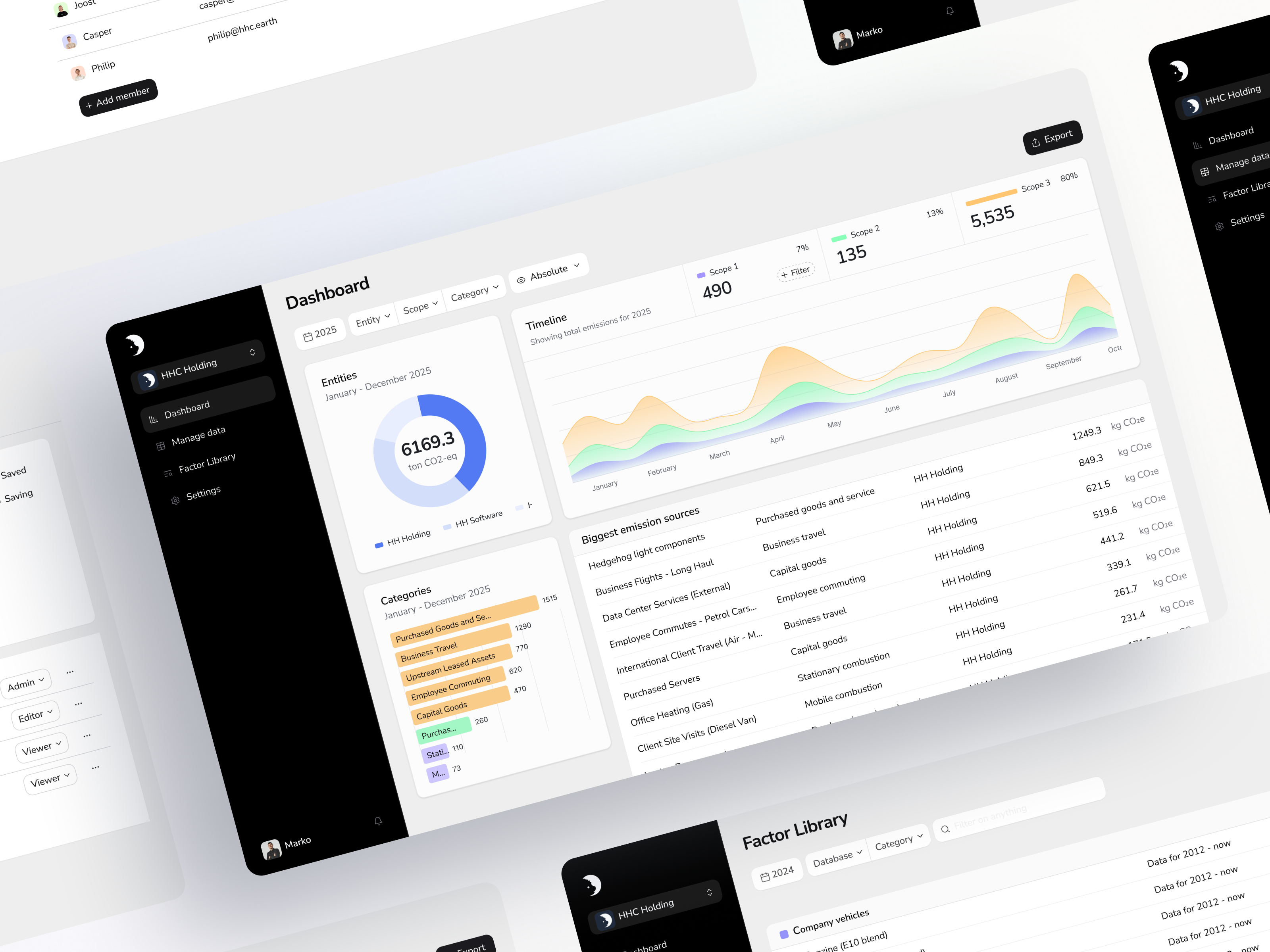
The platform guides you through GHG Protocol setup, a data collection plan and inventory building with an AI guide, with human GHG experts reachable in the product. It holds over 20,000 spend-based and activity-based factors, which is exactly what a spend-based first pass over a startup ledger needs, and it lets you add supplier-specific data later when a cloud provider or a hardware vendor gives you a real figure. Entity management covers multiple locations and entities with roles for data owners, auditors and managers, which matters when the first subsidiary appears. It supports SBTi, B Corp and EcoVadis workflows, which covers most of what investors and procurement teams point at.
A free account needs no sales call, which is the right way to test this when you have no budget line for it yet. Pro from EUR 1,200 per year.
Two limits, both worth knowing before a startup buys.
Integrations with other software are a work in progress. A Mid-Market reviewer wrote on G2 in June 2026 that they would like to see more integrations with other software in the future. If your expectation is an automated connector into your accounting or cloud billing, ask us directly what exists today rather than assume.
Loading the data takes effort. A Small-Business reviewer said on G2 in August 2026 that once the data is in it works perfectly, and getting it in is the challenging part. For a startup with a short ledger that is days rather than months, but it is your days.
To be explicit about scope: the platform does organisational footprints. Product footprints, meaning LCA, EPD, ECI (MKI in Dutch) and PCF, are delivered as a service. A hardware startup asked for a per-product figure by a customer is asking for the second thing, not the first.
What should you do first?
Export twelve months of your purchase ledger and your travel spend. That is most of your footprint sitting in two files you already have.
Then decide the boundary once: which entities, which offices, whether remote working is in or out. Write it in three sentences and keep it. Every future questionnaire will ask, and having a stable answer is what makes your second year comparable to your first.
You can start a free account and get to a first number before the deal or the round forces it, or talk to us about science based targets if an investor has already asked for a commitment rather than a measurement.
Sources: GHG Protocol Corporate Standard, Hedgehog platform, Hedgehog on G2. Verified 27 August 2026.
Facts on this page were last verified on 2026-09-17.

