
In short
- You are usually paying twice for the same data collection, not for expertise.
- Keep the consultant for boundary, method and edge cases. Take back the routine.
- Ask for your working files. If the deliverable is only a PDF, you own nothing.
What has gone wrong is usually not the price. It is that you are paying project rates for a routine. The first footprint is genuinely a project: a boundary to define, a method to choose, data sources to find. The second one is mostly the same data collection done again, and consultancy day rates are a poor way to buy repetition. This week, ask your consultant for the working files behind the deliverable and find out what proportion of the fee was data gathering rather than judgement. What stops it recurring is moving the routine in-house and keeping the consultant for the parts that need a specialist.
We sell both software and consultancy, which means we have no reason to pretend either one is always the answer. Here is the split as we actually see it.
Why does year two cost almost as much as year one?
Because most consulting engagements rebuild rather than update.
The expensive part of a footprint is not the calculation. It is chasing twelve months of invoices, meter readings, fleet records and travel exports from people who have other jobs, then normalising all of it into consistent units. In a project engagement, that work happens inside the consultant's hours, in the consultant's spreadsheets, and it leaves with them.
Twelve months later nothing about your data is easier. The mapping decisions, the assumptions, the supplier list and the unit conversions are in a file you may not have. So the second engagement starts close to where the first one did, and the quote reflects it.
That is the mechanism. It is not overcharging, it is the wrong instrument for an annual obligation.
What are you actually paying for?
Split the invoice into three buckets, because they have very different values.
Judgement. Organisational boundary, consolidation approach, base year selection, which scope 3 categories are material, how to treat a leased fleet. This is genuine expertise and it is worth a day rate. It is also mostly a one-off, revisited when the business changes.
Be precise about which of those is actually a judgement, because vendors and consultants both blur it. The GHG Protocol Corporate Standard gives you two consolidation approaches, equity share and control, and if you take control you then choose between a financial and an operational criterion. That choice is the judgement, and it is worth paying for once. What follows from it is not: under financial control, a joint venture in which the partners share financial control is accounted for on the equity share basis, and the standard says so in terms. If a scope of work prices the consequences of a decision you have already taken, you are being sold arithmetic at day rates.
Production. Collecting data, entering it, applying factors, building the report. This is repeatable, procedural work. It is the largest share of most engagements and the worst value at consultancy rates.
Assurance readiness. Making the inventory traceable enough that somebody else can sign it. Partly judgement, partly production.
If you cannot see that split on your invoice, ask for it. The answer tells you exactly how much of your annual spend is avoidable.
Where is a consultant genuinely worth the fee?
Five situations, and they are all judgement rather than production.
The first boundary. Getting the organisational boundary and consolidation approach wrong is expensive to unwind two years later. Pay for this once, properly.
A material scope 3 category you cannot model. Purchased goods and services in a complex supply chain, or use-phase emissions of a product, are where a specialist earns their money. Our scope 3 consulting work exists because this genuinely is hard.
Product footprints. An LCA, an EPD, an ECI (MKI in Dutch) or a product carbon footprint is a study with its own standard and its own reviewer. No annual subscription covers it, ours included. That work is a service, and it is a per-product cost rather than a per-year one.
A regulated first submission. The first time a figure goes to a regulator, a certification body or an assurance provider, having someone who has done it before is cheap insurance.
A restructure. An acquisition, a divestment or a change of reporting entity breaks comparability, and fixing that is a judgement problem.
Where is a consultant the wrong tool?
When the task is the same task as last year.
Annual data collection, entering activity data, applying an updated factor set, refreshing a dashboard, producing the same report in the same format for the same audience: none of that needs a specialist once the method is settled. It needs a system and a named owner.
The tell is simple. If this year's engagement scope reads almost identically to last year's, you are buying repetition.
What does the hybrid actually look like?
This is the arrangement most companies land on, and it is worth being explicit about who does what.
| Task | Year one | Year two onward |
|---|---|---|
| Boundary and consolidation | Consultant | Reviewed internally, consultant if the group changes |
| Method and factor choices | Consultant | Locked, documented, reused |
| Data collection | Consultant or internal | Internal, in a platform |
| Data entry and calculation | Consultant | Internal, in a platform |
| Report production | Consultant | Internal export |
| Edge cases and new categories | Consultant | Consultant, by the half day |
| Assurance liaison | Consultant | Internal, consultant on call |
The consultancy line does not go to zero. It goes from a project to a handful of days, and it moves from doing the work to checking it. That is the change that makes an annual footprint affordable.
What do you do this week?
Three things, in this order.
Ask for your working files. Not the report. The spreadsheets, the factor mapping, the assumptions log and the source list. If the contract only ever produced a PDF, you have been renting your own data, and that is the first thing to change in the next engagement.
Ask for the hours split. How many hours went into judgement, and how many into collecting and typing? Request it as a number, not a description.
Build one category yourself. Take the messiest one and rebuild it end to end, in a tool, from source documents. It will take longer than you expect and it will tell you honestly whether the internal capacity exists. Our guide to building a footprint from scratch covers the sequence.
What stops it happening again?
Owning the inventory rather than the report.
The structural fix is that your data, your mappings and your assumptions live in a system you control, so year two starts from year one instead of from nothing. That is what turns a repeating project into a repeating routine, and it is the only durable way this gets cheaper.
Two honest caveats before you assume software solves it.
The first load is real work. A Small-Business reviewer said so on G2 in August 2026: it takes a lot of manual labour to load the data, and once the data is there it works perfectly, but getting it loaded is the challenging part. Moving in-house shifts effort from an invoice to your calendar. Make that trade knowingly.
Somebody has to own it. A platform with no named owner produces the same crisis a year later, just without a consultant to call.
What does Hedgehog do here?
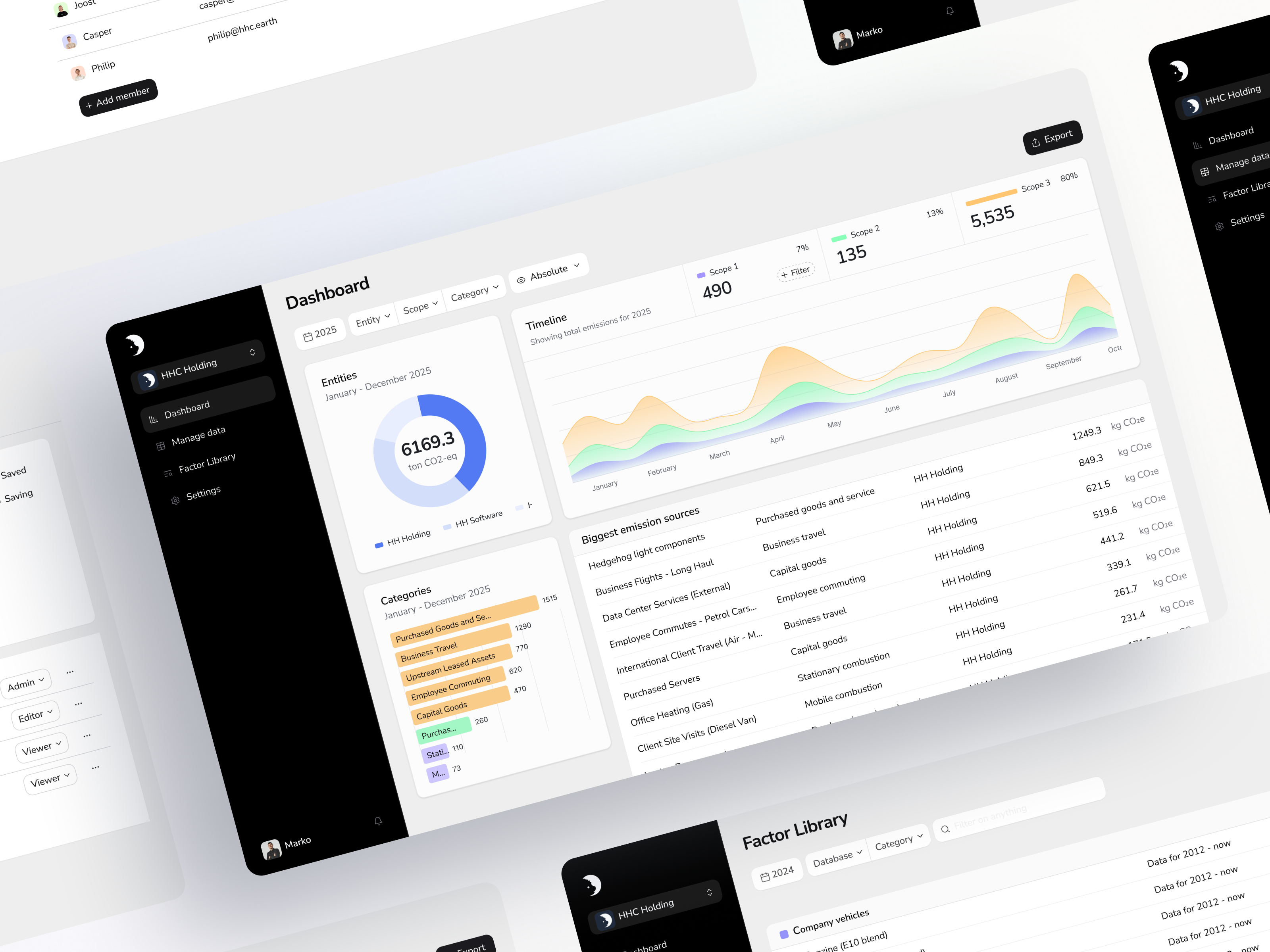
Both halves, deliberately. The platform handles the routine: GHG protocol setup, inventory building, data upload and reporting, guided by an AI assistant, with entity management and roles for data owners, auditors and managers so the collection burden spreads across the people who hold the data. Free account, no sales call, Pro from EUR 1,200 a year.
The judgement work stays consultancy, whether that is a footprint engagement, scope 3 modelling or a product study. We would rather sell you two days of the right thing than twenty of the wrong one.
If you have a quote in hand and want a second read on which parts of it are genuinely specialist, book a call.
Sources: Hedgehog platform and Hedgehog on G2, both read on 27 August 2026. Consolidation approaches, the two control criteria and the joint venture rule from the GHG Protocol Corporate Accounting and Reporting Standard, Revised Edition, chapter 3. Page verified 17 September 2026.
Facts on this page were last verified on 2026-09-17.

