
In short
- MVOI is a policy agenda and a voluntary manifest. Nobody is obliged to sign it and nobody is obliged to follow it.
- If you have signed, what applies to you is the ambition level and the action plan you wrote yourself, evaluated annually.
- For a supplier, MVOI never applies directly. It reaches you only as whatever a specific buyer chose to write into a specific tender.
MVOI applies to you if you signed it. That is the whole test. Maatschappelijk Verantwoord Opdrachtgeven en Inkopen, socially responsible commissioning and procurement, is a national policy agenda plus a voluntary manifest that organisations choose to sign. It is not a rule, it has no scope threshold and no compliance date, and PIANOo says plainly that signatories set their own bar. If you have not signed, nothing in MVOI binds you. If you have, what binds you is the ambition you wrote down yourself. If you are a supplier, it never applies to you directly at all.
What is MVOI, stated once and properly?
It is how the Dutch state organises the ambition that public money should buy socially useful outcomes. The current instrument is the Agenda MVOI 2026 to 2030, and alongside it sits the Manifest MVOI, which individual public organisations sign.
PIANOo, the Dutch public procurement expertise centre, publishes the criteria documents, the guidance and the news about it. What PIANOo does not publish is a list of things a public buyer must do, because there is no such list. The agenda sets direction. The manifest gathers organisations who want to move in it. Neither creates a duty enforceable against anyone.
What is the test, stated exactly?
One question with three possible answers.
Have you signed the Manifest MVOI?
If yes, MVOI applies to you as a commitment you made. The content of that commitment is the ambition level and the concrete objectives you set yourself, because PIANOo states the position in those words: "Hierbij bepalen overheden zelf hun ambitieniveau en concrete doelstellingen." Governments determine their own ambition level and concrete objectives.
If no, and you are a Dutch public organisation, MVOI is available to you and does not oblige you. You may use the MVI-criteria per productgroep, the criteria documents PIANOo publishes for each product group. You may ignore them. Both are compliant, because there is nothing to comply with.
If you are a supplier rather than a public buyer, the question does not arise. You cannot sign the manifest and it does not describe your obligations.
Does it apply differently to different kinds of organisation?
| Who you are | Does MVOI apply? | What actually governs you |
|---|---|---|
| Dutch public organisation that signed the manifest | Yes, as your own commitment | Your own MVOI action plan and ambition level, evaluated annually |
| Dutch public organisation that has not signed | No | Ordinary procurement law. The MVI-criteria are available as tools |
| Education institution that is a contracting authority | No, MVOI is still voluntary | The Aanbestedingswet duty to tender above the EU thresholds, which attaches no environmental criterion |
| Supplier bidding to a Dutch public buyer | No, not directly | The award and suitability criteria written in that specific tender |
| Supplier who has never bid publicly | No | Nothing. MVOI has no supply chain reach of its own |
What does signing actually commit you to?
Writing something down and then looking at it once a year.
Signatories draw up an MVOI action plan and evaluate it annually. The plan states what the organisation intends to do with its purchasing power, at a level of ambition the organisation chose. Several education institutions have published such plans, and those documents are frequently quoted back at suppliers as though they were regulations. They are not. A published action plan is that organisation's own commitment, and the only body that can hold it to that plan is the organisation itself and whoever reads its annual evaluation.
There is no audit, no certificate, no register of non-compliance and no sanction. That is not a criticism of the instrument. It is what a manifest is.
What if you are in, because you signed?
Then treat the action plan as a management document rather than a compliance one, and write it at a level you will still recognise in three years.
Two practical points follow. First, the ambition level is yours, so it should be set against what your procurement pipeline can actually deliver rather than against what a peer institution published. Second, the annual evaluation is the part that decays. A plan with no evidence behind it becomes an embarrassment at exactly the moment somebody quotes it in a tender question.
What if you are out?
Then you are out, and you should say so when asked rather than hedging.
Being outside MVOI does not mean being outside every dated rule. Check separately for the ones that are binding. The Regeling bevordering schone wegvoertuigen sets minimum clean-vehicle shares in tenders for vehicles and certain transport services, it applies to aanbestedende diensten and PIANOo names hoger onderwijs among them, and reference period two runs from 1 January 2026 to 31 December 2030. If you tender for vehicles, that one is real regardless of your view of MVOI. If you employ 100 or more people in the Netherlands, WPM is real too, and it is a reporting duty rather than a procurement one.
How is MVOI different from an instrument that actually bites?
By having no mechanism. The distinction is worth holding because the Dutch market contains both kinds of thing and they look alike from a distance.
An instrument that bites has a named addressee, a dated obligation and a consequence. The Regeling bevordering schone wegvoertuigen is the clearest Dutch example. It names the aanbestedende diensten it binds, it fixes a reference period, it puts a percentage on each vehicle category, and from 1 January 2026 it says which vehicles count toward that percentage and which no longer do. Every part of that is written down and every part has a number.
MVOI has none of those parts. It has a direction of travel and a signature. When a buyer wants MVOI to have teeth in a particular contract, the buyer has to write a criterion into that contract, at which point what binds the bidder is the criterion and not MVOI.
What should a supplier do about it in practice?
Watch the tender documents, not the policy.
If a Dutch public buyer intends to score sustainability, it will appear as a suitability requirement, an award criterion or a contract condition in a specific procurement, with its own weighting. That is the thing to answer, and it is the thing to price. A buyer's MVOI action plan is useful as a signal about what that buyer may ask for next year. It is not a specification and it cannot be bid against.
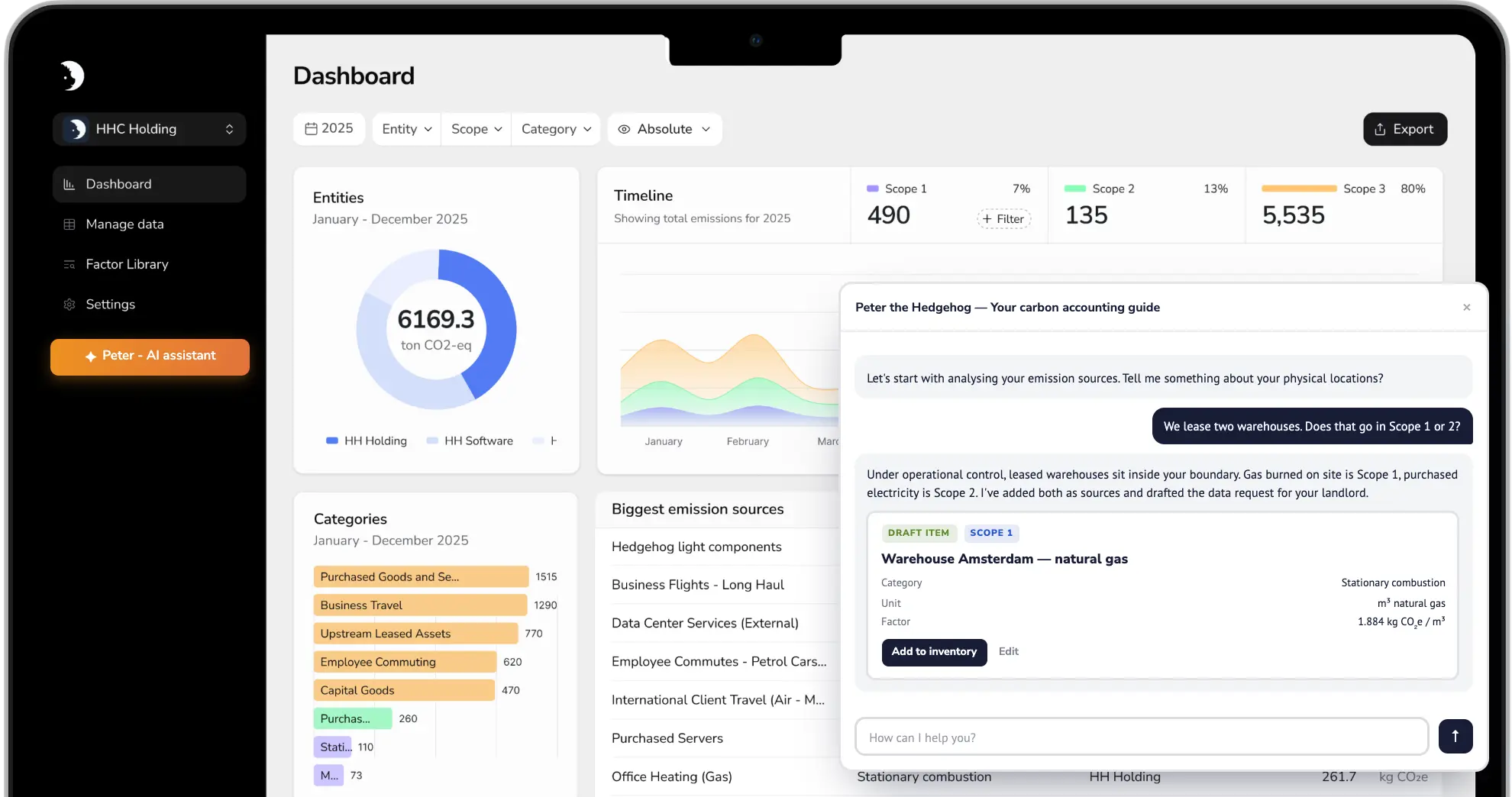
Where the pattern across your pipeline is that buyers keep asking for emissions data, the answer is an organisational inventory you can reuse rather than a bespoke response each time. The Hedgehog platform reports 5,000+ users and holds over 20,000 spend-based and activity-based factors, so a first inventory can start from finance data. The limitation to price in before you commit: a mid-market reviewer on G2 in June 2026 said they want more integrations with other software in future, and we have few today, so plan for exports and manual loads rather than a pipeline from your ERP. If your constraint is upstream supplier data rather than your own, that is scope 3 consulting work, and our note on value chain and ESG questionnaire questions covers what customers typically ask and what you can reasonably decline.
Sources: PIANOo, beleid en uitvoering MVI; PIANOo, Manifest MVOI; PIANOo, Regeling bevordering schone wegvoertuigen (Rbsw); Aanbestedingswet 2012; the Besluit WPM (Stb. 2023, 472); Hedgehog platform; Hedgehog on G2. MVOI and Rbsw facts verified 17 September 2026; other facts verified 28 August 2026.
Facts on this page were last verified on 2026-09-17.