
In short
- The order matters more than the effort. Settle the boundary before anyone touches a spreadsheet.
- Every step should leave an artefact behind, because next year's inventory starts from those artefacts.
- An inventory is finished when a stranger could reproduce it, not when the total appears.
A greenhouse gas inventory is a documented statement of the emissions attributable to a defined organisation over a defined period, built to the GHG Protocol so it can be repeated and defended. You need one if a customer, a tender, a lender, a certification scheme or a regulator has asked for a number. The build has a fixed order, and most of the pain in a first attempt comes from working out of sequence: collecting records before the boundary is agreed, or calculating before anyone has decided which parts of the business count.
This is the sequence and what each step leaves behind.
Why does the boundary have to be settled first?
Because every later step inherits it. The boundary decides which invoices are relevant, which colleagues you involve, and whether the total means anything. Two decisions sit here.
The organisational boundary. How you consolidate the entities you have an interest in. The GHG Protocol offers three approaches: equity share, financial control and operational control. Pick one, apply it to every entity, and write down which you chose. Most companies choose operational control because it lines up with who holds the energy contracts and can act on the result. What you must not do is choose per entity to suit the answer.
The operational boundary. Which activities inside those entities you count, and in particular which of the fifteen scope 3 categories are included. Scope 1 and scope 2 are not really a choice. Scope 3 is, and it has to be justified rather than assumed.
The scopes and the basic arithmetic are covered in our beginner's guide to building a footprint from scratch. Everything below assumes you have that and are now running the project.
What is the right order of operations?
Nine steps, each settling a decision and producing something you keep.
| Step | Decision it settles | What it leaves behind |
|---|---|---|
| 1. Mandate | Why you are doing this, and who signs it off | A one page statement of purpose |
| 2. Organisational boundary | Which entities consolidate, on which basis | Consolidation approach and entity list |
| 3. Reporting period and base year | Which twelve months you count | A period definition, aligned to the financial year |
| 4. Category register | Which scope 3 categories are in, and why | Inclusion and exclusion list with reasons |
| 5. Data collection plan | Who supplies what, in which format, by when | The plan, with named owners |
| 6. Collection | The actual records | Evidence files, one per data point |
| 7. Calculation | Which factor applies to which line | A calculation record per line |
| 8. Consolidation and review | Roll up, reconcile, explain outliers | A variance note |
| 9. Documentation and sign-off | What a reader needs to reproduce it | Inventory management plan, plus approval |
The temptation is to start at step six because it feels like progress. Teams that do usually rework it once the boundary lands. Steps one to four are decisions, step five is a document, steps six and seven are the bulk of the labour, and steps eight and nine turn a number into an inventory. The last two are the most often skipped.
How do you decide which scope 3 categories are in?
Run a screening pass before you commit to any of them. The purpose is not a good number. It is to find where the mass is, so the collection effort goes to the right place. The practical route is a full year of spend by ledger account, mapped to categories, multiplied by sector average factors. That gives you a rough share per category in a day or two.
Then apply relevance criteria. A category is in if it is large, if you can influence it, if it carries commercial or regulatory risk, if stakeholders ask about it specifically, if it covers an activity you outsourced, or if sector guidance expects it in your industry. If none of those hold it is out, and the reason goes in the register.
Two rules make this survive contact with an auditor. Exclusions are stated, not silent. And the register carries forward, because next year the question will be why category nine appeared when it was not there before. If value chain emissions dominate your picture, scope 3 work deserves proper scoping rather than one screening pass.
What turns a calculated number into a finished inventory?
Reproducibility. The test is whether somebody who was not involved could take your documentation and arrive at the same total. Four things carry that weight.
A calculation record per line. Which activity figure, which factor, which source, which version of it, and who entered it. This is what makes a question answerable once the person who did the work has moved on.
An inventory management plan. The written description of the boundary, methods, data sources, estimates and responsibilities. It is the most useful artefact you will produce, because year two is a refresh of it rather than a rebuild.
A recalculation policy. Written before you need it: what kind of change forces a restatement of a prior year, and what threshold makes a change significant. Deciding this in advance stops it becoming a negotiation later.
An approval. Somebody senior signs that this is the company's figure. Without it, you have a spreadsheet a colleague made.
Where do first inventories most often go wrong?
Four failure modes, in rough order of cost.
The boundary moved during the build. An entity was added in month three, so half the data was collected against a different scope. Freeze it in writing and treat a change as a formal decision.
The period was never actually defined. Energy pulled on a calendar year, travel on a financial year, waste on whatever the contractor's report covered. Every input covers the same twelve months, and where it cannot, the adjustment is documented.
Scope 2 was calculated without stating the method. Location-based and market-based give different answers for the same electricity, and an unlabelled figure is not usable in a report.
Nobody wrote anything down. The number exists, the reasoning does not, and year two starts from nothing. This one costs the most, because it recurs annually.
What does Hedgehog do across these steps, and what does it not?
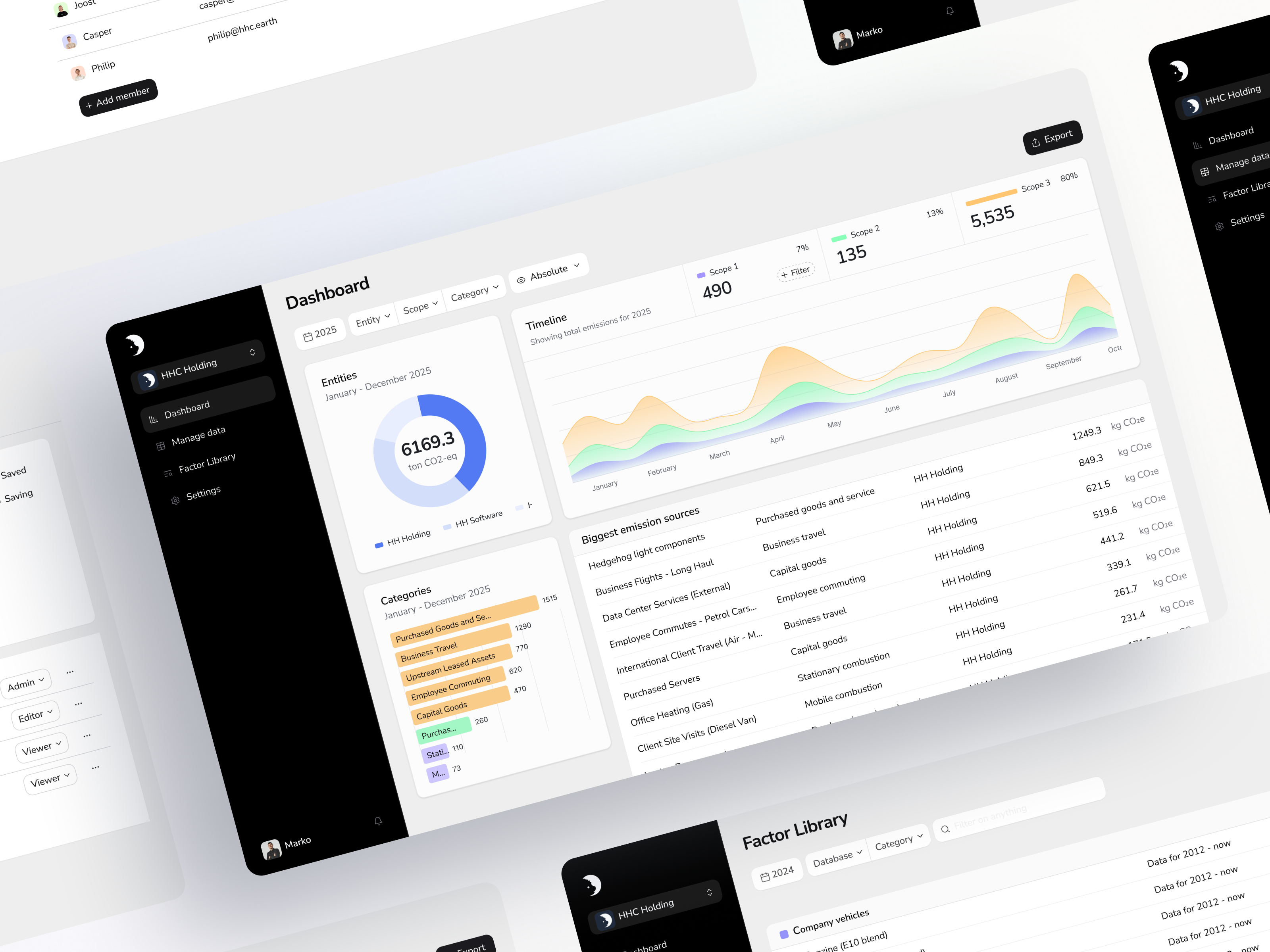
The platform is built around this sequence. An AI guide takes you through GHG Protocol setup, inventory building, data upload and reporting, and helps identify your data sources, data owners and documents, which is the raw material of step five. Human GHG experts are reachable in-app when a boundary question needs a person.
The factor library carries more than 20,000 spend-based and activity-based factors, so a screening pass and a refined calculation live in the same place, and you can add your own organisation-specific or supplier-specific data. Entity management across locations and sites, with roles for data owners, auditors and managers, is what makes step six work across a group rather than through one inbox. Reporting outputs cover the GHG Protocol, PPN 006 and the CO2-Prestatieladder. A free account needs no sales call, and Pro starts at EUR 1,200 a year.
Two honest limits.
Step six is still manual work. A Small Business customer wrote on G2 in August 2026 that it requires a lot of manual labour to load data and they would like that process to be easier, while everything works perfectly once the data is there. That is the line item people underestimate.
We stop at the inventory, not at the target. A Mid-Market customer rated us 3.5 out of 5 on G2 in June 2026 and noted there is no decarbonisation target monitoring feature. If your mandate at step one is a target trajectory rather than a measured baseline, plan for science-based target work alongside the inventory.
One boundary worth stating plainly: the platform builds organisational footprints. Product footprints, meaning LCA, EPD, MKI and PCF, we deliver as a service rather than a feature.
What should you do first?
Write the mandate and the boundary on one page and get somebody senior to agree to it, before anyone opens a spreadsheet. It takes an afternoon and removes the most expensive category of rework. Then run the screening pass, because it tells you where the next three months of effort should go. Both fit on a free account, and the screening result is usually enough to size the project honestly.
Sources: GHG Protocol Corporate Standard and Corporate Value Chain (Scope 3) Standard, Hedgehog platform, Hedgehog on G2. Verified 27 August 2026.
Facts on this page were last verified on 2026-08-27.

