
In short
- Ask for the raw export, never a summary somebody typed out for you.
- Every row needs a fallback estimate and the date you will apply it, agreed in advance.
- Assign owners by role, not by name, or the plan dies with the next resignation.
A data collection plan is a register with one row per data point you need, and six columns filled in for each: the named owner, the system the record actually lives in, the exact format you want it in, the period it must cover, the date you need it, and the fallback if it does not arrive. It is written by whoever is accountable for the emissions figure, and it is the artefact that decides whether collection takes three weeks or three months. Write it before you send a single email.
Who are the data owners, and how do you find them?
Not the sustainability team. Almost none of the data sits with the person building the inventory, which is the structural problem the plan exists to solve. The reliable way to find an owner is to follow the invoice: whoever approves payment for a thing holds the record of it. Ask finance for a supplier list and you will find your owners faster than by asking around.
| Data point | Where it actually lives | Usual owner | What to ask for |
|---|---|---|---|
| Electricity and gas | Supplier portal, invoices | Facilities or office manager | Twelve months of kWh by meter, exported |
| Vehicle fuel | Fuel card statements | Fleet or operations | Litres by card, not the euro total |
| Business travel | Travel agent or expense system | Finance, or the EA who books | Trip level report with origin, destination, mode |
| Commuting | Nowhere | HR | Headcount by site, plus a short survey |
| Waste | Contractor reports | Site or facilities manager | Tonnes by stream and treatment route |
| Purchased goods and services | General ledger | Finance | Full year by account code, with supplier names |
| Freight | Carrier invoices, 3PL portal | Logistics | Weight and distance per shipment or per lane |
| Refrigerants | Maintenance contracts | Engineering or facilities | Kilograms topped up, by gas type, per unit |
Two rows in that table deserve a second look. Commuting has no owner and no system, which is why it is late in every project; decide early whether you are surveying staff or estimating from headcount, because the survey has a lead time and the estimate does not. Purchased goods and services is category 1 of scope 3 in the GHG Protocol's 2011 Scope 3 Standard, and in most organisations it is the single largest line in the inventory. It is also the one that arrives as a ledger export rather than as a measurement, so budget more time for cleaning it than for collecting it.
What exactly should you ask each owner for?
Six things, and being specific about all six is the difference between one exchange and five.
The raw export, not a summary. A total typed into an email cannot be checked, split by site, or reused next year. Ask for the file the system produces.
The physical unit where one exists. Litres, kilowatt hours, kilograms, kilometres. Money is a fallback, not a preference, and asking up front avoids a conversion you later have to explain.
Explicit start and end dates. Not "last year". Systems default to rolling twelve months, calendar years and contract years, and three inputs on three clocks will not reconcile.
A coverage statement. Which sites, entities or cost centres the file covers, and which it does not. That one line prevents the most common silent error in a first inventory, a national figure quietly missing one depot.
The source file itself, attached. Keep it. When somebody questions a number in eighteen months, the export is the answer.
A named person who can answer a follow-up. Preferably not the person forwarding it.
Put those six as a standing paragraph at the top of every request. People answer specific asks and ignore vague ones.
What cadence should the plan run on?
Match your financial close, then go more often than feels necessary.
Annual is the minimum and the worst option: twelve months of memory loss, a missing quarter nobody can reconstruct, and a colleague who left in March.
Quarterly is the sweet spot for most organisations. Errors surface while the underlying records are still fresh, and the annual close becomes a roll-up instead of an excavation.
Monthly is worth it only for the few data points that are genuinely automatic, typically metered energy pulled from a portal.
Write the cadence per row, not for the whole plan. Metered energy can be monthly while a commuting survey is annual. Then set every owner deadline at least two weeks before the date you need it, and tell them the real deadline is theirs. That buffer absorbs the one file that arrives in the wrong format.
What do you do when somebody does not reply?
Assume it and design for it. On any plan with more than ten owners, some rows go quiet. Three mechanisms, agreed with your sponsor before you start.
A published escalation ladder. Reminder at the deadline, a second three working days later, then the sponsor's name on the third message. Publishing it at the start makes escalation procedural rather than personal.
A default estimate clause. For every row, write in advance what you will use if nothing arrives, and when you will apply it. "If waste tonnage is not supplied by 14 February, we will estimate it from headcount and a published average, attributed to this site." Circulate that with the plan. Nothing produces a data file faster than a colleague reading the assumption that will be published in their name.
A materiality filter. Not every silent row deserves escalation. If a data point is a fraction of a percent of the total, estimate it, log it, move on. Save the political capital for rows that move the number, usually purchased goods and services, energy and freight. Where the value chain dominates, that prioritisation is the whole game and scope 3 support is worth budgeting for.
How do you write it so it survives handover?
Four habits, all cheap.
Own by role, not by name. "Facilities manager, Rotterdam" rather than a person. Names change every year, roles rarely do.
Version the plan and date it. The plan is evidence of method, so a reviewer or auditor will ask which version produced which year.
Keep a change log. One line whenever a source, an owner or a format changes. Next year that log answers why a figure moved.
Store it with the inventory, not in your inbox. The plan and the evidence belong where the numbers are, or the next person inherits half a system. The wider sequence around it is in our guide to building a footprint from scratch.
What does a platform change about this?
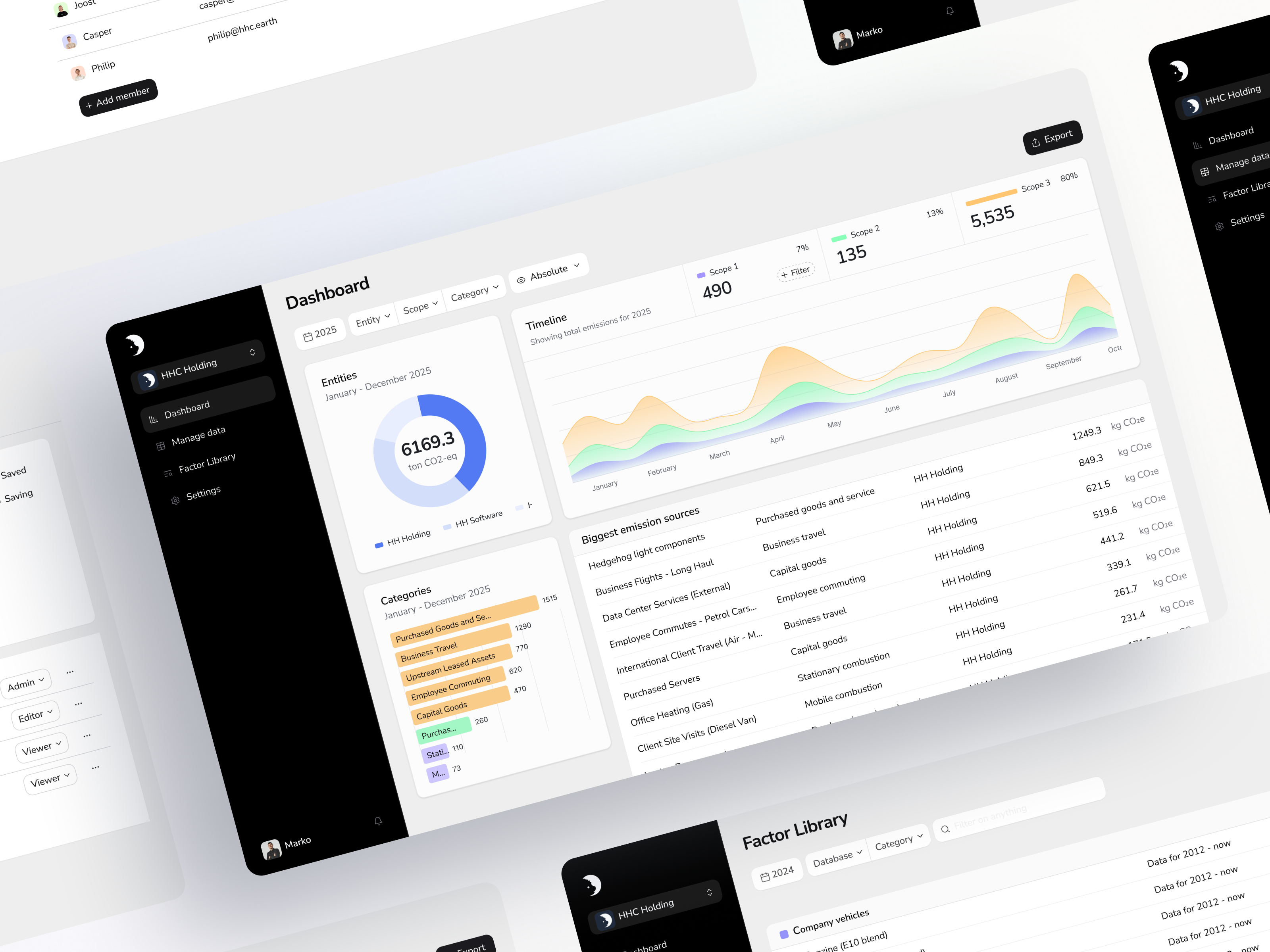
It changes who holds the pen and where the evidence lands. The Hedgehog platform has an AI guide you chat with to identify your data sources, data owners and documents, which is the first three columns of the register above, and human GHG experts are reachable in-app when a row is genuinely ambiguous. The other three columns, format, period and fallback, are yours to decide whatever tool you use. You can invite colleagues, consultants and auditors as data owners, auditors or managers, so a site manager uploads their own file against their own row instead of emailing it to one overloaded person. Entity management across locations and sites keeps those rows separated. The free account needs no sales call, and Pro starts at EUR 1,200 a year.
Two limits worth knowing before you plan around it.
The uploading is still human work. On G2 in August 2026, a Small Business customer said getting the data loaded is the challenging part, even though everything works perfectly once it is there. A collection plan reduces that work by removing rework and chasing. It does not remove it.
Do not assume the source systems will feed it. A Mid-Market customer on G2 in June 2026 named more integrations with other software as the one thing they wanted. If your plan says a row arrives automatically from an ERP or a travel system, verify that specific route before you write it down.
One boundary: this is organisational footprint data. Bills of materials and process data for a product footprint are a different exercise, delivered as LCA consulting.
What should you do first?
Open a spreadsheet and list every data point you can think of, then put a name against each one and leave the rest of the columns blank. The rows with no name are your real project risk, and they are usually commuting, waste and anything owned by a subcontractor.
Take it to your sponsor, agree the escalation ladder and the default estimates, then fill in the format and deadline columns. You can build the same register inside a free account, or have it built with you as part of footprint consulting.
Sources: the Hedgehog platform page and Hedgehog on G2, read on 27 August 2026, and the GHG Protocol's Corporate Value Chain (Scope 3) Standard of 2011 for the scope 3 category numbering, read on 16 September 2026. The method on this page is our own practice, not a quotation from a standard. Verified 16 September 2026.
Facts on this page were last verified on 2026-09-16.

