In short
- A calculator gives you an estimate. It does not give you an inventory anyone can check.
- Three events end its usefulness: a customer, a tender and an auditor.
- An estimate is a good first move. Publishing an estimate as if it were measured is not.
A free carbon calculator costs nothing and answers exactly one question well: roughly how big is our footprint and which part of it dominates. That is a genuinely useful answer and for many companies it is the right first move. It stops being enough the moment somebody outside your company needs to check the working, which in practice means a customer questionnaire, a tender scoring sheet or an auditor. Budget nothing for the estimate. Budget for the inventory only when one of those three arrives, and expect the cost to be mostly your own hours rather than a licence.
Calculators and free tiers of paid platforms are different things and they fail at different points. This page is about calculators.
What is a carbon calculator, actually?
It is a form. You enter a small number of inputs, headcount, floor area, spend, kilometres, energy use, and it multiplies them by stored factors to produce a number.
Most of the free ones on the internet exist for one of three reasons. A trade body publishes one to help members get started. A government or standards body publishes one to raise the floor of a sector. Or a software vendor publishes one as the front door to a paid product.
None of those motives makes the arithmetic wrong. What they share is a design goal: get a plausible number out of the fewest possible inputs. Every simplification that makes a calculator fast is also a simplification you will later have to defend.
What can a free calculator honestly answer?
More than sceptics allow. Four things, reliably.
Order of magnitude. Are we a hundred tonnes company or a hundred thousand tonnes company? Getting that wrong changes everything downstream, and a calculator gets it approximately right in twenty minutes.
Where the mass sits. For most organisations, one or two categories carry the majority of emissions. A calculator identifies them well enough to direct your effort, which is the whole point of a first screening.
Whether you have a scope 3 problem. If purchased goods and services dwarfs everything else, you have found out cheaply that your programme is a supply chain programme. Our scope 3 consulting page covers what that implies.
Whether the data exists at all. Filling the form makes you go looking for numbers. Whatever you could not find is your real project.
If your goal is any of those four, use a calculator today and do not spend money.
Where does a calculator stop being enough?
At a specific and recognisable moment: when the number leaves your building.
A customer sends a questionnaire. Increasingly these ask not for a figure but for the method, the base year, the boundary and the scope 3 categories included. A calculator gives you the figure and none of the rest, and a blank method field scores like a blank answer.
A tender scores carbon criteria. Public buyers ask for a document in a prescribed format. UK central government work above a threshold is expected to require a carbon reduction plan in a set structure covering scope 1, scope 2 and named scope 3 categories, which our PPN 006 checklist sets out. A calculator output is not that document, and reformatting an estimate does not make it one.
An auditor asks to see the workings. Assurance is a test of traceability, not of arithmetic. The question is not is this number right, it is show me where this number came from. A calculator that stored six inputs cannot answer that, because the detail was never captured.
Your second year arrives. The comparison is the point of the second year, and a calculator run twice with slightly different assumptions produces a difference you cannot explain.
What does a calculator not keep?
The gap is less about accuracy than about record.
| A calculator gives you | An inventory gives you |
|---|---|
| A total | A total built from documented lines |
| Stored factors | The factor applied to each line, and its source |
| An answer today | A base year you can restate against |
| One person's inputs | Named data owners per category |
| A screenshot | An export an auditor can reproduce |
| An estimate | Something a third party can sign |
Notice that none of the right hand column is a cleverer calculation. It is all bookkeeping. Carbon accounting is accounting, and the reason it costs more than a calculator is the same reason bookkeeping costs more than a mental estimate.
How do you know you have outgrown it?
Five questions. If you answer yes to two or more, the estimate has run out.
- Has anyone outside the company asked how we calculated this?
- Do we need last year's number to be comparable to this year's?
- Does more than one person have to supply data?
- Is a contract, a tender or a certification riding on the figure?
- Would we be embarrassed if someone asked to see the source documents?
If you answered no to all five, keep using the calculator and spend the money elsewhere. That is a legitimate outcome and most first year companies are in it.
Is publishing a calculator result a risk?
It can be, and this is the part that gets skipped.
Under European rules on environmental claims, a generic claim about your environmental performance is treated as an unfair commercial practice if you cannot demonstrate recognised excellent environmental performance behind it. A figure produced from six inputs, with no boundary stated and no method named, does not demonstrate that on its own. The safe pattern is to publish the number with the method, the boundary and the word estimate attached, or to keep it internal until it is an inventory. Our checklist on environmental claims covers what that is expected to look like.
That constraint applies to us as well as to you, which is why nothing on this page claims an environmental outcome for using our software.
What does the step up actually involve?
Less than people fear on the software side and more than they expect on the data side.
The software part is a boundary, a set of entities, a factor library and roles. Visible entry pricing in this market sits in the low four figures a year, and free accounts exist, including ours, so you can test before spending.
The data part is the real work. Every category you estimated in a calculator becomes a category with a source, a document and an owner. That is the cost, and it is your hours, not a licence fee. Our guide to building a footprint from scratch walks through the sequence.
Where does Hedgehog fit, and what are the limits?
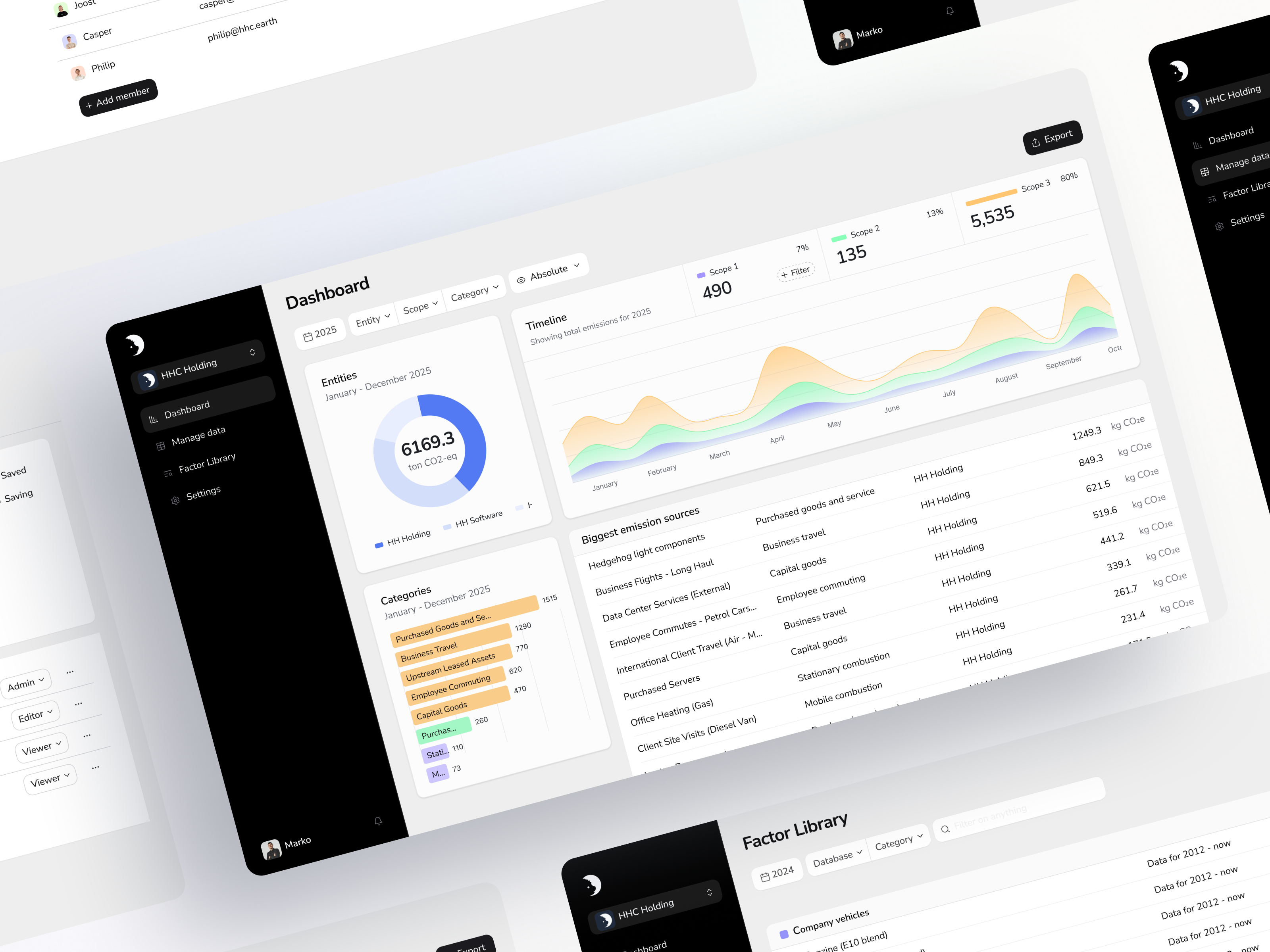
You can start a free account with no sales call and build a real inventory rather than an estimate, guided by an AI assistant through GHG protocol setup, inventory building, data upload and reporting. Pro starts at EUR 1,200 a year. The factor library runs to more than 20,000 spend-based and activity-based factors, and you can add your own organisation-specific or supplier-specific data, which is what moves a category off an estimate.
Two limits worth knowing before you invest an afternoon.
Few integrations today. A customer named more integrations with other software as the thing they would change, on G2 in June 2026. If you were hoping the step up from a calculator would mean data arriving automatically, it will not, at least not yet.
Not a broad ESG suite. A customer rated us 3.5 out of 5 on G2 in June 2026 and said that for broader ESG data and reporting this platform is less complete, with no data source management feature and no decarbonisation target monitoring. If the questionnaire that prompted all this covers social and governance topics as well as carbon, you will need something alongside it.
What should you do this week?
Run the free calculator. Take twenty minutes over it, write down every input you had to guess, and keep the result internal.
Then look at your pipeline and your inbox. If a customer questionnaire, a tender or an audit is coming inside twelve months, start building the inventory now, because the constraint is your data collection cycle and not the software. If none of those is coming, you have your screening and you can stop here.
Sources: Hedgehog platform, Hedgehog on G2, UK Cabinet Office PPN 006. Verified 27 August 2026.
Facts on this page were last verified on 2026-09-17.