
If you supply major retailers like Ahold Delhaize, corporate giants like bol.com, or other large enterprises, you have likely received a new kind of request recently: a formal demand for your carbon emissions' data. By 2026, nearly 50,000 companies will fall under the EU’s CSRD, meaning they urgently need data from their supply chains.
For decision-makers and operational managers within SMEs, compiling this data often feels complex due to constraints on time, budget, and expertise. However, providing clean, accurate data is now a critical requirement to win and keep these valuable contracts. This article explains why your clients require this information and how to deliver it efficiently without overwhelming your team.
Why large clients need your carbon data
To understand the pressure your enterprise clients face, you need to look at how carbon accounting works. Businesses measure their environmental impact across three distinct categories, often referred to as Scopes 1, 2, and 3. Scope 1 covers direct emissions, and Scope 2 covers indirect energy use. Scope 3 covers the wider value chain, encompassing all other indirect emissions.
To put it simply: your direct Scope 1 and Scope 2 emissions form the Scope 3 emissions of your large clients. When a company like bol.com calculates its corporate carbon footprint, it must account for the emissions generated by its suppliers. They are asking for your data because they cannot complete their reports without it.
Several major drivers fuel this data hunger:
- Reporting regulations: Large companies must comply with the Corporate Sustainability Reporting Directive (CSRD). This requires them to publish highly detailed, ESRS-aligned data regarding their environmental impact, including their supply chain.
- Stakeholder demands: Investors and stakeholders now demand transparent, evidence-based sustainability metrics before allocating capital.
- Brand reputation: Consumers increasingly prefer sustainable brands. Large retailers protect their branding by proving their supply chains are actively cutting emissions, rather than relying on vague claims.
Transfer all your data directly with Hedgehog Carbon Platform
The main challenge for SMEs is not necessarily measuring the baseline, but delivering that data in the exact formats that different enterprise clients demand. One retailer might want an overview of your entire operational footprint, while another might ask for the specific carbon intensity of a single product line you supply to them.
If your sustainability data is locked in rigid, static spreadsheets, you will spend hours manually reformatting numbers to satisfy each client’s unique portal or questionnaire. You need a flexible system.
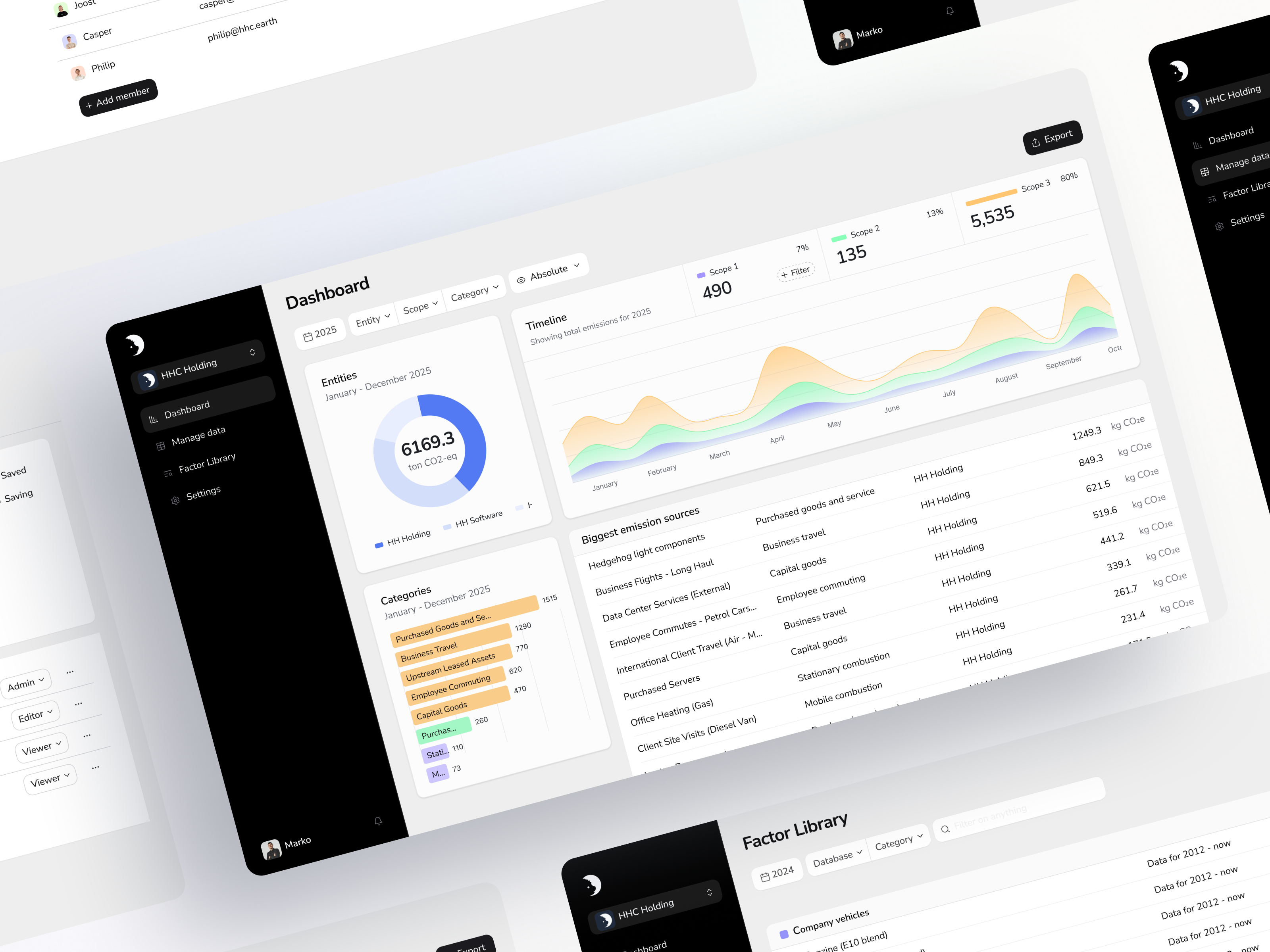
This is where Hedgehog steps in. We designed the Hedgehog Carbon Platform as an intuitive SaaS tool enabling SMEs to efficiently measure, manage, and report their carbon footprint. The platform keeps your CO- data centralised and flexible, allowing you to easily filter your footprint to answer the specific, nuanced questions of your large corporate clients. Ultimately, Hedgehog makes your carbon data fully transferable to the complex reporting systems of your buyers.
How to stay ahead of clients data requests
Do not wait for a large client to threaten to pause your contract before you start gathering your data. Proactive suppliers use structured sustainability reporting as a competitive advantage to satisfy stakeholder demands and improve efficiency.
To position your business as a reliable, future-proof partner:
- Start with your baseline: Measure your Scope 1 and Scope 2 emissions first. This covers the energy your facilities use and the fuel your company vehicles consume.
- Consider a flexible tool: Avoid rigid spreadsheets. Use the Hedgehog Carbon Platform to ensure your data is structured, secure, and ready to be segmented based on client needs.
- Share data proactively: Providing clean, accurate, ESRS-aligned data to your clients before they have to chase you for it builds immense trust and strengthens your commercial relationships.
Securing your position in the supply chain
Meeting the sustainability demands of enterprise clients does not have to drain your resources. By establishing your baseline and using an adaptable system to make your data transferable, you ensure your business remains a vital, compliant partner in the supply chain. Hedgehog offers integrated sustainability solutions, combining expert consulting and a dedicated SaaS tool to help you achieve exactly this.
Would you like to see how easy it is to share your data with large retailers? Reach out to schedule a demo of the Hedgehog Carbon Platform today.