
In short
- Ownership fails because the work spans functions and belongs to none of them.
- Split it: one accountable owner, several data owners, one approver.
- Finance owns it well more often than people expect, because it is bookkeeping.
What has gone wrong is that carbon reporting is cross-functional work with no natural home. The data sits in facilities, fleet, finance, HR and procurement, the deadline belongs to a customer or a regulator, and the job description belongs to nobody, so it drifts until it is urgent. This week, name one accountable owner with the time actually protected, name a data owner for each emissions category, and put the deadline in a calendar that somebody senior sees. What stops it recurring is treating the footprint as a recurring reporting cycle with a fixed owner and a fixed date, in the same way payroll or VAT is treated.
This is the single most common failure we see, and it has almost nothing to do with software. It is an organisational design problem with a small technical component.
Why does nobody own it?
Four structural reasons, all of them predictable.
The work spans functions. Energy sits with facilities, fuel with fleet, spend with finance, travel with HR or office management, and supplier data with procurement. No existing role holds more than a fifth of it.
The deadline is external. Internal deadlines have owners because someone inside the company set them. A customer questionnaire or a tender date arrives from outside and lands in a shared inbox.
It looks like a project. Projects end. So the first footprint gets assigned to whoever has capacity that quarter, and the second one has no owner at all because the project closed.
Nobody knows how big it is. Managers are reluctant to accept a task with an unknown time cost, which is entirely rational, and the estimate never gets made because that itself is a job.
Naming those out loud in a meeting usually moves the conversation faster than arguing about who should do it.
What does owning carbon reporting actually involve?
Less than people fear, once it is split properly. The failure mode is asking one person to do all five roles below.
| Role | What they do | Realistic time |
|---|---|---|
| Sponsor | Sets the deadline, unblocks access to data, signs off scope | A few hours a year |
| Owner | Runs the cycle, chases, assembles, answers questions | Days per month in year one, less later |
| Data owners | Supply their own category from their own records | Hours per year each |
| Reviewer | Sanity checks the numbers against last year | A day per cycle |
| Approver | Signs the figure before it leaves the building | An hour |
The only role that needs protected time is the owner. Everything else is a small ask from people who already hold the data. Most stalled reporting programmes are stalled because that split was never made and one person was quietly expected to be all five.
Which function should own it?
There is no universal answer, but there is a decent heuristic: give it to the function that already runs an annual data cycle to an external deadline.
Finance. Underrated and often the best fit. Carbon accounting is accounting: a boundary, a period, a consolidation, source documents and a figure that has to reconcile. Finance already has the discipline and already touches the spend data that drives most scope 3.
QHSE or compliance. Strong fit where the trigger is a certification or a tender. They are used to evidence, audits and standards, and they usually welcome the mandate.
Operations or facilities. Good access to scope 1 and 2 data and typically weaker on reporting formats and boundary questions.
Sustainability. Obviously right if the role exists. In most mid-sized companies it does not, and waiting to hire one is how two reporting cycles get missed.
Marketing or communications. Almost always wrong as the owner, because the incentive is the story rather than the number, and that is precisely where unsubstantiated environmental claims come from.
Whichever you pick, write it into the job description rather than leaving it as a favour. Favours do not survive a busy quarter.
What do you do this week?
Five concrete steps. None of them takes more than an hour.
Find the actual deadline. Read the customer request, the tender document or the regulation and write down the real date and the required format. Most panic here is caused by an assumed deadline rather than a real one.
Name the owner in writing. One person, named in an email that their manager is copied on, with an agreed number of hours per month. Ambiguous ownership is what got you here.
Name a data owner per category. Energy, fuel, fleet, travel, waste, purchased goods. One name against each. They are supplying data, not doing carbon accounting, and it helps to say so.
Set the sign-off. Who approves the figure before it is sent anywhere. Usually a director. Deciding this now prevents a week of delay at the end.
Estimate the size once. Build one category end to end and time it. That single measurement converts an open-ended obligation into a schedule, and it is the fastest way to get a manager to agree to the time. Our guide to building a GHG inventory sets out a sensible order.
What stops it happening again?
Make it a cycle rather than an event.
Put a fixed annual date in the calendar, tied to your financial year end rather than to whenever the last customer asked. Give the owner a standing slot to refresh the inventory. Ask data owners for their numbers on the same date every year, so it becomes a routine request rather than a surprise.
Then remove the single point of failure. If the whole inventory lives in one spreadsheet on one laptop, the programme ends when that person leaves. Data in a shared system with per-category owners survives staff turnover, which is the most common way carbon reporting quietly dies.
Reporting once is a project. Reporting every year is a process, and processes need an owner, a date and a system. You now have two of the three.
What does a platform change about this?
It changes who has to do the work, which is the part that matters when nobody owns it.
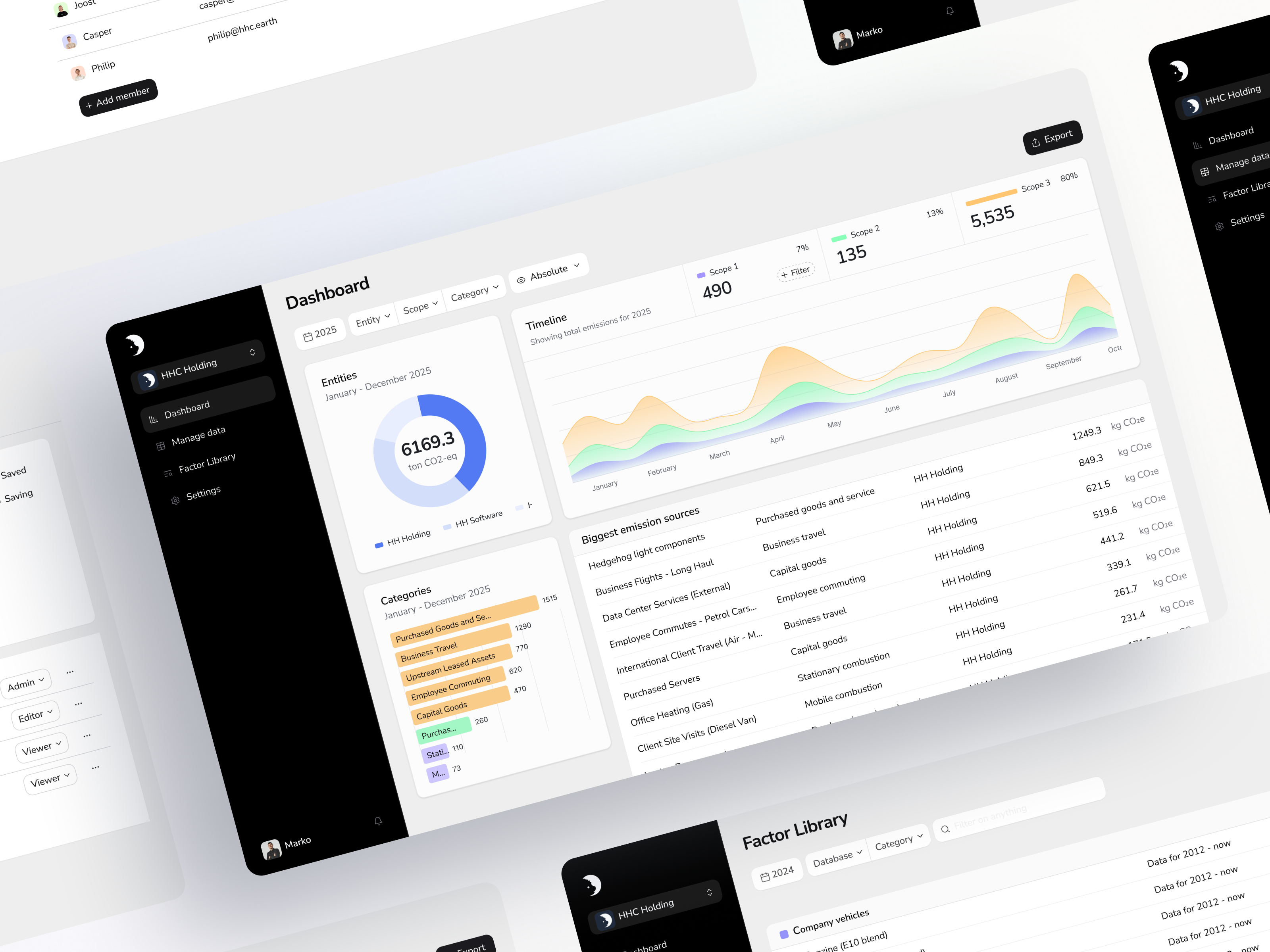
The platform supports entity management across locations and sites with user roles for data owners, auditors and managers, so the fleet manager can enter fleet data without being able to edit the energy figures, and the auditor can look without touching anything. That is the mechanism that turns one overloaded owner into a coordinator. An AI assistant guides GHG protocol setup, inventory building, data upload and reporting, which lowers the expertise barrier for whoever ends up holding the role. Getting started costs nothing and requires no sales call; Pro is EUR 1,200 a year and up.
Two honest caveats.
Software does not create an owner. If the account has no named owner and no protected time, you will be in the same position next year with a subscription attached.
The first load is real work. A customer said on G2 in August 2026 that it takes a lot of manual labour to get the data in, and that once it is there it works perfectly, but loading it is the challenging part. Plan for that in the owner's hours.
And one limit worth knowing if your mandate includes targets: a customer rated us 3.5 out of 5 on G2 in June 2026 and noted there is no decarbonisation target monitoring feature and no data source management. If the person who takes ownership is also expected to track reduction targets, check that specifically. The distinction between a carbon platform and a broader ESG reporting suite is worth settling before you buy anything.
What should you do first?
Send one email today naming the owner and the deadline, and copy the person who can protect their time. Everything else on this page is easier once that email exists.
If you want help working out which function should hold it in your particular structure, book a call. If you would rather find out what the work involves before assigning it to anyone, open a free account and build one category.
Sources: Hedgehog platform, Hedgehog on G2. Verified 27 August 2026.
Facts on this page were last verified on 2026-09-17.

