Have you ever stopped to think about what exactly is in your laundry detergent? And what damage does it cause to the environment? Hedgehog investigated the environmental impact of traditional detergents and compared them with the natural alternative: soapnuts.
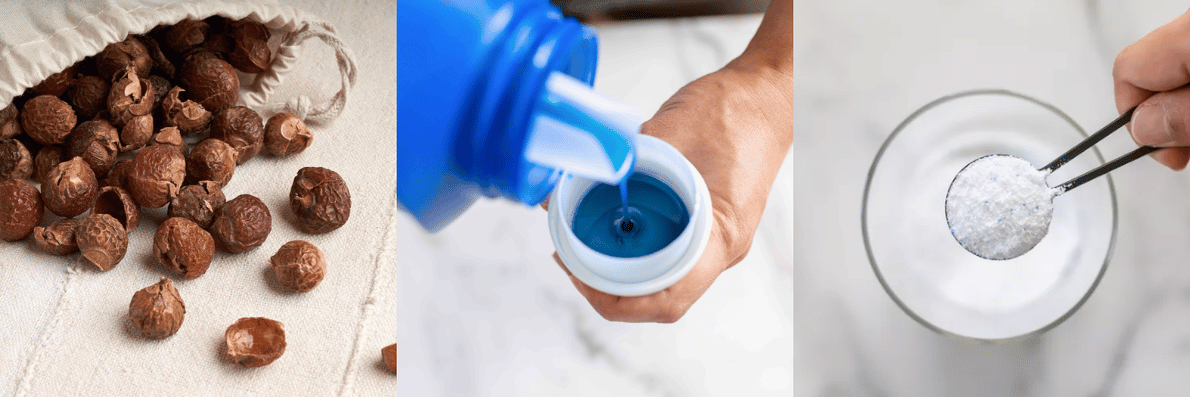
The shells of soapnuts or soapberries (Sapindus mukorossi) have been used for centuries to wash clothes. It is a natural product with virtually the same effect as the chemical detergent we normally toss into our washing machines.
In this study, we quantify the environmental effects of both detergents and soapnuts using a Life Cycle Assessment (LCA). This is a scientifically structured method to measure the negative environmental impact of a product. It considers the entire 'life cycle', from the extraction of raw materials to waste processing. In this article, you can read more about the results of this LCA study.
What is the goal and what do we measure?
In this study, we examine the full life cycle of the products, from cradle to grave. To compare the three options objectively, defining a clear scope is essential. We focus specifically on the impact of a single wash cycle. Since the required dosage varies per detergent, the exact amount of detergent needed for one wash cycle forms the starting point for our comparison. For example, a small bag of soapnuts can be used 3 to 5 times.
Therefore, our functional unit is: 1 wash cycle of 5 kg of normally soiled laundry, washed at the consumer's home. For soapnuts, we assume one-third of a portion for a single wash cycle due to their reusability, and for liquid and powder detergents, we assume the recommended amount for one wash cycle.
Results
Regarding the impact on 'Climate Change', chemical detergents score higher than soapnuts (1.3 kg CO2-eq). Powder detergent has the highest impact (1.6 kg CO2-eq), which is higher than the impact of liquid detergent (1.4 kg CO2-eq).
Remarkably, the largest share of the environmental impact occurs during the use phase. In this phase, a lot of energy is consumed, and wastewater is generated that requires thorough treatment. The environmental impact of the use phase is high for all three alternatives, but it is also virtually comparable for all three. Energy consumption accounts for the largest share of the impact, but since energy consumption is identical for all three alternatives, the difference in impact is mainly due to the treatment of the wastewater.
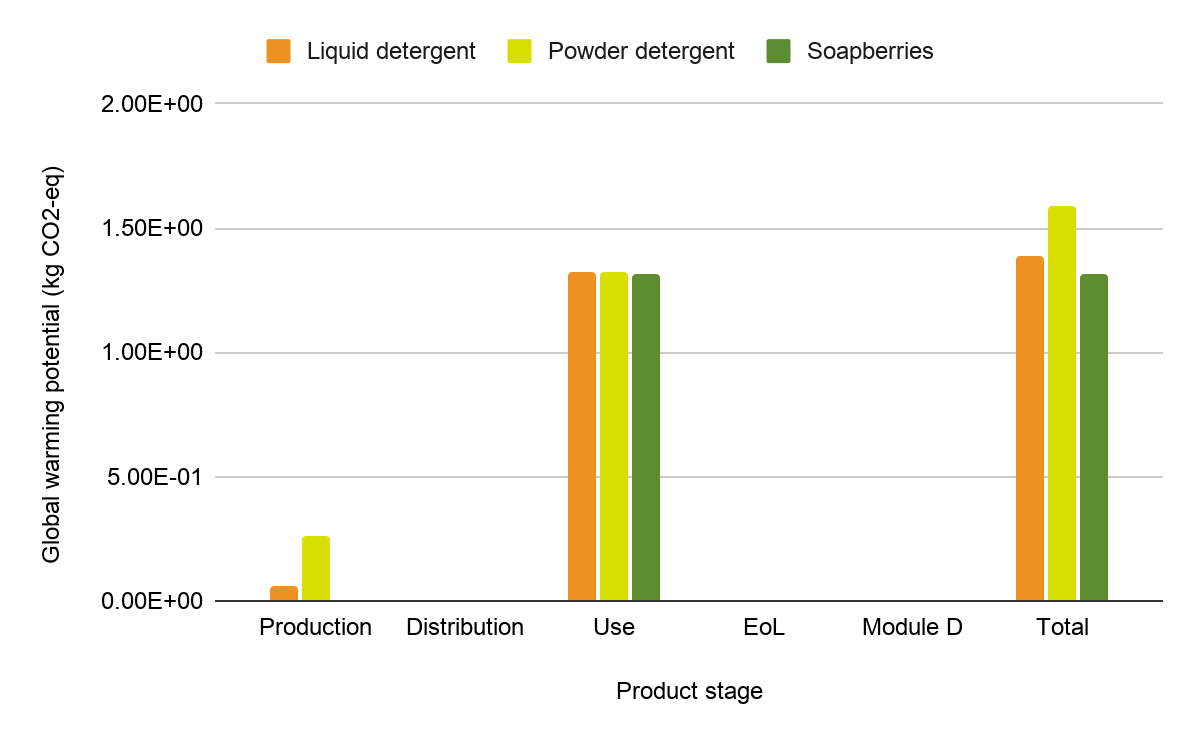
The difference in the total is mainly due to the production of the detergents. Compared to the impact of powder and liquid detergents, the production of soapnuts seems to have almost no environmental impact at all. Furthermore, it can be seen that the impact of producing powder detergent is more than 4 times higher than the impact of producing liquid detergent.
There are also several other impact categories shown in the graph below. In the 'Freshwater eutrophication' category, soapnuts have a higher environmental impact. Eutrophication is the excessive enrichment of water or soil with nutrients, such as nitrogen and phosphorus, leading to explosive algal growth, oxygen depletion, and fish mortality. This process is also known as nutrient enrichment.
The fact that soapnuts score relatively high here can be explained by the different compositions of the two types of wastewater. During the treatment of 'regular' wastewater, different substances are released compared to more heavily polluted wastewater. This is because, with soapnuts, only natural substances enter the water, whereas traditional detergents also release many chemicals into the water. The more natural substances from regular wastewater contribute more to freshwater eutrophication than the chemical substances from more heavily polluted wastewater. However, in the 'Freshwater ecotoxicity' category, which looks at chemical water pollution, we can see that using soapnuts results in fewer truly toxic substances entering the water.
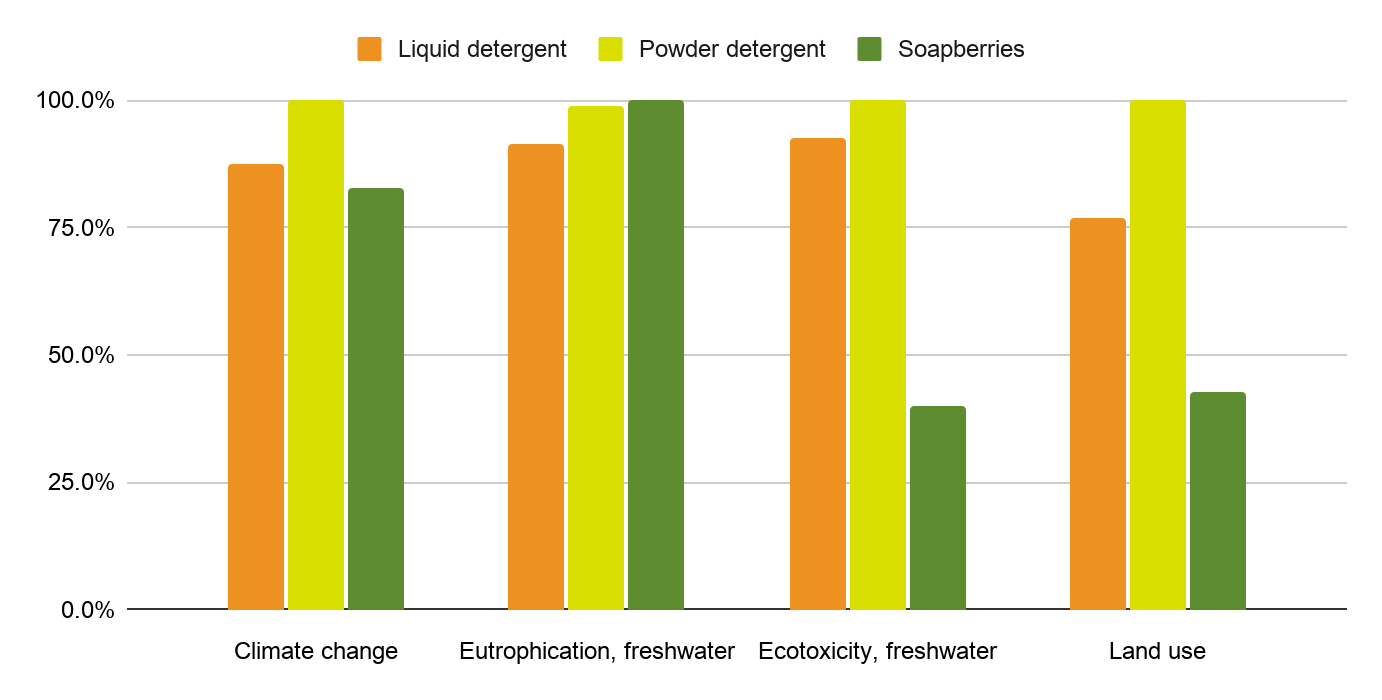
Additionally, we see that in the 'Land use' category, soapnuts have a lower impact than traditional detergents. Many factors influence the impact in this category, such as the effect on soil quality and the maintenance and filtration of groundwater. Since soapnuts have a low impact here, we can conclude that the cultivation of soapnuts generally has a better, or at least less harmful, effect on the soil than the production of liquid and powder detergents.
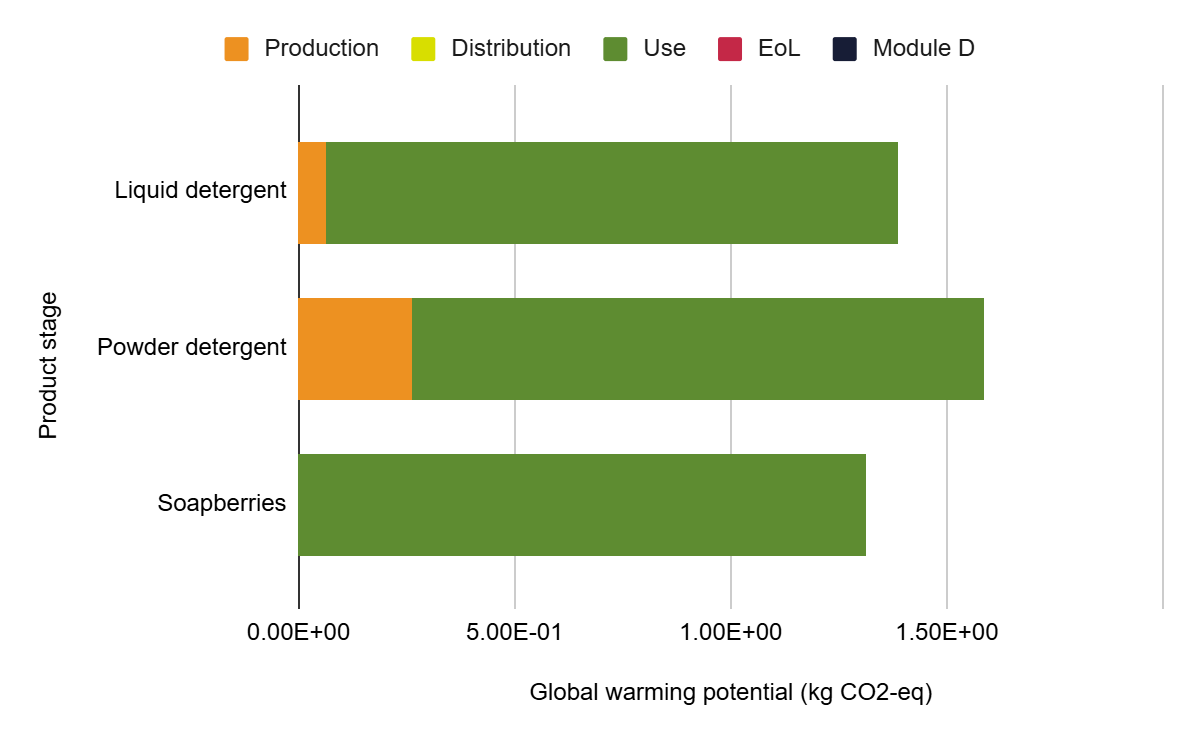
In short, as we saw with the different life stages of detergent, the use of the product has the highest impact, but production also plays a minor role, particularly for traditional detergents. This is mainly explained by the environmental impact of treating the chemical, and therefore more heavily polluted, wastewater, and of producing the non-ionic surfactants present in traditional detergents. Furthermore, energy consumption during the use phase increases the environmental impact of all three alternatives by an equal amount.
The data behind the LCA
Soapnuts
Limited data is available for the cultivation of soapnuts. To ensure we can still model this, we use a 'proxy' – in this case, the jatropha plant. This grows in a similar way to the soapberry tree, with the main difference being that the soapberry tree is slightly hardier, meaning a similar harvest can be expected with slightly fewer pesticides and fertilisers [1]. Furthermore, both grow mainly in India and China and require roughly the same amount of nutrients and water to produce fruit [2].
After harvesting, the soapnuts are shelled by hand, and the shells are sun-dried. They are then ready for packaging and transport to the Netherlands. The soapnuts are shipped from India to the Port of Rotterdam, after which they are distributed across the Netherlands for sale.
At home, the soapnuts must be placed in a small cotton bag before use so they can be properly used and reused. Once the soapnuts become soft, after about 3 washes, they no longer clean effectively and must be discarded, though they can be composted with organic waste. We assume that the packaging and the cotton bag end up in the general waste at the end of their lifespan and are incinerated.
Liquid detergent
The production of liquid detergent is primarily a chemical process. This involves the use of anionic and non-ionic surfactants, among other substances. These are active ingredients in detergent that ensure it can actually remove (greasy) stains from clothes. We assume that the rest of the detergent is topped up with water, as any other potential substances are only present in small quantities and can vary greatly between different brands. Unlike soapnuts, this type of detergent can be produced more locally, meaning the distance the detergent has to travel to the consumer is shorter.
Most people will be familiar with using liquid detergent. A key difference from using soapnuts is that, in this study, we assume the wastewater from washing with (liquid) detergent is more heavily polluted than the wastewater from washing with soapnuts. Wastewater from traditional detergents must therefore undergo more intensive treatment. Furthermore, we assume that the plastic packaging is recycled at the end of its life.
Powder detergent
The production process of powder detergent is similar to that of liquid detergent, except that it contains a few additional ingredients. It also contains anionic and non-ionic surfactants, but additionally, zeolites are present in powder detergent. Just as with liquid detergent, we exclude several ingredients here because they only occur in small quantities and often vary between brands. We also supplement the powder detergent with sodium carbonate—a type of dry filler—instead of water. More energy is also required for the production of powder detergent than liquid detergent, as the powder needs to be dried.
The use phase of powder detergent is modelled in the same way as that of liquid detergent, with the same wastewater in the same quantities. For powder detergent, it is assumed that the cardboard packaging ends up in the general waste.
So, how can I do my laundry more sustainably?
In terms of climate change (CO2), soapnuts perform better than liquid and powder detergents, with a difference of 100 grams and 300 grams of CO2 equivalent per wash cycle, respectively. With about 1 wash cycle per week, this equates to a potential saving of around 5 to 15 kilograms of CO2 per person per year. This is equivalent to the environmental impact of about 24 avocados or 476 cups of coffee.
On the other hand, the usage process changes when you choose to wash with soapnuts, as you also have to retrieve the nuts from the laundry afterwards. Soapnuts are naturally odourless, which does not affect their cleaning power, but if you want to create a fresh scent, you can add essential oils or other natural fragrance products. Naturally, these oils and fragrance products also have an environmental impact. In addition, there are other forms of detergent, such as laundry strips and ecological detergents, which were not included in this LCA but may also have a lower environmental impact.
In short, if you want to do your laundry with the lowest possible environmental impact based on the studied methods, start using soapnuts instead of traditional detergents. If you currently use powder detergent and feel the switch to soapnuts is too big a step, you can still reduce your environmental impact by switching to liquid detergent, or by using other methods. For example, you can choose to always use an eco-programme, wash at lower temperatures, or install a microplastic filter. These methods require little to no change in your washing routine, but they have a proven positive influence on the environmental impact of your laundry [5, 6, 7].
References
- https://books.google.nl/books?hl=en&lr=&id=lCyaDwAAQBAJ&oi=fnd&pg=PA287&dq=soapberry+natural+pesticide&ots=FxrBC8gqCC&sig=urZ5PEaWS8ohGB4LslYmbQ5eWUo&redir_esc=y#v=onepage&q&f=false
- https://doi.org/10.21203/rs.3.rs-196826/v1
- https://housework.store/blogs/blogs/soapberries-natural-laundry-detergent?_pos=2&_sid=1ef4dbc72&_ss=r
- https://www.thespruce.com/types-of-laundry-detergent-4126598
- https://www.tandfonline.com/doi/epdf/10.1080/09603123.2023.2194615?needAccess=true
- https://www.mdpi.com/2071-1050/17/18/8411
- https://www.mdpi.com/2073-4441/17/3/358