
Almost all suppliers of construction materials will face the implementation of the revised Construction Products Regulation (CPR-2025) in 2026. A number of new environmental rules, safety frameworks, and reporting requirements will be mandatory starting this year. Read here what is changing, what this means for your company, and how to prepare your team properly for a changing market.
What is the Construction Product Regulation 2025 (CPR)?
Companies wishing to trade construction products within the European Union must comply with various rules. The CPR is a European regulation that standardises these rules so that the sale of construction products between member states is streamlined.
Manufacturers, importers, and distributors have specific responsibilities to ensure that products meet the requirements. This includes, among other things, ensuring the presence of the CE mark (more on that later) and providing the required documentation.
The aim of the legislation is the free movement of construction products and the provision of reliable information regarding the performance and sustainability of a product. This allows companies, public authorities, and consumers to accurately compare construction products from different producers across different countries.
The objective of the CPR includes:
- Uniform rules for trade in construction materials within EU countries.
- Providing information on the performance of construction products and sustainability in a uniform manner.
- Ensuring safety.
The most important concepts at a glance:
- CE Marking: A mandatory quality mark for construction products to demonstrate they comply with the CPR. It enables free trade of products throughout the EEA.
- Declaration of Performance (DoP): A document from the manufacturer that sets the product's performance against its essential characteristics, certified by the CE marking.
- Harmonised Standards: The regulation establishes a framework for testing and displaying performance information. When a harmonised European standard exists, CE marking is mandatory.
The new CPR regulation
The revised CPR entered into force on 7 January 2025 and will apply to most construction products from 2026 . it contains quite a few major changes compared to the old version. In this section, we discuss the most important components.
Which construction products fall under the CPR?
But first: which construction products are covered? The regulation includes all construction products intended for permanent incorporation in buildings or civil engineering works that are placed on the EU market. These include, for example, insulation materials, windows, structural parts, and prefab systems, and it thus concerns both new-build and renovation projects.
Speaking the same language
Speaking the same “language” is one of the primary goals of the revised CPR. It must ensure that the entire European construction sector uses the same terminology regarding the properties and performance of construction products. This involves ensuring that all agreed rules, definitions, measurement methods, and performance classes are the same across Europe. These agreements are set out in harmonised European standards (hENs) or in European Assessment Documents (EADs). Think, for example, of uniform fire reaction classes or standardised methods to measure the thermal conductivity of insulation material. This shared language makes it easier for manufacturers to bring their products to market in different countries and ensures that designers, contractors, and regulators understand and apply the same information. Because technical developments, national building regulations, and European policy goals are constantly changing, this common language must be regularly updated—for example, to include new sustainability and circularity requirements from the EU Green Deal.
What has changed in the new CPR-2025?
The core of the revised Construction Products Regulation (CPR) is a shift from pure trade promotion to sustainability, digitalisation, and circularity. Whereas the old rules from 2011 were primarily intended to remove barriers to trade, the new regulation sets requirements for the future-proofing of construction. This aligns with other regulations such as the Eco-Design for Sustainable Products Regulation (ESPR) and the Energy Performance of Buildings Directive (EPBD). Consequently, construction products also meet the changing ESG criteria.
These are the three most important changes:
- Environment becomes a hard requirement: sustainability is no longer optional. As a manufacturer, you must be transparent about the environmental impact of your products. Reporting data on, for example, CO₂ emissions (Global Warming Potential) becomes a standard requirement for the CE marking of construction products.
- Room for reuse: the rules have been adapted for the circular economy. Where the old CPR was unclear about second-hand materials, reused construction products now explicitly fall within the scope. This makes it easier to market circular materials as high-quality products.
- The transition to digital: the new CPR introduces the Digital Product Passport (DPP). With this, all relevant product information—from performance to sustainability data—is digitally accessible and directly linked to the physical product.
In short: the new rules force the sector to be more transparent about what is in a product, whether it can be reused, and what impact this has on our planet.
What are the new requirements for CE marking of construction products under the CPR?
Without CE marking for construction products, you may not sell the construction product in the EU, making it a kind of quality label. The new CPR significantly tightens the requirements for CE marking. Where the marking previously primarily confirmed technical performance, a CE label under CPR-2024 also displays the environmental performance of a product.
Manufacturers must be able to demonstrate that their product has been assessed according to the correct standard or ETA, that all mandatory tests have been carried out, and that the environmental data – including the global warming potential (GWP) – has been correctly calculated via an LCA according to EN 15804.
This information is recorded in the DoPC and linked to the digital product passport, so that the CE marking shows not only what a product can do, but also what its impact is. For SME producers, this means that CE marking requires more preparation: up-to-date production data, stable quality control, and complete, digitally accessible documentation.

How do I prepare my construction product for the new CPR-2024?
The updated CPR-2024 changes the way construction products are admitted to the European market. Where the focus was previously on technical performance, environmental performance and traceability are now central. For manufacturers, this means that the development and documentation process of construction products must be thoroughly revised. In this chapter, we discuss a number of points to prepare your product for the CPR.
1. Check if your product falls within the new scope
The basis for any CPR application lies in determining whether your product falls under a harmonised technical specification. This can be a harmonised standard (hEN or hTS) or a European Technical Assessment (ETA). These documents specify exactly which performances you must record, test, and report. Under CPR-2024, the European Commission also distinguishes between priority product groups. Materials such as concrete (including prefab concrete), steel, and various insulation materials are the first to be subjected to the tightened requirements, particularly in the area of environmental performance. Manufacturers in these sectors would therefore do well to check early which obligations are already in force or will apply soon for their products. When technical specifications require it, part of the performance assessments must be carried out or checked by a notified body. Products falling under the higher AVCP systems (2+, 1, or 1+) must take into account inspection of product tests or factory production control.
2. Map environmental performance with an LCA
An important new element of CPR-2024 is the obligation to substantiate the environmental performance of a product with a Life Cycle Assessment (LCA). An LCA describes the environmental impact of a product over its full life cycle: from raw material extraction and production to use, maintenance, and processing or recycling at the end of its life. This analysis is performed according to established European standards and methods.
The CPR makes the LCA a central instrument. From November 2025, every manufacturer must at least be able to report the Global Warming Potential (GWP) of its product. This CO₂ indicator forms the basis, after which more and more environmental and circularity indicators will become mandatory in the following years. The full set must be applied by all relevant product groups by 2031 at the latest.
To perform an LCA, you collect data on production processes, raw materials and energy consumption, transport flows, and emissions. This data is entered into recognised LCA software or processed by a specialised advisor. When the standard requires it, a notified body must verify the results before they can be used for CE marking and market admission. Read here how Hedgehog can help in making an LCA for your product.
3. Draw up a correct Declaration of Performance and Conformity (DoPC)
The result of all technical and environmental assessments comes together in the Declaration of Performance and Conformity (DoPC). In the new CPR, this document serves as the official proof that a product meets the relevant European requirements. A DoPC describes not only technical performance (such as strength, fire safety, or emissions) but also the newly mandatory environmental performance from the LCA.
To draw up a valid DoPC, a manufacturer must first determine which hEN or ETA applies to its product. Subsequently, all mandatory tests and analyses must be performed, and there must be a stable factory production control. Only then can all data be brought together in the prescribed format. The DoPC is signed by an authorised person and made available digitally as part of the CE marking. With the arrival of the Digital Product Passport, DoPC data is also increasingly being created directly digitally.
4. Prepare your organisation for the Digital Product Passport (DPP)
The Digital Product Passport (DPP) will become the new digital identity card for construction products. It bundles all core data in one place: technical performance, environmental performance (such as CO₂ footprint), product and material composition, origin information, declarations of conformity, and instructions for use, maintenance, reuse, and recycling. The DPP is thus the central information document that designers, contractors, regulators, and processors at the end of the life cycle can rely on. For manufacturers, this means that product information must not only be complete but also digitally structured according to European standards. This begins with collecting all relevant data (test results, LCA/EPD data, DoPC, composition, and origin). Subsequently, the product must be linked to a unique digital identity, which is usually made accessible via a QR code on the product or packaging. This information is eventually included in a European database. The introduction of the DPP is happening in phases. Product groups covered by the CPR and having a high environmental impact will be the first to face the obligation. For many construction products, the DPP will become a standard part of CE marking and market admission towards the end of this decade.
What is the definition of a construction product under CPR-2024?
The basis remains the same, but the scope has been significantly broadened. A construction product is any product or any "kit" made to be permanently incorporated in a construction work (both buildings and civil engineering). What is new in the revised version is that the definition has been made future-proof. The following categories are now explicitly included:
- 3D-printed products.
- Reused and "remanufactured" materials.
- Prefab homes (single-family homes of a certain size).
What is the impact of the CPR on manufacturers and importers?
The impact is substantial: your administrative burden shifts from purely technical to also ecological.
- From DoP to DoPC: Your old Declaration of Performance (DoP) will likely become a Declaration of Performance and Conformity (DoPC). In this, you declare not only technical performance but also that you comply with environmental requirements.
- Mandatory environmental data: You must report on the CO2 footprint (Global Warming Potential) of your product. Without this data, you will no longer receive a CE marking.
- Digital Product Passport (DPP): All data must be available digitally via a QR code or tag on the product. Importers are responsible for checking whether this passport is present and correct before the product enters the EU.
When does the new version of the CPR take effect?
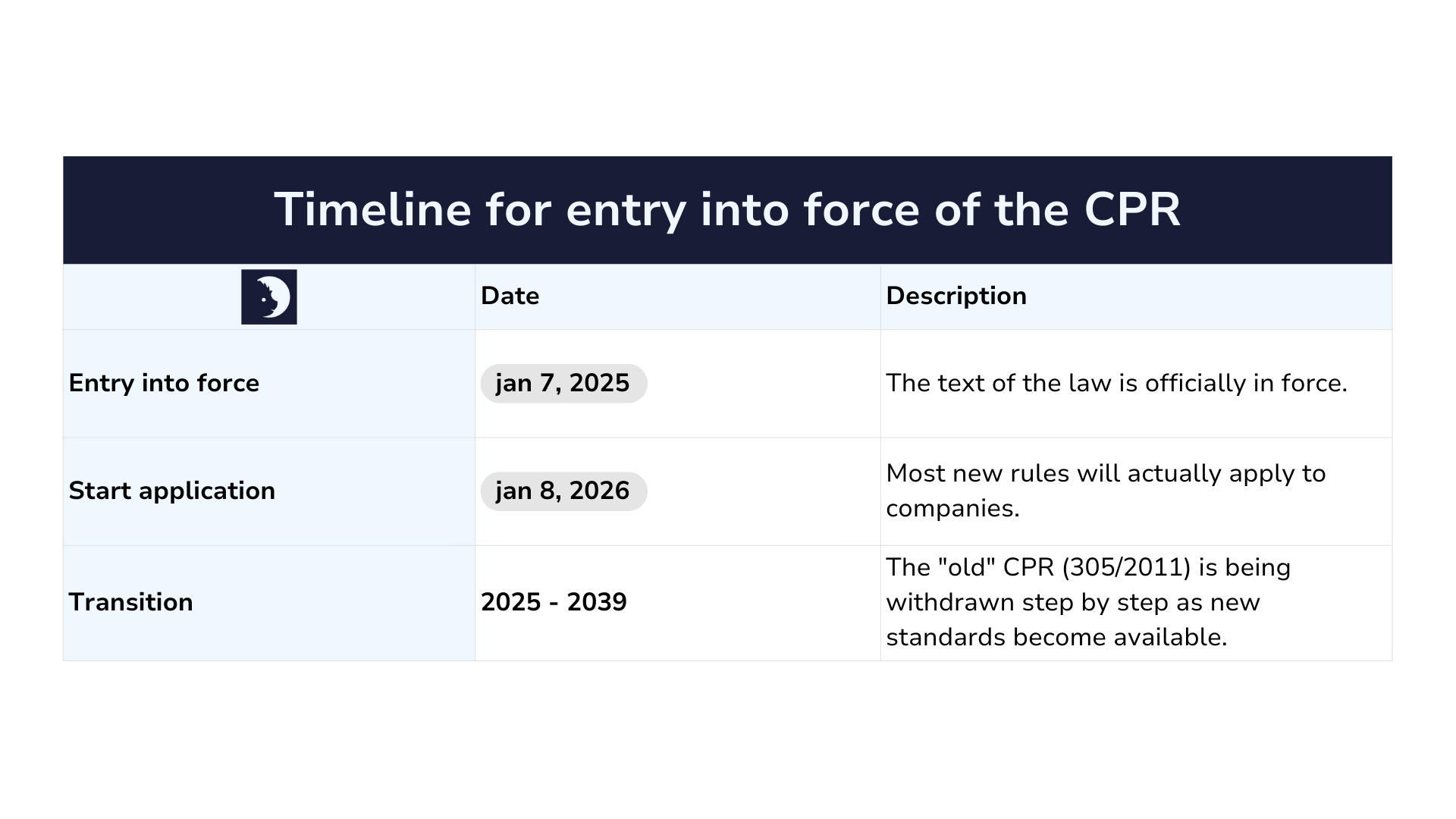
The new regulation (EU 2024/3110) officially entered into force on 7 January 2025. Note: "entering into force" is not the same as "being fully applicable". There is a long transition period. Many new obligations will only be actually enforced from 8 January 2026 (12 months after entering into force). The old CPR will only be fully phased out over a period of 15 years to give the market time.
Which product groups are first in line?
Because the European Commission has a massive backlog in harmonising standards (the so-called "Acquis" problem), they are working with a priority list. The product groups with the greatest impact or the most outdated standards are first in line:
- Prefab concrete products.
- Structural metal products (steel structures).
- Reinforcing steel.
- Doors, windows, and frames.
- Cement and building lime.
Is your product in one of these groups? Then you are first in line to get your data in order.
How does it affect small companies (SMEs)?
The revised CPR ultimately applies to everyone who brings products to the EU market. Nevertheless, the European Commission recognises the administrative pressure on smaller companies. For micro-enterprises (fewer than 10 employees), there are simplified procedures: they may, under certain conditions, deviate from standard test methods and use alternative evidence, provided safety remains guaranteed. However, there is no general exemption for the broader SME sector. Although there is talk of “lighter” obligations, the core points – safety, performance declarations (DoP), and the new environmental indicators such as GWP – remain mandatory for everyone wishing to maintain market access.
The new regulation (formally Regulation (EU) 2024/2749) contains the following provisions:
- Micro-enterprises (Article 38): Companies with fewer than 10 employees and an annual turnover of less than €2 million can use simplified procedures. They may test their products via methods that deviate from harmonised standards, provided they can demonstrate that their product performs equivalently.
- No exemption for sustainability: Although test procedures for safety may sometimes be simpler, there is no structural exception in the new text (which focuses on the Green Deal) for reporting environmental data (such as LCA/EPD). If a product group falls under the new rules, even a small company must provide data for the Digital Product Passport (DPP).
- Help from member states: The regulation obliges member states to set up SME Contact Points to support smaller companies in the complex transition to the new rules.
For a comprehensive explanation of what you as an SME need to know about the new CPR, use this guide from the European Builders Confederation (EBC) and Small Business Standards (SBS).
Overview of deadlines and dates
The following table: CPR Implementation Timeline
What's next? What can you do now?
Waiting until 2026 is risky, as collecting environmental data (LCAs) takes months. This is what you can do now:
- Start measuring: Do you not yet have insight into the CO₂ emissions of your product? Start with a baseline measurement or a Life Cycle Assessment (LCA). This is the basis for your future passport.
- Digitalise your data: Ensure your product data is not just in PDFs, but in a database. This prepares you for the Digital Product Passport. Use our user-friendly Carbon Platform for this.
- Check your status: Do you fall into the priority group (such as concrete or steel)? Then haste is required.
Need help getting started? Our sustainability experts are happy to help you make this complex translation practical and achievable. We support companies in meeting the new requirements by:
- LCA projects: performing full Life Cycle Assessments to accurately map your environmental impact, such as the mandatory Global Warming Potential (GWP).
- EPD preparation: translating this data into officially verified Environmental Product Declarations (EPDs) so that you comply with legislation and strengthen your market position.
- Future-proof data: we ensure that your environmental data is immediately ready for integration into the upcoming Digital Product Passport (DPP).
Together with our digital Carbon Platform, we help you to get that mandatory environmental data on the table quickly and affordably, so that you are ready for the new standard.


