In short
- VSME is an EFRAG standard carried by a non-binding Commission Recommendation, not an EU regulation.
- Its commercial value is the statutory ceiling it sets on customer data requests, in national law by 19 March 2027.
- The emissions disclosure is the only part with a long lead time, so start there.
VSME is the voluntary sustainability reporting standard for small and medium-sized companies. EFRAG wrote it, the European Commission recommended it, and nothing obliges you to use it. You will probably use it anyway, because it has become the agreed answer to a question your largest customers are now required to ask. It is also becoming the ceiling on what those customers may demand from you: EU law written in February 2026 gives suppliers a statutory right to decline anything above the voluntary standard, and Member States have until 19 March 2027 to put it into national law. That is the part worth understanding properly.
Most explainers get the legal status of this standard wrong in one direction or the other. They either present VSME as an EU regulation you must comply with, or they dismiss it as a nice-to-have. It is neither.
What is VSME, exactly?
VSME is a standard developed by EFRAG, the European Financial Reporting Advisory Group, at the European Commission's request and delivered in December 2024. It has two modules. There is a basic module and a comprehensive module, and reporting the basic module is a prerequisite for the comprehensive one.
It is not a Commission act. That distinction matters more than it sounds, and we come back to it below.
Its purpose is narrow and useful. Large companies that report sustainability information under EU law have to say something about their value chain, so they ask their suppliers. Most of those suppliers have no reporting obligation of their own and receive a differently shaped questionnaire from every customer. VSME is the format that lets you answer once.
Why does a voluntary standard matter to a supplier at all?
Because the population of companies that must ask you questions did not shrink as much as the population of companies that must report.
Since Directive (EU) 2026/470 of 24 February 2026, reporting under Articles 19a and 29a of Directive 2013/34/EU applies only to undertakings that exceed both a net turnover of EUR 450 million and an average of 1,000 employees during the financial year. That is a small group. Those that remain still have to report value chain information, and under ESRS E1-6 they still have to disclose gross scope 3 emissions for each significant category. Where they cannot collect the information after reasonable efforts, ESRS 1 paragraph 69 requires them to estimate it using reasonable and supportable information such as sector-average data and other proxies.
Read that last sentence from your side of the table. Your customer will produce a number for you whether or not you give them one. A supplier who reports gets to own its own figure. A supplier who does not gets a sector average.
What is VSME's actual legal status today?
This is the question that separates a useful page from a recycled one, so here is the whole picture in one place.
| The instrument | What it is | Binding? |
|---|---|---|
| The VSME standard itself | An EFRAG standard, delivered December 2024 | No. EFRAG is not a legislator |
| Commission Recommendation (EU) 2025/1710, 30 July 2025 | Reproduces VSME in Annex I with practical guidance in Annex II and recommends its use | No. A recommendation has no binding force |
| Article 29ca of Directive 2013/34/EU | Inserted by Directive (EU) 2026/470. Requires the Commission to establish voluntary-use standards based on Recommendation (EU) 2025/1710 in its original version | Yes, but it binds the Commission, not you |
| C(2026) 5011, adopted 3 July 2026 | The delegated act establishing those voluntary-use standards | Not in force. It was still in Parliament and Council scrutiny on 28 August 2026 |
| Directive (EU) 2026/470, Articles 19a(3) and 29a(3) | The value chain cap, now a statutory right for the supplier | Yes, once transposed. Member States must transpose by 19 March 2027 |
Two things follow. First, nobody can fine you for not reporting to VSME. Second, and more usefully, the Recommendation states that there is no obligation to provide assurance on information reported by non-listed SMEs and that a self-declaration by the SME is sufficient. You do not need an auditor to hand a customer a VSME report.
What does VSME buy you that answering a questionnaire does not?
Three things, in ascending order of value.
A reusable artefact. One calculation, one document, handed to every customer who asks. The alternative is a bespoke response per customer per year, none of which improves the next one.
A defensible standard to name. Saying "we report to VSME" is a stronger position than saying a request is burdensome, because it points at a document instead of at your workload.
A statutory ceiling. This is the one that changed in 2026. Directive (EU) 2026/470 gives undertakings in a reporter's value chain that do not exceed an average of 1,000 employees a statutory right to decline information exceeding the voluntary standard, and makes any contractual provision to the contrary non-binding. It applies only to information gathering for the purpose of sustainability reporting under the Accounting Directive, so it does not touch due diligence requests, risk management requests or ordinary commercial questions. Two caveats on timing, because this is a directive and not a regulation. The right reaches you through national law, and Member States have until 19 March 2027 to transpose it. And the voluntary standard that fixes where the ceiling actually sits, C(2026) 5011, was adopted on 3 July 2026 but was still in Parliament and Council scrutiny when we last checked the Official Journal on 28 August 2026. The right is coming and its shape is known; it is not yet something to quote back at a customer this quarter. We work through how to use that in which ESG questions you can refuse.
Which part of a VSME report is actually hard?
Almost all of it can be written from what you already know about your own business. Policies, headcount, how you are governed, what you do about health and safety. These take a working week and a careful writer.
The greenhouse gas disclosure is different, because it needs a calculation rather than a statement. That means scope 1 and scope 2 at minimum, built from fuel, energy and mileage records you may never have consolidated before, on a boundary you can hold steady so next year's number is comparable to this year's.
That is the part with the lead time. If you take one scheduling decision from this page, take that one. Our beginner's guide to carbon accounting covers the mechanics from a standing start, and what VSME covers covers the standard itself.
What should you do this year?
Find out which of your customers exceed both CSRD thresholds. That tells you who is obliged to ask, and it is a short list. Then get a scope 1 and 2 number you can defend, and write the rest of the report around it.
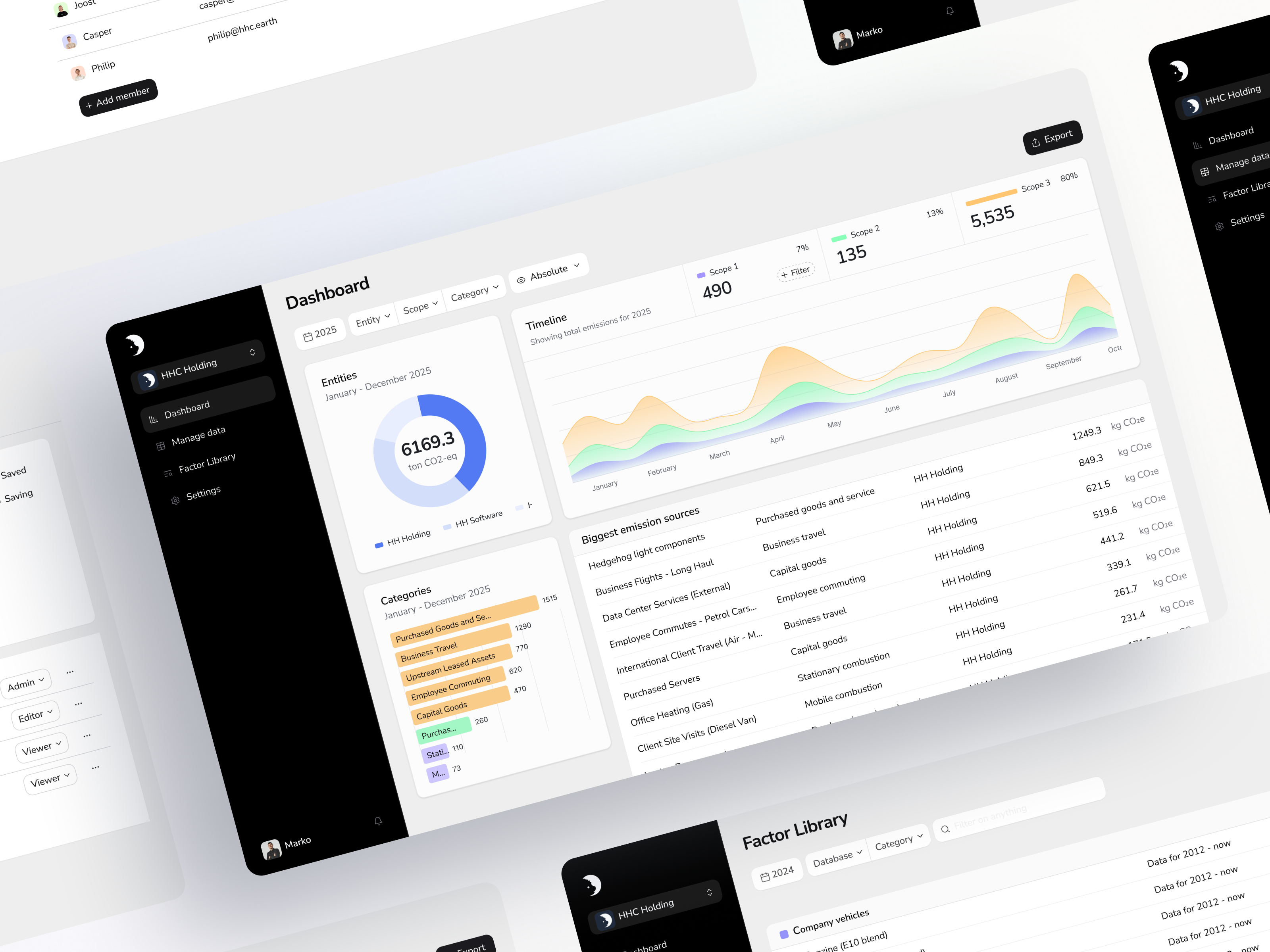
Hedgehog exists for the calculation half of that. The platform guides you through the GHG Protocol with an AI guide for setup and human GHG experts reachable in-app, covers more than 20,000 spend-based and activity-based factors, and lets you add your own organisation-specific or supplier-specific data. The platform page states 5,000+ users. There is a free account with no sales call, and Pro starts at EUR 1,200 per year.
One honest limit. Hedgehog is a carbon accounting platform, not a broad ESG suite. A Mid-Market reviewer on G2 rated us 3.5 out of 5 in June 2026 and said exactly that: for wider ESG and CSRD reporting the platform is less complete, with no data source management feature and no decarbonisation target monitoring. For the non-emissions half of a VSME report, that is what VSME consulting is for.
If you would rather talk it through before starting, book a call.
Sources: Directive (EU) 2026/470, Directive 2013/34/EU, Commission Recommendation (EU) 2025/1710, Delegated Regulation (EU) 2023/2772, all verified against the Official Journal text on 28 August 2026. Hedgehog facts verified 27 August 2026.
Facts on this page were last verified on 2026-08-27.