In short
- 1 January 2027 is a financial-year date. 19 March 2027 is when national law has to exist.
- Two delegated acts were adopted in July 2026 and were still in scrutiny in August 2026.
- Work backwards from your customer's reporting cycle, not from the directive.
There is no VSME deadline, because VSME is voluntary and nothing in it obliges you to file anything anywhere. What there is instead is a calendar of dates on which other people's obligations start, and those dates decide when the questions land on your desk. This page lays out the sequence, marks which dates are fixed in the Official Journal and which are not yet, and turns the whole thing into a plan for your own year.
What is the actual sequence of dates?
Everything below comes from the enacted instruments rather than from press coverage of them. Where an instrument is adopted but not in force, the table says so.
| Date | What happens | Status |
|---|---|---|
| 5 August 2025 | Commission Recommendation (EU) 2025/1710 published, recommending VSME for voluntary reporting by non-listed SMEs and micro undertakings | In force, non-binding |
| 18 March 2026 | Directive (EU) 2026/470 enters into force, twenty days after publication | In force |
| 3 July 2026 | The Commission adopts C(2026) 5010 (revised ESRS) and C(2026) 5011 (voluntary-use standards) | Adopted, still in scrutiny on 28 August 2026 |
| 31 December 2026 | Last financial year that can start inside the first CSRD wave, under Article 5(2)(a) as rewritten | In force |
| 1 January 2027 | Financial years starting on or after this date are the first reported under the revised scope | In force as a directive obligation |
| 19 March 2027 | Deadline for Member States to transpose Articles 1, 2 and 3 of Directive (EU) 2026/470 | In force |
| 1 July 2027 | Deadline for the Commission to adopt limited assurance standards under Article 26a(3) of Directive 2006/43/EC | In force, moved from 1 October 2026 |
| 1 January 2028 | First financial years for the Article 40a third-country regime | In force |
| 26 July 2028 | Transposition deadline for the Article 4 amendments to the due diligence directive | In force |
Which of those dates are actually fixed?
Most, but not all, and the exceptions matter if you are planning a document rather than a dataset.
C(2026) 5010 and C(2026) 5011 were adopted on 3 July 2026 and were still in the Parliament and Council scrutiny period on 28 August 2026. Until they are published in the Official Journal they are not in force. C(2026) 5010 was still carrying an unfilled entry-into-force placeholder. So the standards in force are Delegated Regulation (EU) 2023/2772 as amended by (EU) 2025/1416, and the definitive content of the voluntary standard, which is what sets the height of the value chain cap, is not yet law.
The practical consequence is small but real: build the data, not the document layout. A dataset survives a change of datapoint list. A document formatted against a draft does not.
Why is 19 March 2027 the date to watch, not 1 January?
Because CSRD is an amending directive, and a directive binds Member States to legislate rather than binding companies directly. Every company-facing date in the table is a date by which national law must produce the effect, not a date on which an EU rule starts applying to your business.
That has two consequences worth planning around.
Member States must transpose Articles 1, 2 and 3 of Directive (EU) 2026/470 by 19 March 2027. Until your own national law is in place, the statutory right to decline requests exists in a directive rather than in a rule you can point a customer to.
And the relief for the intervening years is optional. Directive (EU) 2026/470 gave Member States the power, not the obligation, to exempt undertakings below the new thresholds for financial years starting between 1 January 2025 and 31 December 2026. Whether that exemption exists where you operate depends on national transposition, which is why no page, including this one, can give you a reliable national date without checking the transposing law.
When will the questions actually arrive?
Earlier than the reporting dates, and this is the part that catches suppliers out.
Your customer's first report under the revised scope covers a financial year starting on or after 1 January 2027 and is published the following year. But it has to collect the data during that financial year, and it will start planning the collection before the year begins. So the questionnaire wave runs ahead of the reporting wave by twelve to eighteen months.
There is also a seasonal pattern. Supplier requests cluster in the first quarter, once large companies have closed their annual reports and started collecting for the next cycle. If you are going to be asked, you will most likely be asked between January and March.
Work backwards from that rather than from the directive.
What should your own year look like?
Four moves, in this order, and none of them depends on a delegated act being published.
Identify who is obliged to ask. Which of your customers exceed both a net turnover of EUR 450 million and an average of 1,000 employees? That is a short list, and it tells you the size of the problem. A supplier with no customer above both thresholds has a commercial decision to make, not a regulatory one.
Confirm your own status in writing. A reporting undertaking may rely on a self-declaration of size and does not have to verify it unless it knows the declaration is manifestly incorrect. State your average headcount once, in a standard sentence, and reuse it.
Get the emissions number early. Scope 1 and scope 2 from fuel, energy and mileage is the only part of a report with a lead time measured in weeks. Everything else is writing. If you have never done this, our guide to carbon accounting from scratch is the place to start, and what VSME covers sets out the rest of the standard.
Fix the boundary before you need it again. VSME reporting is annual and the value is in the series, so the boundary and method you choose this year determine whether next year is an update or a rebuild.
What is the risk of waiting?
Modest legally and significant commercially, which is an awkward combination to plan around.
Nothing happens to you if you skip VSME. But your in-scope customers still have to disclose gross scope 3 emissions for each significant category under ESRS E1-6, and where they cannot collect information after reasonable efforts, ESRS 1 paragraph 69 requires them to estimate it using sector averages and other proxies. A supplier who has not reported gets a sector average attached to its name in someone else's report. That number is rarely flattering and you cannot correct it retrospectively.
The other risk is timing. If the first request arrives in February and you start the calculation then, you are negotiating under pressure with nothing to show, which is the weakest version of the conversation described in which ESG questions you can refuse.
Where does Hedgehog fit in that calendar?
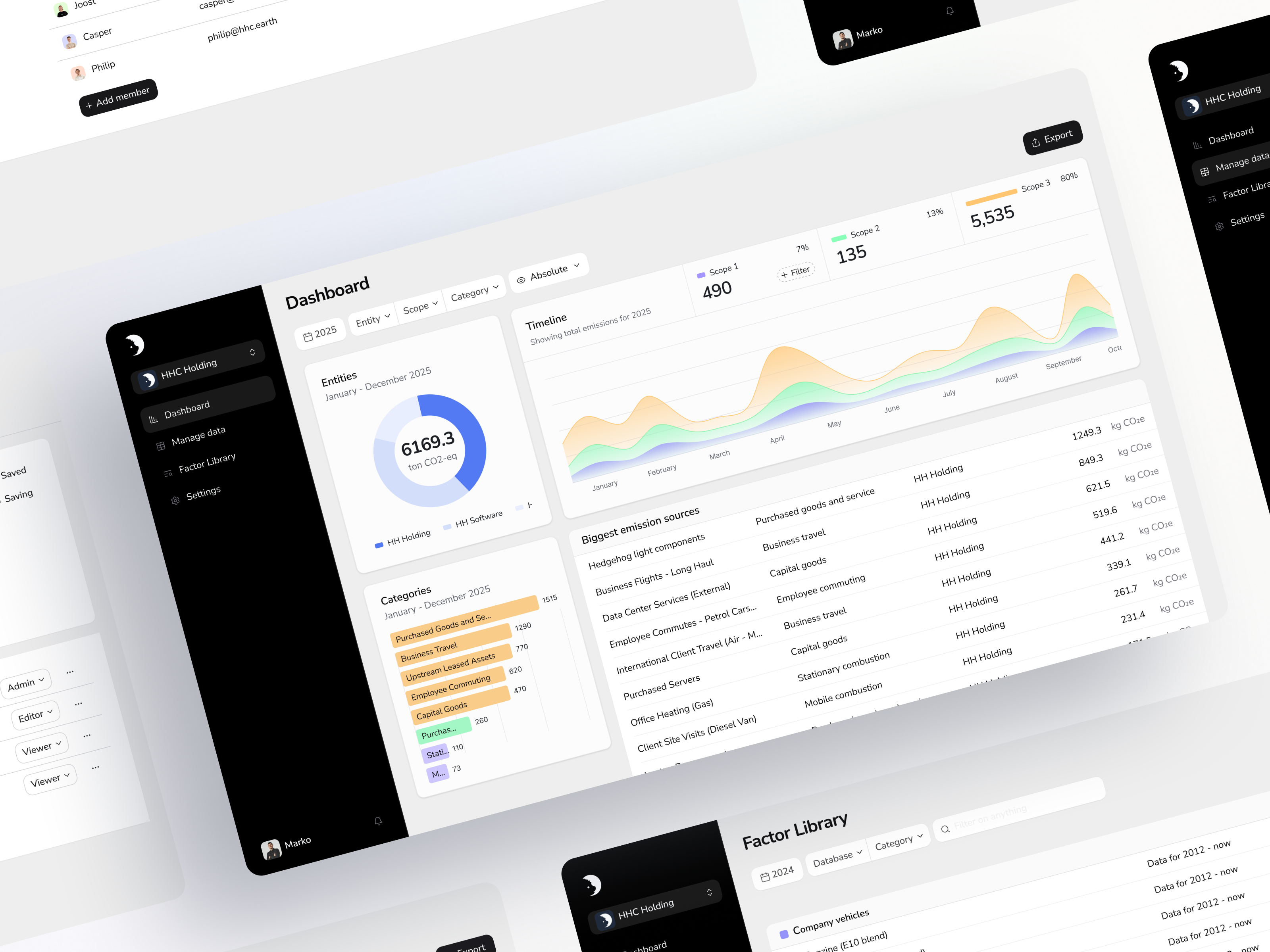
On the emissions step, which is the one with the lead time. The platform guides you through the GHG Protocol with an AI guide for setup and human GHG experts reachable in-app, carries more than 20,000 spend-based and activity-based factors, supports several entities with roles for data owners, auditors and managers, and serves 5,000+ users. The free account needs no sales call and Pro starts at EUR 1,200 per year.
One limitation that bears directly on planning a multi-year calendar: a Small-Business reviewer on G2 said in August 2026 that forecasting would be a welcome addition and that Hedgehog told them it is on the development list. If your plan needs projected figures rather than reported ones, budget for that outside the platform for now.
If you want the year mapped against your own customer list rather than against the directive, book a call.
Sources: Directive (EU) 2026/470, Directive (EU) 2025/794, Directive (EU) 2022/2464, Directive 2013/34/EU, Commission Recommendation (EU) 2025/1710, Delegated Regulation (EU) 2023/2772 as amended by (EU) 2025/1416, and Commission Delegated Regulations C(2026) 5010 and C(2026) 5011 as adopted and not in force. Verified against the Official Journal text on 28 August 2026. Hedgehog facts verified 27 August 2026.
Facts on this page were last verified on 2026-09-17.