
In short
- Staatsblad 2026, 381 raised the WPM threshold from 100 to 250 employees. It applies since 14 November 2026, retroactive to 1 January 2026.
- Employers with 100 to 249 staff reported for the last time over 2025. That report was due 30 June 2026 and the change did not cancel it.
- The collective goal fell to 1.2 Mton CO2, and the 96 grams limit is still not in force. It could not apply before 2030.
The threshold for WPM moved from 100 to 250 employees. The change was published in the Staatsblad on 13 November 2026 as Staatsblad 2026, 381, has applied since 14 November 2026 and works back to 1 January 2026. Employers with 100 to 249 employees therefore reported for the last time over calendar year 2025. Everything else about the duty is unchanged. Two quieter changes came with it: the collective reduction goal is now 1.2 Mton, and the earliest date a CO2 limit could apply to an individual employer has moved out to 2030.
WPM is the rapportageverplichting werkgebonden personenmobiliteit, the reporting obligation for work-related personal mobility, in force since 1 July 2024.
What exactly did the amendment change?
Two words in one article of the Besluit activiteiten leefomgeving.
Article I of the amending decree, dated 3 November 2026, replaces "minder dan 100 werknemers" with "minder dan 250 werknemers" in art. 18.11, second paragraph, under c and d. That is the whole mechanism of the exemption. Article II puts it into force on the day after publication and makes it work back to 1 January 2026. There is no separate transitional rule.
According to the explanatory note, about 4,640 organisations leave the scheme. For them, 2025 is the last reporting year, and the competent authority can no longer enforce the duty for 2026 or later.
How did it get from announcement to entry into force?
In just over nine months, with a long wait at the end.
| Step | Date | Meaning |
|---|---|---|
| Internetconsultatie | 2 February to 9 March 2026 | Public consultation on the draft |
| Ministerraad akkoord | 24 April 2026 | Cabinet approval |
| Voorhang Eerste and Tweede Kamer | 24 April to 1 July 2026 | Laid before both chambers |
| Raad van State advice | Requested 19 May, issued September 2026 | Council of State advice |
| Decree signed | 3 November 2026 | Formally adopted |
| Staatsblad 2026, 381 | 13 November 2026 | Published |
| Entry into force | 14 November 2026, retroactive to 1 January 2026 | Law |
The gap between April and November is why so much published guidance on WPM in 2026 was wrong in one direction or the other. Through the spring and summer, the exemption was announced but not law. Since 14 November it is law, and some pages written earlier have not caught up. When we checked on 22 November 2026, RVO's own WPM pages still described the change as a plan.
What did not change, and who does that affect?
The report over 2025, and the rules for everyone at 250 or more.
The retroactive effect starts on 1 January 2026. It does not reach back into 2025. Every employer with 100 or more employees on 1 January 2025 owed a report over calendar year 2025 by 30 June 2026. An organisation of 180 people that read the April announcement and skipped that filing made an understandable mistake, but the report was still owed. RVO says the loket stays open for late filers.
While the decree was before parliament, the government asked municipalities, through their association VNG, to refrain from enforcement against small and medium-sized businesses. That request concerned enforcement only. It did not change what was owed for 2025.
For employers with 250 or more employees on 1 January, nothing moved. Headcount is still tested per KvK number, and only staff contracted for at least 20 paid hours a month count. The content is the same: commuting and business travel kilometres by travel mode and fuel type, with freight, flights and vessel trips left out. You still file with RVO by 30 June. The competent authority is still the municipality of your head office, which hands the checking to an omgevingsdienst.
How did the collective reduction goal change?
It has moved twice since 2019.
The Klimaatakkoord of 2019 set a collective reduction goal of 1.0 Mton CO2. The Van Ginneken motion of 6 December 2022 raised it to 1.5 Mton. The ministerial letter of 16 September 2025 lowered it to 1.2 Mton for 2030, in proportion to the smaller employers leaving the scheme. The 2026 explanatory note repeats the 1.2 Mton figure.
If a strategy document says the Dutch goal for work-related mobility is 1.5 Mton by 2030, it predates September 2025.
Did the CO2 limit get closer or further away?
Further away, which is the opposite of how it is usually described.
An emission limit value of 96 grams CO2 per passenger-kilometre for business mobility is written into art. 18.12 of the Besluit activiteiten leefomgeving. It has never been brought into force.
Footnote 39 of the 2022 Green Deal Duurzame Zorg text said a norm would follow from 2025, and secondary sources still repeat it. That did not happen. The 2026 explanatory note says that if emissions over 2025 exceeded the ceiling, the limit value would come into force and apply from 2030. It adds that the figure will most likely have to be revised first, because 96 grams was the Dutch average when the decree was drafted.
The decision point is the intermediate evaluation, which the note places in the autumn of 2026. On 22 November 2026 no outcome had been published. There is no CO2 limit on any individual employer today, and 2030 is the earliest one could apply.
What should you check now?
Your headcount on 1 January 2026, per KvK number.
If it was 250 or more, you report over 2026 by 30 June 2027. If it was below 250, you have no WPM duty for 2026 or later, but check that your report over 2025 was filed if you had 100 or more on 1 January 2025.
Dropping out of WPM does not make the data worthless. Commuting and business travel kilometres map almost exactly onto GHG Protocol scope 3 categories 7 and 6, and customers keep asking for them. If a voluntary standard is your next step, the VSME standard is where that reporting lands. If the next request comes from a buyer, the value chain cap on ESG questions sets out what is reasonable to ask.
How do you keep a changing obligation from breaking your process?
Keep the data routine separate from the legal trigger.
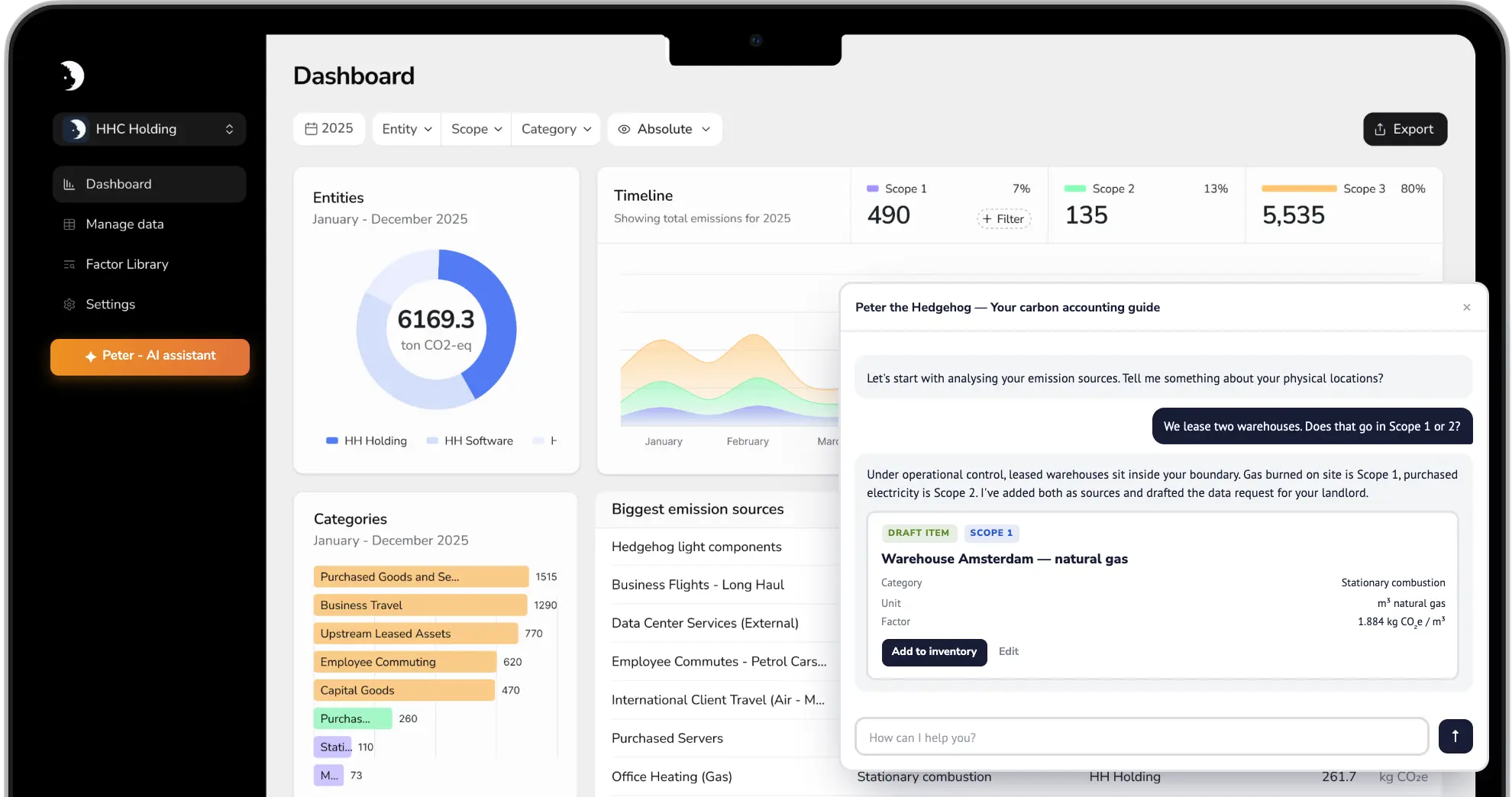
The Hedgehog platform supports entity management across locations and sites, with roles for data owners, auditors and managers. It carries over 20,000 spend-based and activity-based factors you can supplement with your own data. When a threshold moves and some entities leave scope, a structure that already knows which entity is which keeps working. The platform page reports 5,000+ users.
A limitation to know: a small business reviewer on G2 in August 2026 rated the platform 5 out of 5 and said there is no forecasting, which Hedgehog had told them was on the development list. Modelling what a rule change does to your reporting population is not something the tool does for you. For that question, and the boundary decisions behind it, carbon footprint consulting is the right route.
Sources: Staatsblad 2026, 381 and its nota van toelichting, Wetgevingskalender WGK028577, RVO rapportage WPM, Stb. 2023, 472, art. 18.11 and 18.12 Besluit activiteiten leefomgeving, Hedgehog platform, Hedgehog on G2. Read on 22 November 2026.
Facts on this page were last verified on 2026-11-22.

