
In short
- EUDR asks for no emissions figure of any kind. It is a market access rule, not a carbon rule.
- Downstream operators and traders do not file due diligence statements and need not ascertain that due diligence was exercised.
- The 30 June 2027 deferral is narrow: it excludes former timber regulation products and only covers firms already micro or small on 31 December 2024.
Most of the work people are told to do for EUDR is work the regulation does not ask for. It does not require a carbon footprint, a greenhouse gas inventory or a land-use emissions calculation. It does not require most EU manufacturers to file a due diligence statement, because since December 2025 they are downstream operators and downstream operators do not file one. And nothing in it applies before 30 December 2026. Here is what is actually being asked, claim by claim.
Does EUDR require a carbon footprint?
No. Not a figure, not an inventory, not a methodology.
The regulation is a market access rule. It permits a relevant product on the EU market where it is deforestation-free, was produced in accordance with the law of the country of production, and is covered by a due diligence statement. Nothing in the operative articles asks for a tonne of CO2e. Greenhouse gases appear in the recitals, which set out why the legislature acted, and recitals do not create obligations.
This one matters commercially, because deforestation and climate get bundled in proposals. If a quote in front of you prices an emissions platform as part of EUDR readiness, those are two separable projects and only one of them has a statutory date on it.
The relationship that is real is a data relationship. A food producer's scope 3 category 1 footprint and its EUDR file are both built from ingredient purchase data at supplier and origin level. Traceability collected for one improves the emission factors defensible in the other. That is an efficiency argument about the order you do things in. It is not a compliance argument and it should never be sold as one.
Do you have to file a due diligence statement?
Only if you are an operator, and most EU manufacturers are not.
Regulation (EU) 2025/2650 of 19 December 2025 created the downstream operator: a business that places on the market products made using relevant products that are already covered by a due diligence statement. The text is explicit that downstream operators and traders are not required to submit due diligence statements, and not required to ascertain that due diligence was exercised.
What is left for that group is small. Those above SME size must register in the EU information system before placing products on the market. The first downstream operator or trader in a chain, whatever its size, must collect and keep the due diligence statement reference numbers or the declaration identifiers. That is a goods-in data capture task, not a due diligence programme.
Which claims are wrong, and what is true instead?
| The claim you have probably met | Status | What the text actually establishes |
|---|---|---|
| "EUDR started on 30 December 2025" | Wrong, and very common | That date was itself an amendment and was replaced. Application is 30 December 2026 |
| "Every company selling covered products must file a due diligence statement" | Wrong since December 2025 | Only operators file. Downstream operators and traders do not |
| "Small companies have until 30 June 2026" | Superseded | The deferred date is 30 June 2027, and only for firms established as micro or small by 31 December 2024 |
| "Small companies are covered by the deferral for everything they sell" | Wrong | Products covered by the Annex to the old EU Timber Regulation are excluded from the deferral |
| "EUDR requires land-use emissions accounting" | Wrong | It requires geolocation, legality evidence, risk assessment and a statement. No emissions figure |
| "Soluble coffee and palm oil derivatives are covered from 30 December 2026" | Wrong | Delegated Regulation (EU) 2026/2102 adds them from 30 December 2027. The same act removed leather in September 2026 |
| "Another delay is coming" | Not supported | The Commission's review of 4 May 2026 declined to reopen the file |
Does the 30 June 2027 date give small companies a general reprieve?
No, and this is the carve-out most often quoted without its conditions.
The deferral runs to operators who are natural persons or micro or small undertakings within the meaning of Article 3(1) or 3(2) of Directive 2013/34/EU, and who were established as such by 31 December 2024. Two limits follow. A business that only became micro or small after that date does not qualify, because the qualifying moment is fixed in the past. And the deferral expressly excludes products covered by the Annex to Regulation (EU) No 995/2010: for those, micro and small operators start on 30 December 2026 alongside everybody else.
There is also a role limit hiding in the wording. The deferral is written for operators. If you are a downstream operator or a trader, the interesting question is not which date you get but which obligation set you carry, and that answer is much shorter.
Does EUDR care how big your company is?
Only for timing and for registration.
The prohibition itself binds by role in the chain. Whoever first places the relevant product on the EU market or exports it is an operator and carries the full obligation, whether that business has four employees or four thousand. Size enters twice and no more: it sets the deferred start date for micro and small operators, and it decides whether a downstream operator or trader has to register in the information system.
That is the opposite of how most reporting regimes work, and it is why a size-threshold habit of mind produces wrong answers here. A very small importer can carry the heaviest obligation in the chain.
What should you stop doing as a result?
Three things, and each of them is a live budget line somewhere.
Stop scoping an emissions deliverable into a deforestation project. There is no carbon figure in the requirement. If you want the ingredient-level footprint too, that is a legitimate second project with its own justification, and its own timing, and it usually goes better after the traceability work rather than before.
Stop building a due diligence statement process before establishing your role. The most expensive mistake available here is an operator-grade programme built by a company that turns out to be downstream of one. Establish the role first, in writing, per product line, with a date on the conclusion.
Stop working from the old product list. Delegated Regulation (EU) 2026/2102, published in the Official Journal on 17 September 2026, took cattle hides, skins and leather off Annex I and narrowed the tyre entry to tyre treads. The products it adds, such as soluble coffee and a list of palm oil derivatives, come in from 30 December 2027. Check each product line against the amended Annex I before you scope any work.
What is worth doing instead?
Trace one product line back to the point where the covered commodity entered the EU. That single exercise answers the role question, tells you whether reference numbers will be arriving or need requesting, and produces the supplier and origin records that make an ingredient footprint defensible later.
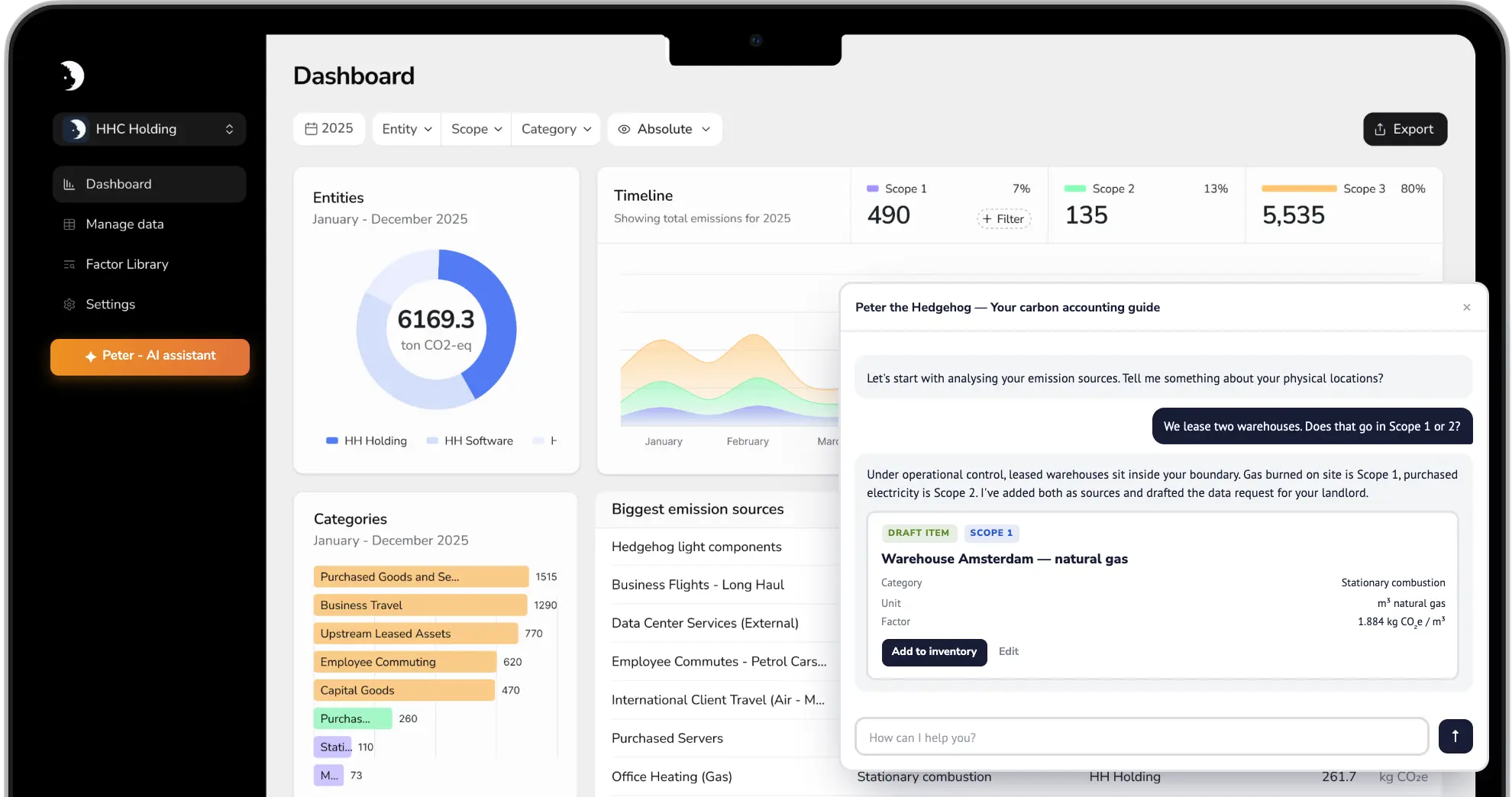
If the footprint is the deliverable somebody is actually waiting for, that is scope 3 consulting or a first inventory on the Hedgehog platform, which reports 5,000+ users. Worth knowing before you assume one tool covers everything: a mid-market reviewer on G2 in June 2026 described it as less complete as a broad ESG or CSRD reporting platform, with no data source management feature and no decarbonisation target monitoring. A deforestation evidence file is a document management problem more than a calculation problem, and it is better handled where it belongs. If the request landed on your desk as a customer questionnaire rather than a legal date, read the value chain cap on ESG questions first, and the VSME standard for the answer-once format.
Sources: Regulation (EU) 2023/1115, Regulation (EU) 2025/2650 and Commission Delegated Regulation (EU) 2026/2102 as published in the Official Journal, the European Commission EUDR page, and COM(2026) 191 final of 4 May 2026. Hedgehog facts from the Hedgehog platform and Hedgehog on G2. Verified 22 November 2026.
Facts on this page were last verified on 2026-11-22.

