In short
- Structural change forces a base year recalculation. Organic growth does not.
- Write the recalculation policy before you need it, or it becomes a negotiation about a number you already dislike.
- A restatement declared in advance reads as rigour. The same restatement found by a reader reads as a correction.
Comparability means this year's figure and last year's were produced the same way, so a difference between them reflects a change in the business rather than a change in how you counted. Keeping that true takes three things: a fixed base year, a written recalculation policy that says which events force you to restate prior years, and a restatement note whenever you use it. Anyone publishing a trend, a target or a reduction claim needs all three, because the trend is the thing being relied on, not the individual number.
What actually breaks comparability?
Seven events, and only one of them, an error, is a mistake. Boundary changes, when an entity or site joins or leaves the consolidation. Method changes, when a category moves to a different calculation approach. Factor updates, when the library refreshes and last year's activity data would now give a different answer. Acquisitions and disposals. Data improvements, when an estimated category becomes measured. Corrections of errors. And reporting period changes, when the financial year shifts.
Notice what is absent: the business getting bigger or smaller. Growth and decline are the signal. Everything above is noise that has to be separated from it, and separating it is what a restatement does.
How do you choose a base year, and when should you change it?
The base year is the fixed point every later figure is compared against. Choose it on three criteria: representative of normal operations, data good enough to defend, and a boundary you can still reconstruct. Avoid an abnormal year. One distorted by a plant shutdown, an unusual contract or a disposal makes every future reduction look better or worse than it was, and a reader who knows the sector will notice.
Then leave it alone. You do not change the base year because the trend is inconvenient. You recalculate it, which is a different operation: the base year stays the same year, restated onto today's basis. Moving to a later base year resets the clock and looks like what it usually is.
Where a scheme fixes a baseline for you, such as the plan behind PPN 006, year one anchors every refresh afterwards. Setting it carelessly stays expensive for a long time.
When does a change force a base year recalculation?
The dividing line is structural against organic. Structural means the shape of the organisation or the method moved. Organic means the same organisation did more or less of the same thing.
| What changed | Recalculate the base year? | What to disclose |
|---|---|---|
| Organic growth or decline | No | Nothing beyond normal commentary |
| Acquiring an existing entity | Yes | Which entity, from when, effect on each year |
| Selling or divesting an entity | Yes | Which entity, which years were adjusted |
| Opening or closing your own site | No | Note it in the commentary |
| Outsourcing or insourcing an activity | Yes | The activity and the scopes it moved between |
| Change of calculation method | Yes | Old and new method, size of the effect |
| Change of consolidation approach | Yes | Old and new approach, revised entity list |
| Material error discovered | Yes | What was wrong, which years, corrected figures |
The word doing the work there is material. Your policy should state a significance threshold, decided in advance and applied to every event, so the question is arithmetic rather than a debate about whether this restatement is worth the trouble.
What do you do when emission factors update?
This is the case that catches careful teams, because nothing about the business changed. Your provider refreshes a factor set, you re-run the year, the total moves. Two policies are defensible. Pick one and say which.
Contemporaneous factors. Each year keeps the factor set current when it was published, and prior years are never re-run. Simple and stable, but part of your trend is then a factor effect nobody can isolate.
Consistent factor set. The whole series is re-run on the current factor set each time the library updates. More work, and the trend genuinely reflects activity. Better if you are tracking towards a target, and what science-based target work tends to assume.
What is not defensible is mixing them: refreshing the current year on new factors while leaving prior years on old ones, silently. That moves the trend with no cause in the business, and it is what turns a reduction claim into a problem under the rules on substantiating environmental claims, covered in our claims checklist. Whichever you choose, record the factor set and vintage against every reported year, or neither policy can be evidenced later.
How do you handle an acquisition or a disposal?
Two decisions, and they are separate.
The current year. Include the acquired entity from the date control transferred, and say so. Part-year inclusion is normal. What causes trouble is a full year of its emissions appearing in a year you owned it for four months.
The prior years. If the acquisition is significant under your threshold, recalculate the base year and every intervening year as though you had always owned it, from the entity's historical data. Where that data does not exist, which is common for smaller deals, say so, state what you used instead, and note the effect. An honest gap is a limitation. A silent one is a finding.
Disposals run the same logic in reverse, and the reverse case is where the temptation lies: a disposal removes emissions from the current year, and leaving prior years untouched makes it look like a reduction you delivered. Restate, or the trend claims something you did not do.
What does a restatement note need to say?
Six lines, next to the figures rather than in an appendix. What changed. Why it triggered a restatement under your policy. Which years were affected. The figure as previously published and the figure now. The restatement effect separated from the real change. And who approved it.
Restatements read very differently depending on who finds them. Declared by you with the arithmetic shown, one reads as method discipline. Found by a customer comparing two of your reports, the same restatement reads as a correction you hoped nobody would notice.
What does Hedgehog do about the series, and what does it not?
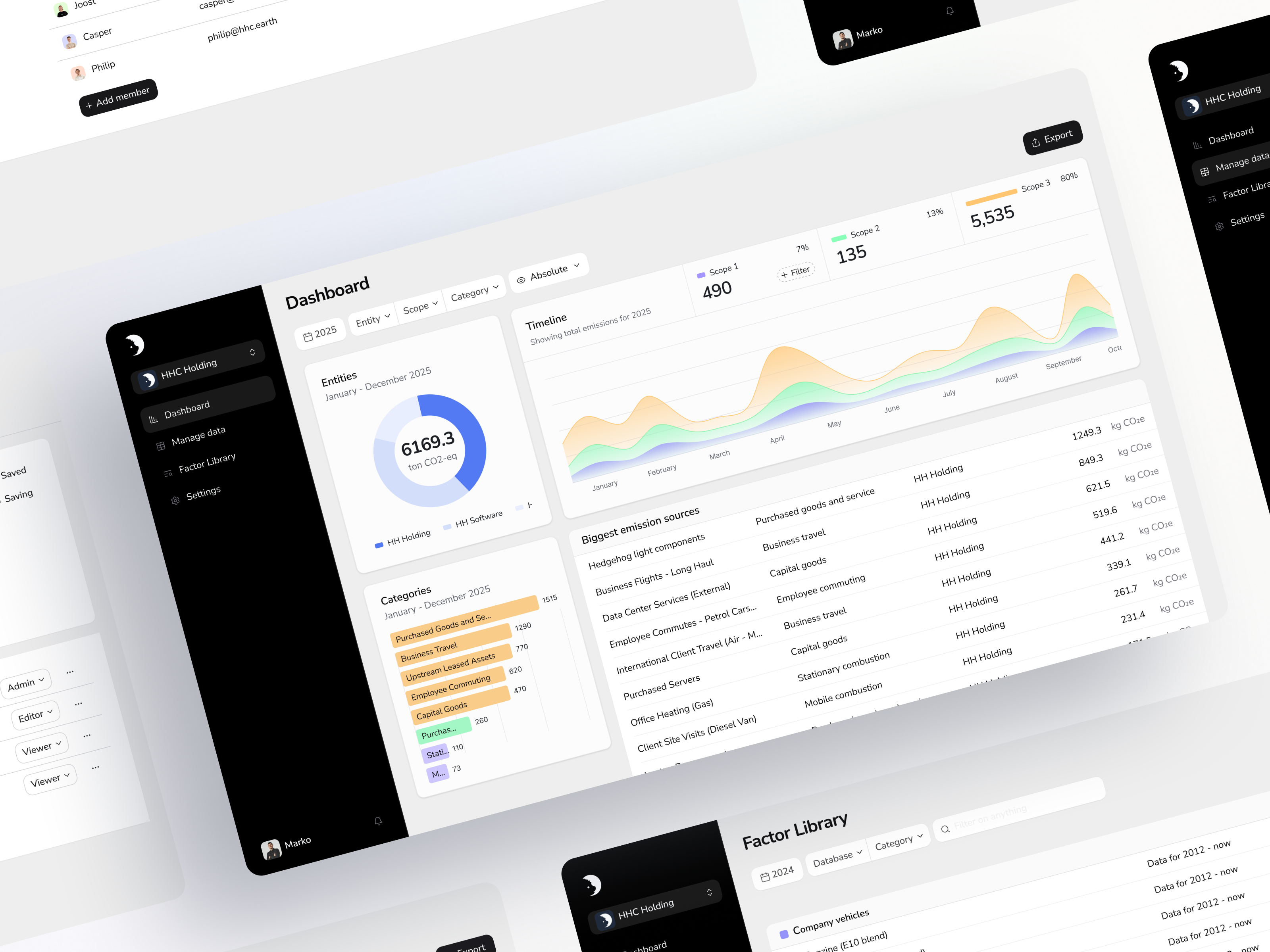
The platform is built around repeated annual cycles rather than one-off calculations: entity management across locations and sites, roles for data owners, auditors and managers so the same people run the same process each year, and a reporting module covering the GHG Protocol, PPN 006 and the CO2-Prestatieladder. On G2 in May 2026, a Mid-Market customer said all their data is in one place and it provides a good overview with a nice progression over different years. The factor library covers more than 20,000 spend-based and activity-based factors, and you can add organisation-specific or supplier-specific data as a category improves. Free account, no sales call, Pro from EUR 1,200 a year.
Two limits.
No forecasting. A Small Business customer on G2 in August 2026 said forecasting would be nice and that we had told them it is on the development list. If you want the series projected forward rather than reported backward, that is not there today.
The first year is still manual. A Small Business customer said on G2 in August 2026 that loading data takes a lot of manual labour, while everything works once it is in. A consistent series makes year two much lighter than year one, but year one is the one you have to budget for.
Where a restatement question is genuinely hard, an acquisition with no historical data for instance, that is a conversation rather than a feature, and it is what footprint consulting is for.
What should you do first?
Write the recalculation policy this year, before anything triggers it. One page: your significance threshold, the list of events that force a restatement, your factor update policy, and who approves one. Written in advance it is a rule. Written afterwards it is a negotiation about a number somebody already dislikes.
Then check the base year is still reconstructible. If nobody can say which entities were in it or which factor set produced it, fix that before publishing another comparison. You can rebuild a prior year alongside the current one on a free account and see how far apart they are.
Sources: GHG Protocol Corporate Standard, Chapter 5 "Tracking Emissions Over Time" (read 17 September 2026), Hedgehog platform, Hedgehog on G2. Hedgehog and G2 facts verified 27 August 2026.
Facts on this page were last verified on 2026-09-17.