In short
- Answering CSRD and filing CSRD are different jobs. Most software in this market is built for the filer.
- A supplier under 1,000 employees has a statutory right to decline requests above the voluntary standard, which changes what you need to buy.
- Judge tools on export flexibility. You will answer the same numbers in five different templates.
If you are a supplier rather than a filer, the seven tools worth looking at are Hedgehog, EcoHedge, Coolset, Greenly, Watershed, Persefoni and Seedling, and most of them are built for the company writing the sustainability statement rather than the company answering its questionnaire. What separates them on verifiable facts is price transparency, checked on 27 August 2026, and how easily numbers come back out in somebody else's template. Which one fits depends on whether you are answering one large customer, twenty of them, or heading toward a reporting obligation of your own.
We make one of these tools, and it appears here with the same dated sourcing and the same list of things it does not do.
Why is a supplier's problem different from a reporter's?
Because you are producing an input to someone else's report, not a report.
Companies in CSRD scope have to account for value chain emissions. Since Directive (EU) 2026/470 of 24 February 2026 that scope catches only undertakings exceeding both a net turnover of EUR 450 million and an average of 1,000 employees during the financial year, for financial years beginning on or after 1 January 2027. Both tests, not either. They cannot invent your numbers, so they ask you for them, and in manufacturing that request is the most common reason we see a first carbon inventory get started: your customers are in scope even when you are not.
The consequence for software selection is specific. A reporter needs breadth: double materiality, policies, targets, social and governance disclosures, a full statement. A supplier needs depth on exactly one disclosure, greenhouse gas emissions, plus the ability to hand the same numbers to every customer who asks, in whatever shape each one wants.
Buying a reporting suite to answer a questionnaire is the classic overspend in this segment. The distinction is worth ten minutes of reading in ESG reporting software versus carbon accounting.
What are your customers actually allowed to ask for?
More than most suppliers expect, and less than most questionnaires contain.
There is a statutory ceiling, and almost every supplier we speak to has either not heard of it or has the wrong version of it.
The cap is not set by VSME. VSME is an EFRAG standard carried by a non-binding Commission Recommendation, (EU) 2025/1710. The cap itself was created by Directive (EU) 2026/470 of 24 February 2026, which rewrote Articles 19a(3) and 29a(3) of the Accounting Directive and turned what used to be a constraint on the standards into a right you hold. A protected undertaking, meaning one that does not exceed an average of 1,000 employees in the preceding financial year and sits in the value chain of a reporting company, has the right to decline to provide information exceeding the voluntary standard when the request is made for sustainability reporting. The reporting company must not require more, must tell you which parts of its request exceed the standard and that you may decline, and any contractual clause to the contrary is not binding.
Read that employee number again, because it is the part suppliers get wrong. The protection is not limited to small companies. A 900-person manufacturer is a protected undertaking.
Three limits, and they are where a confident supplier gets caught out. The cap does not stop you sharing more voluntarily. It does not override an obligation you already signed up to within the voluntary standard. And it applies only to information gathering for sustainability reporting under that Directive, so it does nothing about due diligence requests, risk management requests or ordinary procurement questions. Refusing a supplier questionnaire that is really a procurement questionnaire is not a right, it is a commercial decision.
One caveat on timing. The voluntary standard that fixes the content of the cap, Commission Delegated Regulation C(2026) 5011, was adopted on 3 July 2026 and was still in scrutiny on 28 August 2026, and its Article 3 is written to apply from financial years beginning on or after 1 January 2027. The right exists; the exact list of what sits under the ceiling is not final.
In practice that turns your buying criterion into a very concrete test: can the tool produce a VSME-shaped emissions disclosure, and can it export the same underlying numbers into an arbitrary customer spreadsheet. Ask the second question harder than the first, because the shape of the voluntary standard can still move and the customer spreadsheets will not. We cover which requests fall outside the cap in what you can decline, and the standard itself in the VSME standard explained.
What does a customer questionnaire actually want?
Strip the branding off a dozen of them and the same rows appear.
| What is asked | What it needs from you | Where suppliers get stuck |
|---|---|---|
| Scope 1 and scope 2 for the reporting year | Fuel, fleet, purchased electricity and heat | Landlord will not release sub-metered data |
| Market-based and location-based scope 2 | Two figures, not one | Only one method was ever calculated |
| Selected scope 3 categories | Usually purchased goods and transport | Full fifteen categories are assumed to be required |
| Emissions allocated to their spend with you | Revenue or volume allocation, stated | No allocation basis is documented |
| Method and boundary statement | One page, consistent year to year | Boundary moved and nobody recorded it |
| Third-party verification status | An honest yes, no or planned | Ambiguity read as a no |
The fourth row is the one that surprises people. Large customers increasingly want a figure attributable to their own purchases from you, not just your company total. Ask early whether the tool can slice by customer, product line or entity, because retrofitting that later means recollecting.
What separates the seven on facts you can check?
We opened each vendor's public pricing page and G2 profile on 27 August 2026.
| Tool | G2 rating and reviews | Price found on 27 August 2026 | What else that check showed |
|---|---|---|---|
| Hedgehog | 4.7 from 9 reviews | Free account, Pro from EUR 1,200 a year | Names CSRD, SECR and SB253 as supported legislation |
| EcoHedge | Not listed on G2 | Lite free forever, Express Growth GBP 990 a year | Largest SME content footprint we measured, 46 SME and VSME pages |
| Coolset | 4.7 from 18 reviews | None found | Largest regulation footprint we measured, 197 regulation pages, heavy VSME investment |
| Greenly | 4.7 from 27 reviews | None found | Quote only |
| Watershed | 4.5 from 25 reviews | None found | Quote only |
| Persefoni | 4.8 from 11 reviews | No plan price found | Persefoni Pro is offered free, with paid add-ons |
| Seedling | 5.0 from 11 reviews | No plan price found | A Start for Free signup, which is not the same as a published free tier |
Two things worth saying about that table. The content footprint columns measure publishing effort, not product quality, and we include them because they tell you honestly where each vendor is aiming: Coolset at the regulation reader, EcoHedge at the SME. And review counts across this whole market are small, so a 5.0 from 11 and a 4.5 from 25 carry roughly the same weight.
EcoHedge's comparison page about us, read on 27 August 2026, claims native one-click integration with Xero, QuickBooks and Sage and a library of 277,000+ emission factors. We have not tested the integrations, so take that as their claim rather than our finding; the factor count, as published, is larger than the 20,000+ we publish. Worth knowing before you weigh it: the same page gets two things about Hedgehog wrong, stating that we publish no free tier and do not disclose pricing, when the platform page offers a free account with no sales call and the Pro price sits on our public G2 profile. If your entire scope 3 will be spend-based out of an accounting system, ask them to demonstrate that integration on your own ledger.
Which tool fits which supplier?
Sorted by pressure rather than ranked.
One large customer asking once a year. Buy the cheapest thing that produces a defensible scope 1 and 2 and exports cleanly. A free tier is genuinely enough for a first cycle. Hedgehog and EcoHedge are the two that publish a price you can read without a call, and there are two more ways in without paying: Persefoni offers Persefoni Pro free, and Seedling has a Start for Free signup, though Seedling publishes no plan, limit or price behind it, so treat that as a trial rather than a tier.
Twenty customers with twenty templates. Export flexibility beats every other criterion. Test it with two real customer spreadsheets before you buy anything, because this is where tools quietly fail.
A supplier who will fall into a reporting obligation themselves. You are buying for the year after next as well. That argues for something that keeps the method stable across years rather than something optimised for a single questionnaire.
A mid-market European company building a full sustainability statement. Now you are the reporter, not the supplier, and the shortlist inverts. Coolset is aimed at that audience, with 14 of its 18 G2 reviews from Mid-Market. Where the statement itself is the deliverable, the work is usually part software and part CSRD consulting.
A large group with a global supply base and investor scrutiny. Watershed and Persefoni sit in that conversation, and you should expect a quote plus services.
Where does Hedgehog fit, and where does it not?
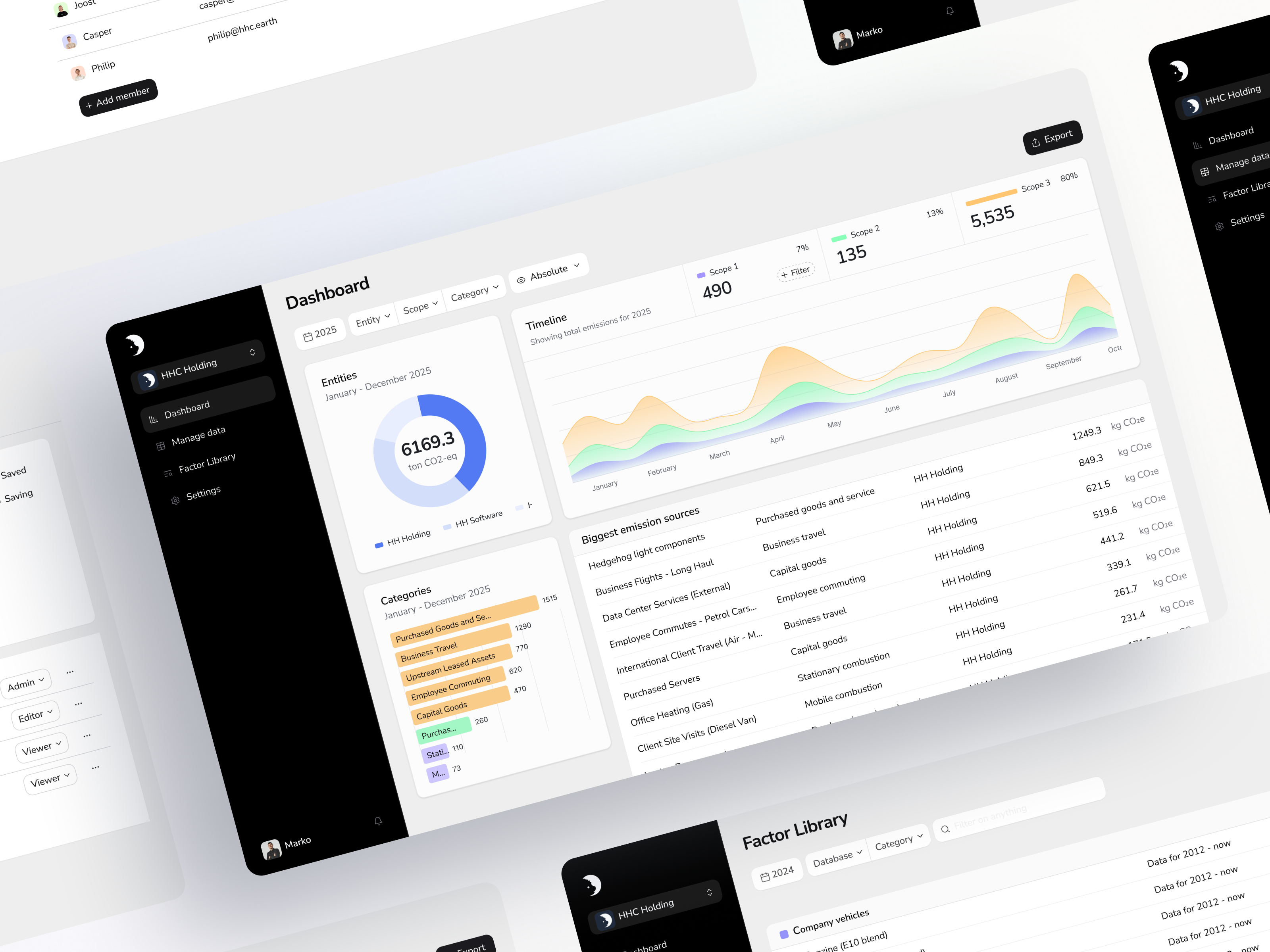
The platform builds a GHG Protocol inventory with an AI assistant for setup that walks you through identifying your data sources, data owners and documents, covers over 20,000 spend-based and activity-based factors plus organisation-specific and supplier-specific data you add yourself, handles multiple entities across locations and sites with roles for data owners, auditors and managers, and names CSRD, SECR and SB253 among supported legislation. It runs in English, French and Dutch, has a free account with no sales call, and Pro from EUR 1,200 a year. G2 rating is 4.7 from 9 reviews.
Two limitations that matter directly to this reader.
It is not a broad ESG platform, and a customer said so about CSRD specifically. A Mid-Market reviewer rated Hedgehog 3.5 out of 5 on G2 in June 2026 and wrote that if you are looking for a broader ESG data and reporting platform, for example for CSRD, this platform is less complete, with no data source management feature and no decarbonisation target monitoring. If you are the filer rather than the supplier, take that seriously.
Loading data is manual work. A Small Business reviewer wrote on G2 in August 2026 that it takes a lot of manual labour to load data, and that once the data is there it works perfectly, but getting it loaded is the challenging part. Every supplier in this segment underestimates that line, and the first cycle is always the expensive one.
What should you do first?
Take the questionnaire you have already received and work backwards from it. Mark every row you could answer today, every row you could answer with data you hold but have not compiled, and every row you genuinely cannot answer. That third list is your project, and it is usually four or five items long rather than fifty.
Then build scope 1 and 2 before anything else, because they are fast and they close most of the questionnaire. Add scope 3 categories only where a customer has actually asked. A wider selection framework, if you are still comparing, is in choosing carbon accounting software.
You can build that first inventory on a free account without a sales call, and find out how much of the questionnaire it already answers.
Sources: vendor pricing pages and G2 profiles for Hedgehog, EcoHedge, Coolset, Greenly, Watershed, Persefoni and Seedling, each read on 27 August 2026, together with the EcoHedge comparison page about Hedgehog, read on 27 August 2026. Hedgehog platform and Hedgehog on G2, both read on 27 August 2026. Scope thresholds, the value chain cap and the status of the voluntary standard from Directive (EU) 2026/470, Commission Recommendation (EU) 2025/1710 and Commission Delegated Regulation C(2026) 5011, read against the enacted texts. Page verified 17 September 2026.
Facts on this page were last verified on 2026-09-17.