
In short
- Below 50 tonnes of CBAM goods a year you are outside the regime. Weigh your tonnage before you chase a single supplier.
- Embedded emissions may come from the producer or from a Commission default value. Both are lawful, and only the first needs an accredited verifier.
- The dates are fixed: definitive regime from 1 January 2026, certificate sales from 1 February 2027, first report and surrender 30 September 2027.
CBAM is a border charge on the carbon embedded in imported goods, and the number it needs is a product number, not a company number. The definitive regime started on 1 January 2026. Certificate sales open on 1 February 2027 for 2026 imports, and the first report and surrender fall on 30 September 2027. But the first question is not which supplier to ask. It is how many tonnes you import: below 50 tonnes of CBAM goods in a calendar year you are outside the regime entirely, and on the Commission's own estimate that is around nine importers in ten.
So the project starts with a weight, not a questionnaire. We set out the mechanism in what you need to know about CBAM.
Are you actually in scope?
Two tests, and most importers fail the first one, which is good news for them.
The 50 tonne threshold. An importer whose CBAM goods do not cumulatively exceed 50 tonnes of net mass in a calendar year is outside the regime. The threshold was introduced by Regulation (EU) 2025/2083 and it is measured per importer across the year, not per consignment. The Commission's stated effect is that it takes roughly 90 percent of importers out while leaving roughly 99 percent of embedded emissions in scope, which tells you the shape of it: it is aimed at SMEs and occasional importers, not at the steel trade.
Which goods. CBAM covers cement, iron and steel, aluminium, fertilisers, electricity and hydrogen. The 50 tonne threshold applies to the first four. It does not apply to electricity or hydrogen, so there is no de minimis relief on either of those.
If you expect to cross the threshold you must apply for authorisation before you cross it. There was a concession for the first year: an importer who applied by 31 March 2026 could keep importing during 2026 while the decision was pending, even after passing the threshold. That date is gone, so an importer only now discovering this is on the ordinary route.
Above the threshold, from 1 January 2026 customs will not clear CBAM goods for anyone who is not an authorised CBAM declarant. That is the part with teeth, and it is a customs problem before it is a carbon problem.
Which CBAM dates actually matter to you?
Three, and they are not the same date for the same thing.
1 January 2026. The definitive regime began, across all six sectors above. Imports from this point onwards carry an obligation rather than a reporting exercise.
1 February 2027. Certificate sales open for 2026 imports. This is the point at which the exercise starts costing money rather than time.
30 September 2027. The first report and the first surrender of certificates. That is your real deadline, and it covers a year that has already happened.
The awkward part of that sequence is that the data window closed before the reporting window opened. Emissions embedded in goods you imported in 2026 have to be evidenced in 2027, from suppliers who may have had no reason to record them at the time. If you have not started asking, you are reconstructing history rather than collecting data.
Is CBAM a job for carbon accounting software at all?
Partly, and it is worth being precise about which part, because the category name misleads people here.
Carbon accounting software, including ours, calculates organisational footprints. It answers the question "what did this company emit last year" using activity data and emission factors. CBAM asks a different question: "how much carbon is embedded in this consignment of this good from this installation."
Those are different objects. One is a company boundary over a year. The other is a product boundary over a production route, and the answer is supposed to come from the producer or from a published default value, not from your own estimation.
So the honest split looks like this.
| What CBAM needs | Where it comes from |
|---|---|
| Embedded emissions per tonne of good | Your supplier's installation, or a Commission default value |
| Identification of goods in scope | Your customs and purchasing records |
| Verification and evidence trail | Supplier documentation, held and retrievable |
| Certificate volumes and cost exposure | Your import volumes multiplied by the embedded figure |
| The wider inventory the obligation sits inside | Your own organisational carbon accounting |
| A product footprint where a supplier cannot give you one | Specialist LCA or PCF work, not a subscription |
Software earns its place in rows two, four and five. It does not earn its place in row one, and a vendor implying that a carbon platform will generate your embedded emissions figure is describing something the regulation does not accept from you.
Row one has two lawful answers and it is worth knowing both. You can use actual emissions from the installation that made the goods, or you can use default values published by the Commission. Only the first has to be checked by an accredited verifier. That makes the choice commercial rather than moral: for a large, steady flow from a producer who will engage, actual emissions are usually worth the effort and usually cheaper per tonne. For a small or occasional flow, or a producer who will not answer, the default value is the route the regulation intends you to take, not a corner you are cutting.
Where does the data actually come from?
From your purchasing and customs records first, then from your suppliers.
Customs and import records. You cannot ask the right question until you know exactly which commodity codes you brought in, in what quantity, from which producer. Most importers discover their own list is less tidy than they assumed.
Supplier and installation data. Embedded emissions per tonne, tied to an installation. This is a procurement conversation, not a data upload. It usually takes several rounds, and for the flows where it does not converge you fall back to a default value rather than keep chasing.
Your own energy and process data, where you also produce. If you both import and manufacture, the two exercises overlap and you want one method across them.
Your existing organisational inventory, which is what tells you whether the imported goods are a small line or the dominant one.
The pattern we see is that the first CBAM cycle is 80 percent supplier chasing and 20 percent calculation. Budget it that way.
What should the software do around a CBAM obligation?
Four things, none of which is "file the declaration for you".
Hold supplier-specific figures alongside generic ones. When a producer gives you a real number for a real installation, it has to replace the placeholder and stay replaced, with the original still visible.
Trace every entry back to its source. A CBAM position invites scrutiny. If you cannot show how a supplier document became a reported figure, you are asking an auditor to take your word for it.
Keep the method stable across years. Your 2026 and 2027 positions get compared. A quiet factor library change between them turns a flat year into an apparent movement.
Roll up multiple entities. Importers rarely import through one legal entity, and the exposure calculation only makes sense consolidated.
What does Hedgehog do around CBAM?
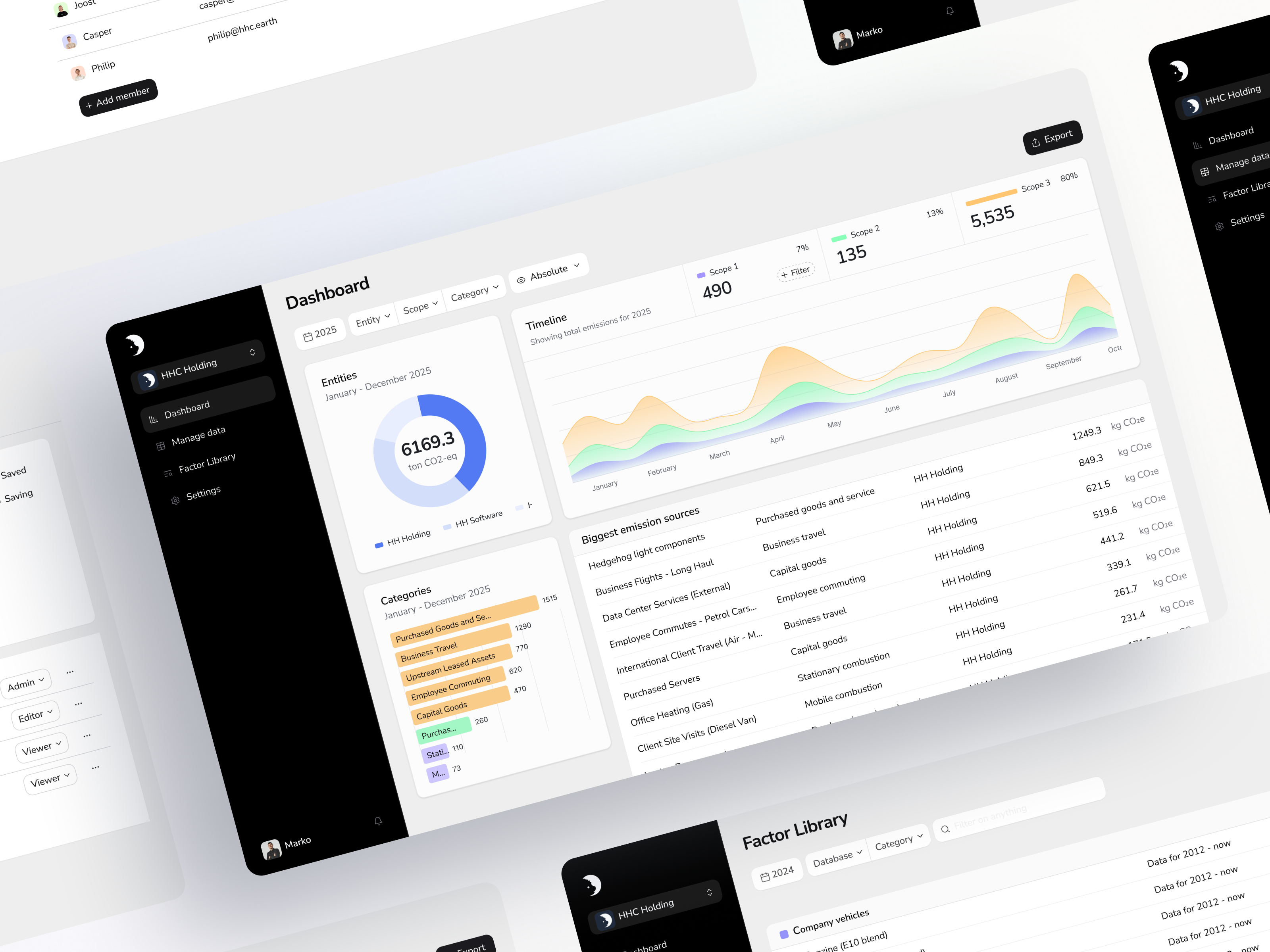
The platform builds the organisational footprint that a CBAM obligation sits inside. It guides you through GHG Protocol setup, a data collection plan and inventory building with an AI guide, holds over 20,000 spend-based and activity-based factors, and lets you add your own organisation-specific or supplier-specific CO2 data. That last mechanism is how supplier figures enter the record. Entity management covers locations and sites with roles for data owners, auditors and managers.
Free account with no sales call. Pro from EUR 1,200 per year.
Three limits you should weigh before you buy anything for CBAM specifically.
The platform does organisational footprints. Product footprints are a service. An LCA, an EPD, an MKI or a product carbon footprint is delivered by our people as LCA consultancy, not by a subscription. Since CBAM is fundamentally a product-level question, that distinction is the most important thing on this page. You can buy both from us. You should know which is which before you sign.
Getting data in is the slow part. A small business customer said on G2 in August 2026 that once the data is loaded everything works perfectly, and getting it loaded is the challenging part. With supplier documentation arriving in a dozen formats, that is the honest shape of a first CBAM cycle.
Traceability is not complete. A mid-market reviewer on G2 in July 2026 asked to see the conversion factor and the distance calculation applied to their inputs, because they wanted to confirm that a platform entry matched their original file. For an audited CBAM position, ask us directly what an export of a single line looks like before you rely on it.
What should you do first?
Add up the tonnage. Pull your import records for 2026, list the commodity codes and producers, and total the net mass of CBAM goods. Not an estimate, the actual list. If it comes in under 50 tonnes for the year, and none of it is electricity or hydrogen, you are done and the rest of this page is background.
If it comes in over, write to your largest producers and ask for embedded emissions per tonne at installation level. Ask now rather than in mid 2027, because the answer takes months and the deadline does not move. Where a producer will not or cannot answer, use the Commission's default value and spend the time on the flows where a real number is worth having.
While you wait, get the organisational footprint done, since it is the context the CBAM number gets read in and it is the faster half. You can start a free account and build one without a sales call, or book a meeting if you want to talk through where the product-level work starts. If the wider picture is what you need first, carbon footprint consulting is the service side of the same work.
Sources: the CBAM regulation as amended, Regulation (EU) 2025/2083, read 16 September 2026, for the 50 tonne threshold in Article 2a, the two methods in Article 7(2), the verification duty in Article 8(1) and the dates in Articles 6, 20 and 25. Sector list from the Commission's CBAM page, read the same day. Platform facts from the Hedgehog platform page and customer reviews on our G2 profile, both read 27 August 2026. Due for re-check before the 2027 reporting window.
Facts on this page were last verified on 2026-09-16.

