
In short
- The tool has to hold the method, because the person doing this will forget it between reporting cycles. That is the whole requirement.
- The risk is not a wrong number. It is a number nobody can reproduce after the person who built it changes jobs.
- Start with scope 1 and 2 from data you already hold. Do not start with a data collection programme.
Carbon accounting software for a company with no sustainability team has one job above every other: it has to hold the method, because the person doing the reporting will not remember it a year from now. This is for the office manager, the financial controller or the operations lead who was handed a customer questionnaire and told to sort it out. The next step is small and specific: get scope 1 and scope 2 out of data you already hold, in an afternoon, before you agree to anything larger.
That first number tells you how big the rest of the job is. Nothing else you can do this week is as useful.
Who actually ends up doing this?
Not a sustainability specialist, because there is not one. In our experience it lands on whoever is closest to the trigger.
A financial controller, if the trigger was a bank, an investor or a group reporting request. They tend to do this well, because they already think in boundaries, periods and restatements.
An operations or QHSE lead, if the trigger was a tender or a certification. They have the site data but not the reporting habits.
A marketing or commercial lead, if the trigger was a customer questionnaire. They are closest to the deadline and furthest from the data.
The owner, in a smaller firm, usually late in the evening.
All four have the same problem, which is not intelligence or motivation. It is discontinuity. Carbon reporting is annual. You will do it, learn it, and then not touch it for eleven months, by which point you have forgotten which factor you used for the van fleet and why.
What does the absence of a specialist actually cost you?
Four things, in rough order of how much damage they do.
Method drift. Year two gets calculated slightly differently from year one, so the comparison shows a reduction or an increase that is really just a methodology change. This is the single most common failure and it is invisible until somebody audits it.
Key person risk. The method lives in one person's head and one spreadsheet on one laptop. When they leave, the next reporting cycle starts from zero. Every consultant has been called in to rebuild a footprint that already existed once.
Over-scoping. Without someone to say what is material, people try to measure everything, stall on the hardest category, and produce nothing. A complete scope 1 and 2 beats an abandoned scope 3.
Buying the wrong thing. Enterprise ESG suites are sold to companies who need a carbon number, and the implementation cost exceeds the value by a wide margin. We wrote about the difference in ESG reporting software versus carbon accounting.
Which features actually matter when nobody owns this full time?
The feature list you should care about is short, and it is not the one on most vendor comparison pages.
| What matters | Why it matters here | What to ask for |
|---|---|---|
| Guided setup | Nobody knows the GHG Protocol by heart | A walkthrough that names the next step |
| Method held in the tool | Eleven months pass between sessions | Last year's boundary and factors, visible |
| Data from what you already hold | You cannot start a metering programme | Upload of energy bills, fuel cards, spend |
| Help you can reach inside the product | The blocker is one question, not a project | A human expert, not a ticket queue |
| Roles for other people | You should not be the only one entering data | Separate logins for data owners |
| Honest pricing in year two | This is an annual routine, not a project | A published renewal price |
The item people underweight is the second one. A tool that recalculates cleanly but does not remember why last year's number was what it was leaves you with the same problem you started with.
What should you refuse to buy?
Three things, and refusing them will save you more than any discount.
An implementation project. If a vendor cannot show you a working number without a multi-week onboarding engagement, the tool is designed for a team you do not have.
A quote-only price. You are a small buyer with no leverage and no procurement department. If the number is not published, you will not find out whether it is fair. We went looking at eleven competitors on 27 August 2026 and actually reached eight pricing pages; three returned a 404, so we cannot say what those publish. Of the eight we read, exactly one published plan prices: EcoHedge, with a free-forever Lite tier and Express Growth at GBP 990 a year. Two more let you start free without publishing a plan price: Persefoni offers Persefoni Pro free, and Seedling has a Start for Free signup, though its pricing page names no free plan. The remaining five route you to a quote or a demo. So the market is worse than it looks on price transparency, but not as closed as a shortlist of quote-only vendors suggests: there is a way in at three of the eight without a sales call.
Anything sold on the promise of automation you cannot verify. Ask to see the actual upload step for your actual data. Every carbon tool in the world looks automated in a demo built on clean sample data.
What does Hedgehog do for a company with no sustainability team?
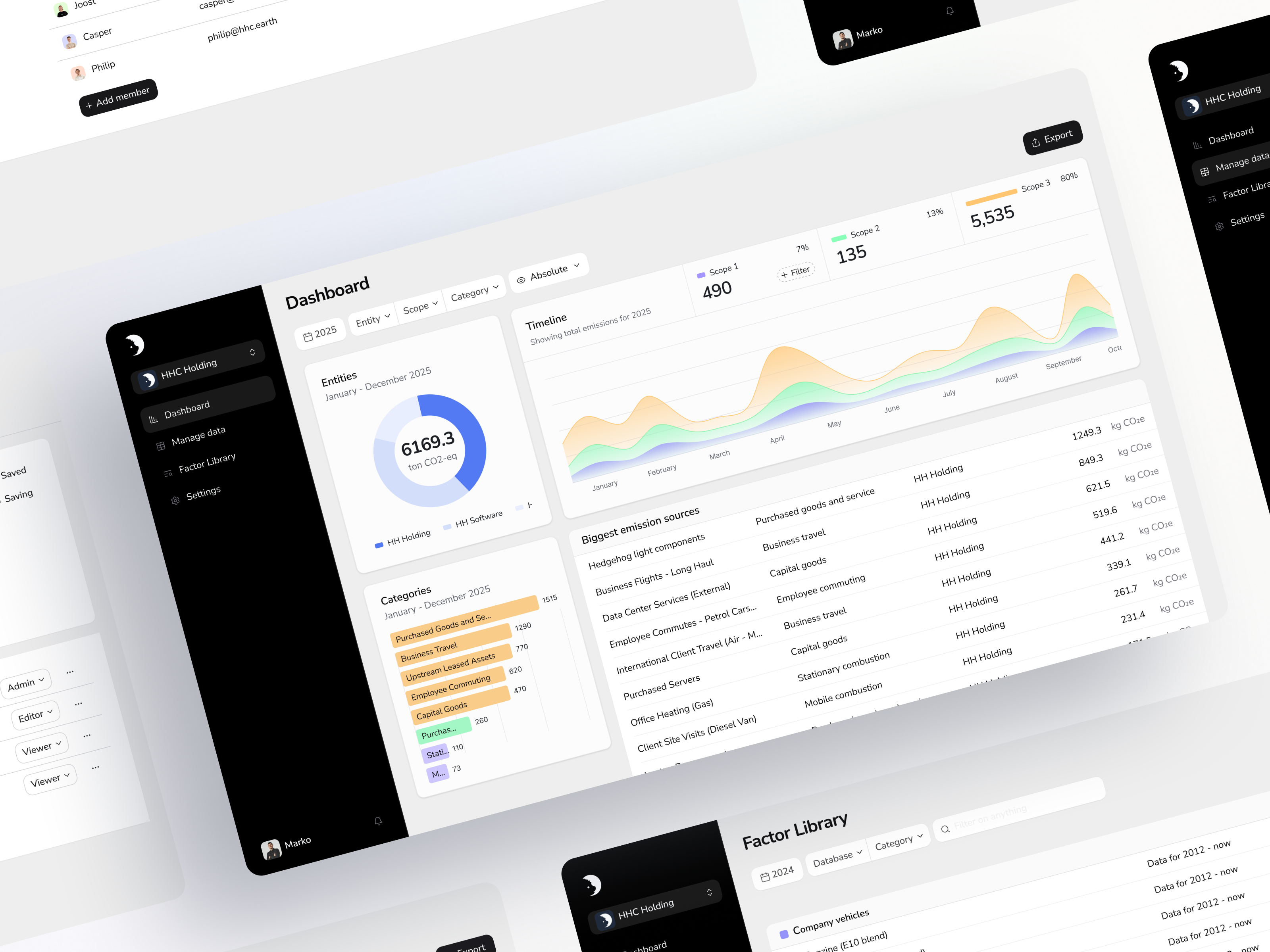
The platform guides you through GHG Protocol setup, identifying your data sources, data owners and documents, and building a GHG inventory, with an AI guide taking you through it and human GHG experts reachable in-app. It holds over 20,000 spend-based and activity-based factors, so you can start from spend when you do not yet have activity data. Entity management covers multiple locations and sites, with roles for data owners, auditors and managers, which is how you spread the data entry rather than carrying it alone. Reporting outputs include the GHG Protocol, PPN 006 and the CO2-Prestatieladder, and named legislation support includes CSRD, SECR and SB253.
Free account with no sales call. Pro from EUR 1,200 per year, published rather than quoted.
Three honest limits.
Getting the data in is real work. A small business customer said on G2 in August 2026 that once the data is loaded everything works perfectly, and getting it loaded is the challenging part. If you are doing this alongside another full time job, plan for days rather than hours in year one.
There is no forecasting. A small business reviewer said so on G2 in August 2026 and noted we had told them it is on the development list. If you need scenario modelling for a board paper, that is not what this does today.
Product footprints are a service. LCA, EPD, MKI and PCF work is delivered by our people, not by the subscription. The platform does organisational footprints. If a customer is asking for a per-product number, carbon footprint consulting is the right door.
What should you do first?
Get scope 1 and scope 2 from what is already on your desk: energy bills, fuel cards, a mileage claim export. That is a short afternoon and it gives you a defensible number for most questionnaires.
Then write down what you did, in the tool rather than in a document, because next year you will not remember. If you are starting completely cold, our carbon accounting from scratch guide walks through the sequence, and choosing the right carbon accounting software for SMEs covers what to compare.
You can start a free account without a sales call and find out where you actually stand before committing budget or explaining anything to anyone.
Sources: the GHG Protocol Corporate Accounting and Reporting Standard for the inventory requirements. Hedgehog platform and Hedgehog on G2, read on 27 August 2026. The pricing census covers eleven competitors, whose own pricing pages were read on 27 August 2026; three of the eleven returned a 404 and are reported as unreached rather than as quote-only. Page verified 16 September 2026.
Facts on this page were last verified on 2026-09-16.

