In short
- The scope test is both EUR 450 million turnover AND 1,000 employees. Most buyers looking for CSRD software fail it and no longer have to report.
- ESRS E1 wants gross scope 1, scope 2 on two bases, scope 3 by significant category, and a limited assurance opinion over all of it.
- Out of scope does not mean unasked. Suppliers under 1,000 employees now have a statutory ceiling on what an in-scope customer may demand.
Most companies that think they need CSRD software do not. Since February 2026 the duty reaches only undertakings above both EUR 450 million of net turnover and 1,000 employees, and it restarts for financial years beginning on or after 1 January 2027. Fall below either number and you are out. The questionnaires have not gone away though, because the companies still in scope must report value chain data and they will come to you for it.
So this page does two things: settle whether you are in scope, then be useful either way.
Are you actually in scope for CSRD?
Run the test before you run a demo. Directive (EU) 2026/470 of 24 February 2026 rewrote Articles 19a and 29a of the Accounting Directive: undertakings exceeding a net turnover of EUR 450,000,000 and an average of 1,000 employees during the financial year. Parents are measured on a consolidated basis.
Both tests. Not either.
| Your situation | In scope? |
|---|---|
| EUR 2 billion turnover, 600 employees | No. Fails the headcount test. |
| 4,000 employees, EUR 300 million turnover | No. Fails the turnover test. |
| EUR 600 million turnover, 1,200 employees | Yes, from financial year 2027. |
| Listed SME on an EU regulated market | No. That wave was deleted. |
One correction worth making loudly: the "large undertaking" test most 2025 guidance quotes, roughly 250 employees and EUR 50 million of turnover, stopped being the CSRD trigger in February 2026.
When does the new regime actually bite?
Two amendments in under a year, which is why published advice contradicts itself.
| Date | What |
|---|---|
| 17 April 2025 | Directive (EU) 2025/794 pushed waves two and three back by two years. |
| 24 February 2026 | Directive (EU) 2026/470 replaced the thresholds and deleted the listed SME wave. |
| 1 January 2027 | First financial years reported under the revised scope. |
| 19 March 2027 | Deadline for Member States to transpose 2026/470 into national law. |
CSRD is a directive, so the obligation reaches you through your own country's implementing law. Do not take a national start date from a vendor without seeing the national act.
The standards are mid revision too. A simplified version of the European Sustainability Reporting Standards was adopted on 3 July 2026 but was still in Parliament and Council scrutiny at the end of August 2026, so what applies is Delegated Regulation (EU) 2023/2772 as amended by (EU) 2025/1416. A tool marketed as ready for the new ESRS is describing a document that is not yet law.
If you are in scope, what does ESRS E1 ask for?
More than a footprint. Disclosure Requirement E1-6 asks for gross scope 1, scope 2, scope 3 and total in tonnes of CO2 equivalent. Three details underneath decide whether a tool can do it.
Scope 2 twice. Location based and market based, as two separate figures, and the total presented on both bases. A tool that stores one number per site cannot do this.
Scope 3 by significant category, meaning the categories that are a priority for you rather than all fifteen automatically. You do have to defend the selection, and if that is the hard part, scope 3 is where the effort goes.
Intensity per net revenue, with the denominator tied back to a line in your financial statements.
The boundary is the other half. Your statement covers the same reporting undertaking as your financial statements, but for greenhouse gases associates, joint ventures and jointly controlled operations come in at 100 percent where you have operational control, not at your equity share. Two boundaries side by side in one report. Ask a vendor to show you that, not describe it.
The statement then carries a limited assurance opinion. Not reasonable assurance: that step was removed in February 2026, and harmonised standards are not due until 1 July 2027, so your provider works to national ones and will ask how each figure was produced. Traceability from source file to reported number is what matters most, and it is what demos skip.
If you are not in scope, why are you still being asked?
Because your customer is, and value chain information is part of what they report. The standards let them estimate with sector averages, but most would rather ask you.
What changed in February 2026 is that you now have a defence. Directive (EU) 2026/470 turned the value chain cap into a statutory right. If you do not exceed an average of 1,000 employees you are a protected undertaking, and you may decline to provide information beyond the voluntary reporting standard where the request is made for your customer's CSRD reporting. A contract clause saying otherwise is not binding, and if they ask anyway they must tell you which parts exceed the cap and that you may refuse.
The cap has edges, and overstating them will cost you a customer. It covers CSRD reporting only, so it does not touch due diligence, a tender or a rating questionnaire, and it does not stop you sharing voluntarily. Which requests fall inside it is the subject of refusing ESG questions.
The ceiling is the voluntary reporting standard, and that standard is not in force yet either. The delegated act fixing its contents was adopted on 3 July 2026 and was still in scrutiny at the end of August 2026, so the working reference until it is published is EFRAG's VSME standard as carried by Commission Recommendation (EU) 2025/1710, which binds nobody. What that covers is set out in the VSME standard.
What should the software do, depending on your answer?
| What you need | In scope | Not in scope, answering customers |
|---|---|---|
| Emissions | Scope 2 on both bases, scope 3 by category, intensity per revenue | Scope 1 and 2, scope 3 where asked |
| Boundary | Financial consolidation plus operational control | One legal entity, usually |
| Evidence | Traceable enough to survive limited assurance | Enough to answer a follow up |
| The rest of it | Social and governance disclosures, targets, transition plan | A short self declaration |
That last row decides your shortlist. A carbon accounting platform is not an ESG reporting suite: ESG reporting software versus carbon accounting is the distinction to settle first.
What does Hedgehog do here, and where does it stop?
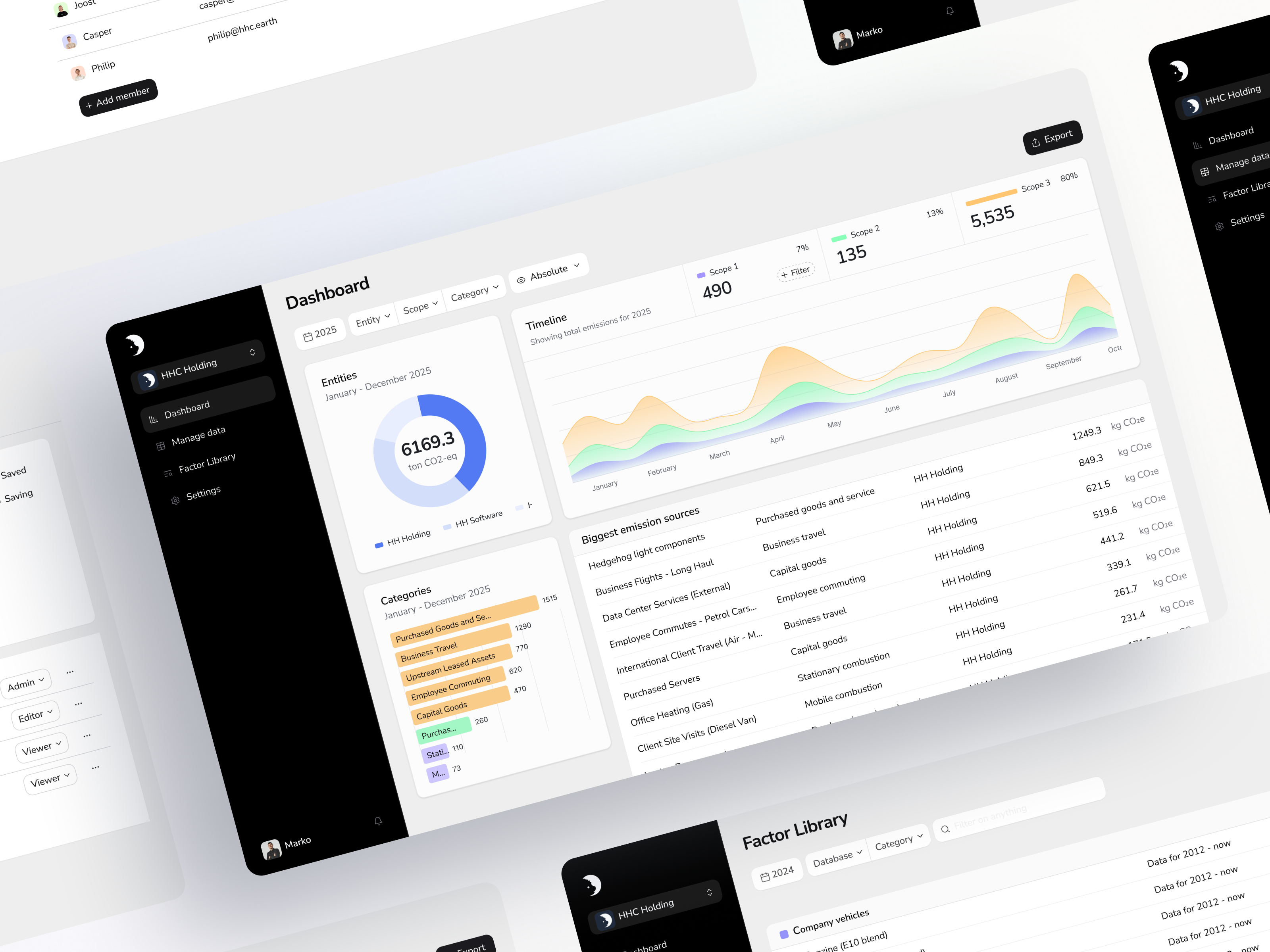
The platform names CSRD in the legislation it supports, alongside SECR and SB253. It guides you through GHG Protocol setup, identifying your data sources, data owners and documents, and building an inventory, with an AI guide throughout and human GHG experts in the product. It covers over 20,000 spend based and activity based factors, handles entities across locations and sites, and lets you invite colleagues, consultants and auditors as data owners, auditors or managers. Free account, no sales call. Pro from EUR 1,200 per year.
Now the part that matters most here.
We are not a CSRD reporting suite, and a customer said so publicly. A Mid-Market reviewer rated us 3.5 out of 5 on G2 in June 2026 and wrote that if you are looking for a broader ESG data and reporting platform, for example for CSRD, this platform is less complete, adding that it has no data source management feature and no decarbonisation target monitoring. That review is about this exact use case, and we would rather you read it now than find it in month three. Assembling the full statement is CSRD consultancy work, with the platform underneath doing the greenhouse gas half.
Traceability is a live gap, and an assurance provider will find it. Another Mid-Market reviewer, 4 out of 5 on G2 in July 2026, could not see the conversion factor applied between their input file and the platform entry. If yours is going under a limited assurance opinion, ask us about that.
What should you do first?
Run the threshold test on your last balance sheet date, consolidated if you are a parent. Ten minutes, and it changes what you are shopping for.
If you clear both thresholds, your first financial year is 2027, so the work now is boundary and data rather than software selection. Settle what sits inside the financial consolidation and what arrives through operational control, then find out which entities cannot yet produce a market based scope 2 figure. That is where schedules slip.
If you do not clear both, stop buying for CSRD. Build a repeatable scope 1 and 2 inventory you can reuse across every customer who asks, keep the method stable so year two compares to year one, and treat the value chain cap as your ceiling. A free account gets you a first number without a sales call, and you can book a meeting to work out which side of the line you are on.
Sources: Directives (EU) 2022/2464, (EU) 2025/794 and (EU) 2026/470, Directive 2013/34/EU, Commission Delegated Regulations (EU) 2023/2772 and (EU) 2025/1416, and Commission Recommendation (EU) 2025/1710, read against the Official Journal on 28 August 2026. Hedgehog platform and Hedgehog on G2, both read on 27 August 2026. Page verified 17 September 2026.
Facts on this page were last verified on 2026-09-17.