In short
- Energy companies are typically in CSRD scope under the revised thresholds, so this is assured reporting rather than a marketing exercise.
- Market-based and location-based accounting produce two different, both correct, answers. Report both and keep them separate.
- The emissions from the energy you sell usually dwarf the emissions from running the company.
Energy companies are typically in CSRD scope under the revised thresholds, which makes this assured reporting rather than a voluntary exercise. The emissions sit in two places: scope 1 from your own generation and operations, and the emissions from the energy you sell, which usually dwarf everything else. The software has to carry a dual market-based and location-based scope 2 position, hold grid and fuel mix factors by year and by country, and produce an audit trail that survives an assurance provider asking how a figure was built.
Which rule applies to an energy company, and when?
CSRD is the one that governs the shape of the work. Energy companies are typically in scope under the revised thresholds, which changes the exercise in three concrete ways.
It is assured. Somebody external checks the method, not just the total. That moves the requirement from "produce a number" to "produce a number with a documented route back to source data".
It is comparative. Prior years are restated and compared, so a change of method has to be disclosed as a change of method rather than absorbed into a trend.
It reaches into the value chain. Your own suppliers get asked, and so do you, by everyone downstream. Smaller counterparties often want a standard format to report once against, which is where the VSME standard comes in.
For a regulatory reporting lead, none of this is unfamiliar. It is the same discipline already applied to other regulated submissions, which is an advantage this sector has over most.
Where do energy sector emissions actually sit?
In two lines that need to be kept visibly separate, because mixing them produces a number nobody can interpret.
Scope 1 from generation and operations. Combustion at your own plant, fugitive emissions from networks and storage, your fleet. This is the part you control and the part with the best data quality, because generation is metered to a standard no other sector matches.
The emissions from the energy you sell. Downstream, in the hands of your customers, and typically far larger than everything you emit directly. It is calculated from volumes sold and the appropriate factor rather than measured.
That asymmetry is the sector's defining feature. A retailer with almost no scope 1 can have an enormous total. A generator with heavy scope 1 can look better after a fuel switch that changed nothing downstream. Reporting one without the other is how both get misread.
Why do market-based and location-based give different answers?
Because they are answering different questions, and both answers are correct.
Location-based uses the average emissions intensity of the grid where the consumption happened. It tells you the physical reality of the electricity system you sit in.
Market-based uses the contractual instruments attached to your supply: guarantees of origin, certificates, power purchase agreements. It tells you what you procured.
| Aspect | Location-based | Market-based |
|---|---|---|
| Question answered | What did the grid emit | What did I contract for |
| Driven by | National or regional grid factor | Certificates and supply contracts |
| Moves when | The grid mix changes | Your procurement changes |
| Weak spot | Insensitive to your buying | Can show a reduction with no physical change |
| In an assurance review | Factor vintage and geography | Instrument evidence and no double counting |
Report both. Keep them in separate fields rather than as one adjusted total, because an assurance provider will ask to see them separately anyway, and because a market-based improvement with a flat location-based figure is a specific, explainable thing rather than something to hide.
Two operational rules follow. Fix the factor vintage you use for each reporting year and record it, because grid factors are published in arrears and get revised. And keep the certificate evidence with the entry, since instrument-backed claims are exactly where an unsubstantiated environmental claim can appear without anyone intending one, a risk we set out in the EmpCo claims checklist.
What does the software have to produce for an audit?
Five capabilities, and they are stricter than a general purpose tool usually offers.
Dual scope 2 reporting as a first class feature. Not a manual second calculation. If a tool treats market-based as an adjustment, it will not survive review.
Factor sets versioned by year and by country. Multi-country supply means multiple grid factors, and last year's number has to keep using last year's factor.
Entity and site level detail that consolidates. Generation assets, network areas and retail entities in one structure, without double counting energy that moves between them.
A traceable route from source record to reported figure. Ask for an export of a single line item showing the input, the factor and the calculation.
A restatement mechanism. When a factor is revised, you need to restate while keeping the originally published figure visible.
What does Hedgehog do for energy companies?
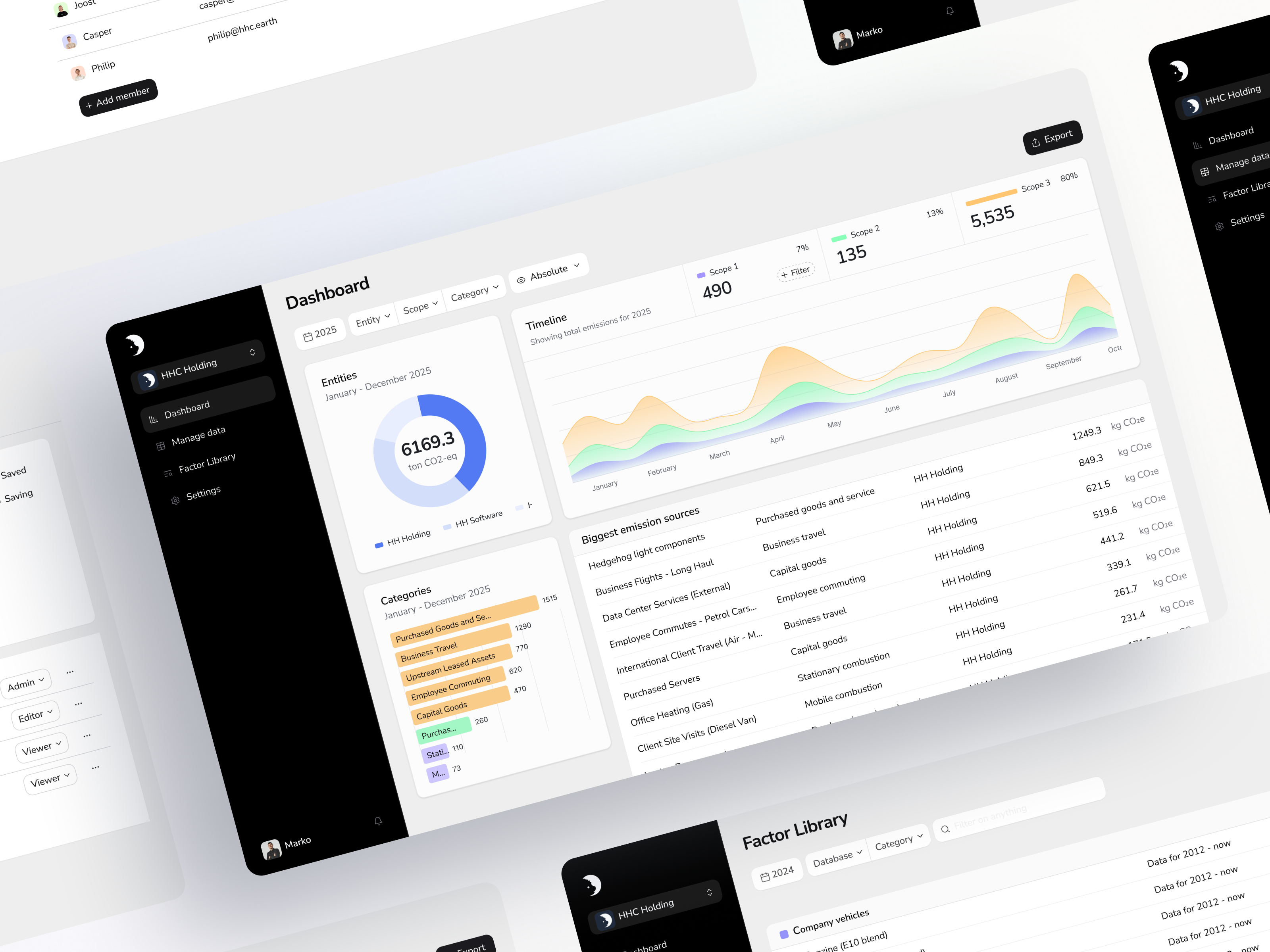
The platform guides you through GHG Protocol setup, a data collection plan and inventory building, with an AI guide and human GHG experts reachable in-app. It holds over 20,000 spend-based and activity-based factors and lets you add your own organisation-specific or supplier-specific CO2 data, which is how sector-specific values enter the record. Entity management spans locations and sites with roles for data owners, auditors and managers. Named legislation support includes CSRD, SECR and SB253.
Free account with no sales call. Pro from EUR 1,200 per year.
Three limits, and for this sector the first one is the one to press us on.
Applied factors are not fully exposed today. A mid-market reviewer on G2 in July 2026 asked to see the conversion factor and the distance calculation applied to their inputs, so they could confirm that a platform entry matched their original file. For a regulatory reporting lead facing assurance, that is a direct question to put to us before you buy. Ask what a line level trace looks like and judge it yourself.
We are an emissions platform, not a full ESG suite. A mid-market reviewer rated us 3.5 out of 5 on G2 in June 2026 and said that for broader ESG and CSRD reporting this platform is less complete, with no data source management feature and no decarbonisation target monitoring. CSRD is far wider than emissions, and ESG reporting software versus carbon accounting sets out the difference.
Loading data takes effort. A small business customer said on G2 in August 2026 that once the data is loaded everything works perfectly, and getting it loaded is the challenging part.
Product footprints, meaning LCA, EPD, MKI and PCF work, are delivered as a service by our people rather than by the subscription. The platform does organisational footprints.
What should you do first?
Decide and document your scope 2 policy before you calculate anything: which instruments you count, which geography you assign, which factor vintage you fix. Doing this after the numbers exist means redoing the numbers.
Then build the dual position for one reporting year and take it to whoever will assure it, early, with the method attached. An assurance provider's objections are much cheaper in October than in March.
You can start a free account and test the dual scope 2 handling on real supply data, or book a meeting if you want the traceability question answered by a person first. Where the wider inventory needs building with you, carbon footprint consulting is the service side.
Sources: GHG Protocol Corporate Standard and Scope 2 Guidance (read 17 September 2026), EU Corporate Sustainability Reporting Directive as revised and ESRS 1 (read 17 September 2026), Hedgehog platform, Hedgehog on G2. Hedgehog and G2 facts verified 27 August 2026.
Facts on this page were last verified on 2026-09-17.