
In short
- The deadline is the tender date, not the reporting year. That single fact should decide which tool you buy.
- Fleet, cleaning consumables and subcontractors are the three lines. Subcontractors are where the arguments happen.
- Client-site energy is usually the client's scope 2, not yours. Getting that boundary right stops you reporting somebody else's number.
Corporate and public clients score carbon in facility management tenders, so the deadline that matters is the submission date rather than a reporting year end. If you write bids, this is yours. Your emissions sit in three places: fleet fuel, cleaning and consumables purchasing, and subcontractor spend. The software has to turn those three into a company footprint you can hand over with the evidence attached, per contract where a client asks, and refresh it every year without rebuilding the method from scratch.
Start by finding the last three tenders you lost or nearly lost and reading what they asked for on carbon. That is your specification.
What actually forces a facility services firm to measure?
The client, every time, and the scoring is getting heavier rather than lighter.
Corporate clients ask because they are assembling their own value chain data. You are a supplier in their scope 3, and their reporting deadline becomes your questionnaire.
Public clients in the Netherlands frequently use the CO2-Prestatieladder, which carries an award advantage in Dutch public procurement. A certification tier is worth something concrete against a bid price, which is a different kind of argument from a questionnaire. We set out how it works for smaller firms in the CO2-Prestatieladder for SMEs.
Framework renewals are the quiet one. A framework you have held for years comes up for retender with carbon criteria that were not there last time, and the incumbent advantage evaporates if you cannot answer.
The commercial logic is uncomfortable but simple. In a sector where the service specification is broadly comparable between bidders and price is tightly squeezed, a scored non-price criterion becomes a real differentiator. Carbon is now one of those criteria.
Where do facility services emissions actually sit?
Three lines, and they behave very differently.
Fleet fuel. Vans, service vehicles, occasionally specialist equipment. This is your scope 1, it is measurable to the litre from fuel cards, and it is usually the line you can genuinely reduce.
Consumables. Cleaning chemicals, paper products, bin liners, replacement parts. Purchased goods, mostly calculated from purchasing data, and much larger in total than people expect when they first add it up.
Subcontractors. Specialist trades, window cleaning, pest control, waste removal, anything you resell rather than perform. Usually the largest and always the least documented.
There is a fourth line that is not yours, and getting this wrong is common. Energy consumed at a client site while you deliver the service is generally the client's scope 2, not yours. Reporting it as your own inflates your footprint, makes your intensity metrics meaningless, and double counts against the very client who asked. Draw that boundary explicitly and write it down.
What does a tender answer actually have to contain?
More than a number, and less than a sustainability report. This is the mapping worth having in front of you when you compare tools.
| What the tender asks for | What you have to produce |
|---|---|
| Current company footprint | Scope 1, scope 2 and material scope 3, for a stated year |
| A stated boundary and method | Which entities, which standard, which factors |
| Evidence behind the figures | Source records retrievable on request |
| Contract or site level figures | The same method applied to a subset |
| A reduction commitment | A target with a baseline behind it |
| Actions already taken | Your own operational record, dated |
| Certification, where scored | An external assessment, on its own timeline |
Row four is the one that catches people. A client scoring your bid frequently wants to know the footprint of serving them, not just your company total. If your tool cannot slice by contract or site, you will be doing that by hand under deadline, every time.
How do you handle subcontractors without double counting?
By picking one treatment and applying it consistently, then telling the client which one you picked.
There are two defensible approaches and one indefensible habit.
Treat subcontracted work as purchased services and calculate it from spend. Fast, complete, and weak, because you cannot show a reduction without reducing spend.
Ask subcontractors for their own emissions for the work they do for you. Slower, better data, and it improves each year as the relationships mature. It is also what a client scoring you on supply chain engagement is actually looking for.
The habit to avoid is doing both without deciding, so some subcontractors are counted from spend and others from their own returns, with no record of which is which. That produces a total nobody can reconcile and a year-on-year change that means nothing.
Start with spend for everything, then move your five largest subcontractors onto real data. That progression is itself a good answer in a tender, because it shows a plan rather than a claim. If clients are pushing harder on the value chain than a questionnaire, scope 3 consulting is usually the next conversation.
What does Hedgehog do for facility services firms?
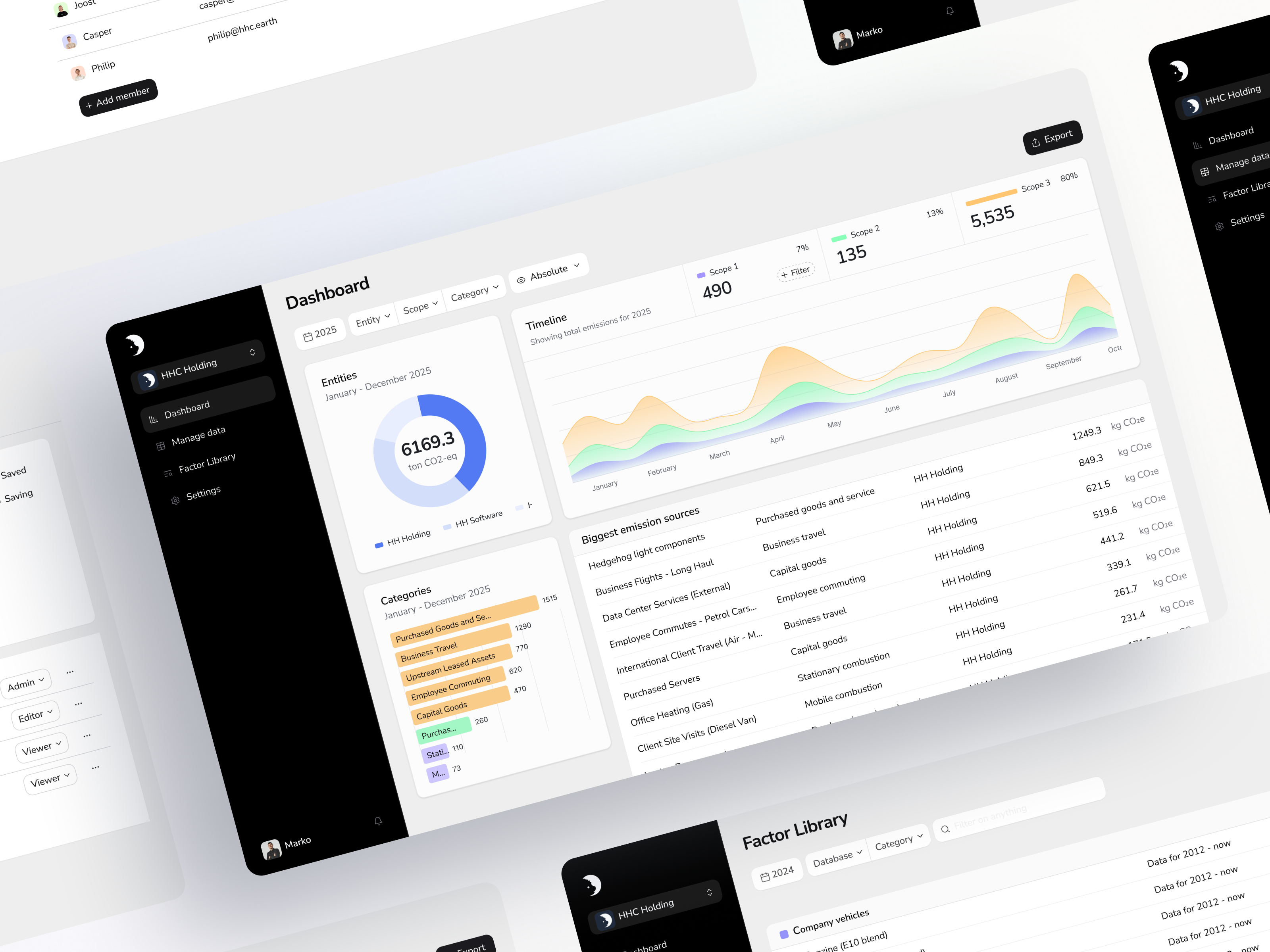
The platform names the CO2-Prestatieladder as a reporting output alongside the GHG Protocol and PPN 006. It guides you through GHG Protocol setup, a data collection plan and inventory building, with an AI guide and human GHG experts reachable in-app. It holds over 20,000 spend-based and activity-based factors, which is how consumables and subcontractor spend get calculated before better data exists, and it lets you add your own organisation-specific or supplier-specific CO2 data as subcontractors start reporting. Entity management across locations and sites, with roles for data owners, auditors and managers, is what supports contract level views. It runs in English, French and Dutch.
Free account with no sales call. Pro from EUR 1,200 per year.
Three limits, stated openly.
Getting the data in is the work. A small business customer said on G2 in August 2026 that once the data is loaded everything works perfectly, and getting it loaded is the challenging part. With a consumables purchase ledger of thousands of small lines, that is the honest shape of the first footprint. Anyone promising you a tender-ready number in a week has not seen your ledger.
There are few integrations today. A mid-market reviewer on G2 in June 2026 said they would like more integrations with other software. If you were expecting your fleet telematics or your purchasing system to connect automatically, ask us what is possible before you assume it.
Product footprints are a service. LCA, EPD, MKI and PCF work is delivered by our people rather than by the subscription. The platform does organisational footprints, which is what a tender asks for. Where a client wants something deeper, that is carbon footprint consulting work.
What should you do first?
Do the fleet. Fuel card data is already digital, already complete, and it gives you a real scope 1 figure inside a day. It is also the line you can act on, which makes the reduction commitment in your next bid a statement rather than an aspiration.
Then decide your subcontractor treatment and write it into your bid boilerplate, so every submission says the same thing. Inconsistency between two bids to the same client is worse than a modest number consistently explained.
You can start a free account and have a fleet-based footprint before your next submission deadline, without a sales call.
Sources: SKAO CO2-Prestatieladder scheme documentation, GHG Protocol Corporate Standard, Hedgehog platform, Hedgehog on G2. Verified 27 August 2026.
Facts on this page were last verified on 2026-09-17.

