
More and more governments, construction and infrastructure companies, and other organisations are driving sustainability using the CO₂ Performance Ladder. This is increasingly visible in tenders; the sustainability certificate is becoming a common requirement. Although it may initially seem like yet another administrative burden, in practice, it is a valuable enhancement for your company.
In this article, we explain what the CO₂ Performance Ladder entails, what is changing with the new Handbook 4.0, and how you as an SME can make a smart start.
What is the CO₂ Performance Ladder, and what are the benefits?
The CO₂ Performance Ladder is a sustainability instrument for the Netherlands and Europe. It offers organisations a concrete and structured framework to measure and reduce their CO₂ emissions and to make their supply chain more sustainable. It also provides clear commercial advantages.
The main benefits of the CO₂ Performance Ladder are particularly noticeable during a tender. Governments, as well as parties such as railway managers and large construction companies, reward a certificate with a so-called "fictitious award advantage".
During the evaluation of tenders, the client subtracts a percentage from the bid price for companies that are demonstrably sustainable. This moves the offer higher up the ranking, providing an advantage compared to non-sustainable companies. The higher you are on the ladder, the greater the fictitious discount on your bid price.
However, this discount exists purely on paper to reward the greenest entrepreneur. If you win the contract, you may simply invoice the original amount!
Which sectors are leading?
The ladder originated in the rail sector, but is now the standard in countless industries. The sectors that make the most use of it are:
- Construction & Infra (GWW): Almost no infrastructure project is awarded without ladder requirements.
- ICT & Tech: Increasingly, governments are asking IT service providers about their carbon footprint.
- Business Services: Think of waste processors, landscaping companies, and transport firms.
What has changed? From Handbook 3.1 to Handbook 4.0
A new version of the performance ladder, Handbook 4.0, has recently been released. Several aspects have been organised differently compared to the previous version, 3.1. The structure has been streamlined, and the levels have also been addressed.
The CO₂ Performance Ladder works as a management system with which you can reduce your CO₂ emissions step-by-step. The more actively you work towards sustainability, the higher you rise on the ladder, and the more financial benefit (fictitious award discount) you receive in tenders.
Every company on the ladder is assessed on four fixed perspectives:
- Insight (measuring CO₂ footprint)
- Reduction (setting savings targets)
- Transparency (internal and external communication)
- Participation (sharing knowledge within the sector)
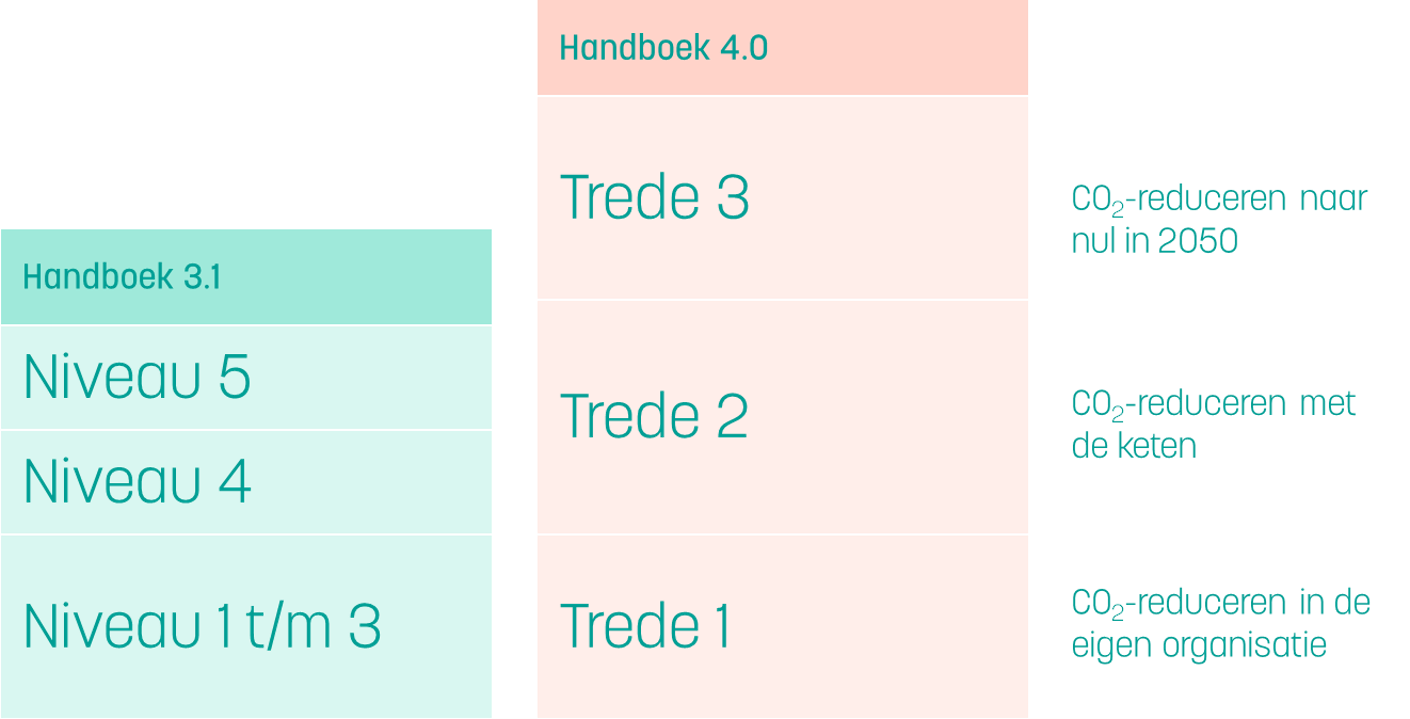
The Steps of the Ladder from the new Handbook 4.0
Since the introduction of the latest Handbook 4.0, the system has been simplified from 5 levels to 3 active steps on which a company can score.
- Step 1 (Requirement: Internal focus): You map out the direct emissions of your organisation (Scope 1 & 2, such as your vehicle fleet and energy consumption) and start with concrete, absolute energy savings. This replaces levels 1 to 3 from the old Handbook 3.1.
- Step 2 (Requirement: Chain focus): You look beyond your own company walls. You are required to analyse the CO₂ impact of your suppliers and materials (Scope 3) and draft a long-term plan for climate transition together with the chain. This is comparable to the old levels 4 and 5.
- Step 3 (Requirement: Net-Zero focus): This is the highest and newest step. You commit to a hard, scientifically backed transition path towards complete climate neutrality (net-zero emissions) by 2050, where circularity and radical innovation are central.
The most important shifts at a glance:
- Level 3 (from 3.1) is equivalent to Step 1 in the new Handbook 4.0.
- Step 2 is comparable to the old Level 5.
- Step 3 is an entirely new step and has no comparable equivalent from the old 3.1 version. Here, the focus lies even more strongly on absolute net-zero goals and circularity.
Deadlines and obligations
If your organisation is certified for CO₂ Performance Ladder version 3.1, the transition to version 4.0 is mandatory for your first audit after 14 January 2027.
How can Hedgehog support your CO₂ Performance Ladder certification?
The transition to a new handbook requires up-to-date expertise, especially because the requirements regarding chain impact (Scope 3) have become stricter. Hedgehog offers targeted guidance in this area. You can already make a good start yourself with perspectives C (Transparency) and D (Participation), but we actively help you with the crucial first steps: ensuring clear insight and creating a strong reduction plan.
This is how we help your organisation become more sustainable and certified:
- Setting up a GHG footprint (Requirement 3.A.1): Hedgehog is an expert in accurately calculating the Greenhouse Gas (GHG) emissions of companies. This is something we have already done for many organisations. We ensure that the quality of your data is high, so your footprint meets all official GHG requirements.
- Reduction plans (Requirement 3.B.1 & 3.B.2.D): This involves setting CO₂ reduction targets (3.B.1) and the energy management action plan (3.B.2). Hedgehog helps with personal guidance in drafting reliable reduction plans.
- Analysis of data (Perspective A): Within the performance ladder, the 3.A.1 requirement (formerly A.3 data) stands for the in-depth analysis and inventory of your emission data. Hedgehog helps you in this step by allocating CO₂ emissions very specifically per unique business activity. This allows you to see not only how much you emit, but especially what exactly causes those emissions.
- Value chain analysis (Scope 3 (Requirement 4.A.1)): Our Scope 3 expertise is indispensable for the transition to stricter chain requirements. We carry out a thorough analysis of your entire value chain to accurately map the emissions of your suppliers and product chain.
- Identifying hotspots and chain partners (Requirement 4.A.1 & 4.B.1): With the value chain analysis, we identify the most important 'hotspots' (the biggest polluters) within your chain. We look at the strategic role your chain partners can play and clearly map out where the biggest gains can be made with targeted reduction measures. This forms the perfect data-driven start for writing your reduction plan (Requirement 3.B.1 & 3.B.2.D).
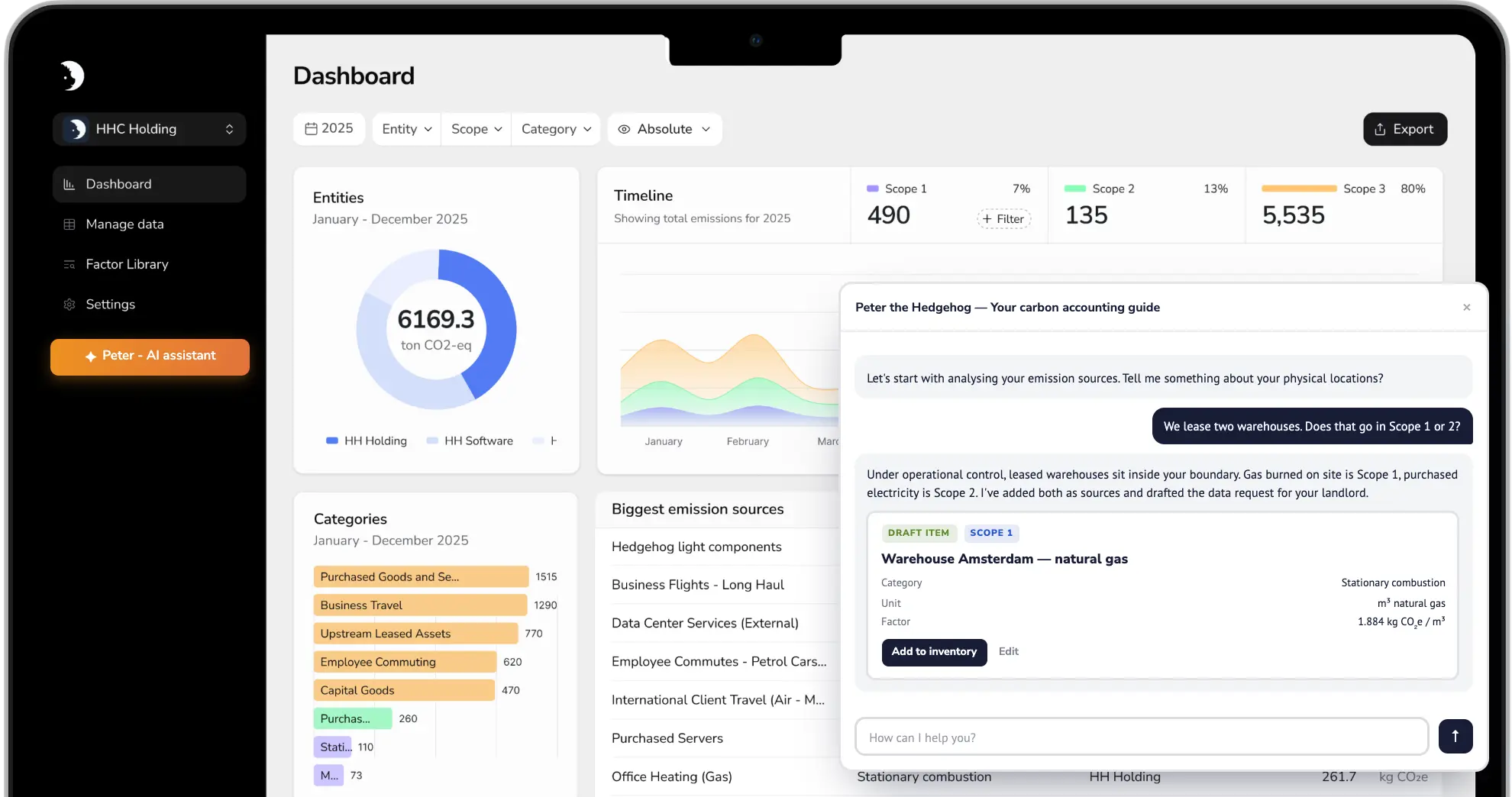
- The Hedgehog Carbon Platform: No hassle with confusing, error-prone Excel sheets. With our innovative platform, you can automate your entire carbon accounting. You have continuous, real-time insight into your footprint, and all data is immediately available and clearly organised for the audit.
The CO₂ Performance Ladder SME Roadmap
How do you start your CO₂ Performance Ladder certification? With the following steps, you bring structure to the process. The ladder is always built on four fixed pillars:
- 1. Insight (Measurement): You start by setting up your own CO₂ footprint. Where is most of the energy leaking? Think of gas consumption, electricity, and the vehicle fleet.
- 2. Reduction (Setting targets): You formulate ambitious yet realistic reduction targets. Think of concrete measures such as electrifying the fleet or insulating your business premises.
- 3. Transparency (Communication): Sustainability is not something you do in secret. You communicate internally and externally (for example, via your website) about your footprint and your progress.
- 4. Participation (Collaboration): You actively take part in a sector initiative to share knowledge and tackle emissions in the industry together with peers.
We provide a more accurate estimate for your organisation
Do you want to know where you stand? We can create a detailed, bespoke assessment for your organisation. If this sounds interesting, send us a message with the following information:
- What is the size or turnover of your organisation?
- Which level (Step 1 to 3) do you want to achieve for the next tender?
- Do you want to set this up entirely yourself via our platform, or would you prefer intensive guidance from a Hedgehog advisor?


.jpeg)

