
In short
- The carbon inventory is a second ledger on the same close cycle, and finance is the only function that already runs one.
- Most of the source data is spend data, which finance owns. The mapping work is the cost, not the calculation.
- Traceability from a reported figure back to a source record and a factor version is the control that matters most.
Carbon accounting software builds a second ledger for a company: one that records activity in litres, kilowatt hours and purchased goods instead of euros, and closes on the same annual cycle as the books. Finance teams end up owning it because most of the source data is spend data they already control, because the output ends up in a report a director signs, and because no other function in the business runs a controlled close. If that is landing on your desk, the useful first step is a trial calculation on one entity and one financial year, built from the general ledger you already have.
Why does carbon reporting keep landing on finance?
Because of where it ends up rather than where it starts.
Carbon numbers begin life as an operational curiosity and then move into places finance already governs: a lender's questionnaire, a tender submission, a customer contract, an annual report, an assurance engagement. The moment a figure is published under the company name, somebody has to be able to say where it came from and who checked it. That is a finance question, not a facilities question.
The second reason is more practical. Ask where the data lives and the answer is usually the purchase ledger, the fuel card statements, the expense system and the utility invoices. Finance holds three of those four. A sustainability coordinator with no access to the ledger is doing archaeology. A controller with access is doing an extraction.
What does a finance team already have that nobody else does?
Four things that turn out to be exactly what an emissions inventory needs.
A defined reporting entity. You already know which legal entities consolidate, which are minority holdings and where the boundary of the group sits. Carbon accounting needs the same decision, and groups that get it wrong spend the second year restating.
A chart of accounts. Spend-based emission factors attach to categories of purchase. A chart of accounts is a category structure that somebody has already maintained and reconciled. It is imperfect for this purpose, but it is a decade ahead of starting from nothing.
A close calendar. Carbon reporting is annual and repeatable or it is worthless, because a figure that cannot be compared to last year's proves nothing about a reduction.
A habit of evidence. Finance does not accept a number without a document behind it. That instinct is the single most valuable thing you bring to this, and it is what separates a defensible inventory from a spreadsheet nobody can reproduce.
Where does a carbon ledger behave differently from the financial one?
It looks familiar until three things surprise you. Estimation is permitted and often unavoidable. The units are heterogeneous. And the factors you multiply by change underneath you.
| Financial close step | Carbon equivalent | What changes |
|---|---|---|
| Trial balance | Activity data by category | Units are mixed, not all monetary |
| Chart of accounts | Emission factor mapping | One account can need several factors |
| FX rate table | Emission factor library | Factors are revised, and revisions move history |
| Accruals and estimates | Proxy and spend-based data | Estimation is expected, not exceptional |
| Prior year comparatives | Base year and restatement policy | A method change can look like a reduction |
| Audit file | Source record plus factor version | Traceability is the whole control |
The row that causes the most trouble is the factor library. When a factor is revised, last year's figure would change if you recalculated it, so you need a written policy on when you restate and when you hold the original. Decide that in year one. It is a finance policy decision and it belongs in your accounting manual, not in a vendor's release notes.
If the vocabulary is new, our guide to building a footprint from scratch covers the mechanics without assuming a sustainability background.
What controls does the number actually need?
Fewer than a financial audit and more than most sustainability tools provide.
Segregation of input and review. Whoever loads the data should not be the only person who signs it off. Any tool worth buying supports separate roles.
A traceable route from output to source. Pick any figure in the report and you should be able to walk back to the invoice or meter reading, and to the exact factor applied. If a step in that chain is a black box, the number is not auditable.
A locked reporting period. Once a year is signed, further edits should be visible as restatements rather than silent overwrites.
A documented boundary. Which entities, which sites, which categories, and why anything material was excluded.
A named owner per data stream. Fuel, energy, travel, purchased goods. Unowned streams are the ones that are missing in March.
One distinction worth settling early, because it decides your budget: a carbon accounting tool and a broad ESG reporting suite are not the same purchase. We set out the difference in ESG reporting software versus carbon accounting.
What should a finance team test before buying?
Run the demo on your own data and watch for five things.
Export an audit trail for one line item. Not a dashboard screenshot. The source value, the factor, the version and the result.
Import a real ledger extract, not a sample. Ask how many lines fail to map and what happens to them.
Check the entity model. Can you hold subsidiaries separately and consolidate without double counting intercompany purchases?
Ask what happens at year end. Is the period locked, and can a prior year be restated while the original is retained?
Get the year-two price in writing. Seat and entity counts grow. A first-year figure that resets is not a budget.
For a wider view of the market, choosing carbon accounting software as an SME covers the criteria that survive a procurement review.
What does Hedgehog do for finance teams?
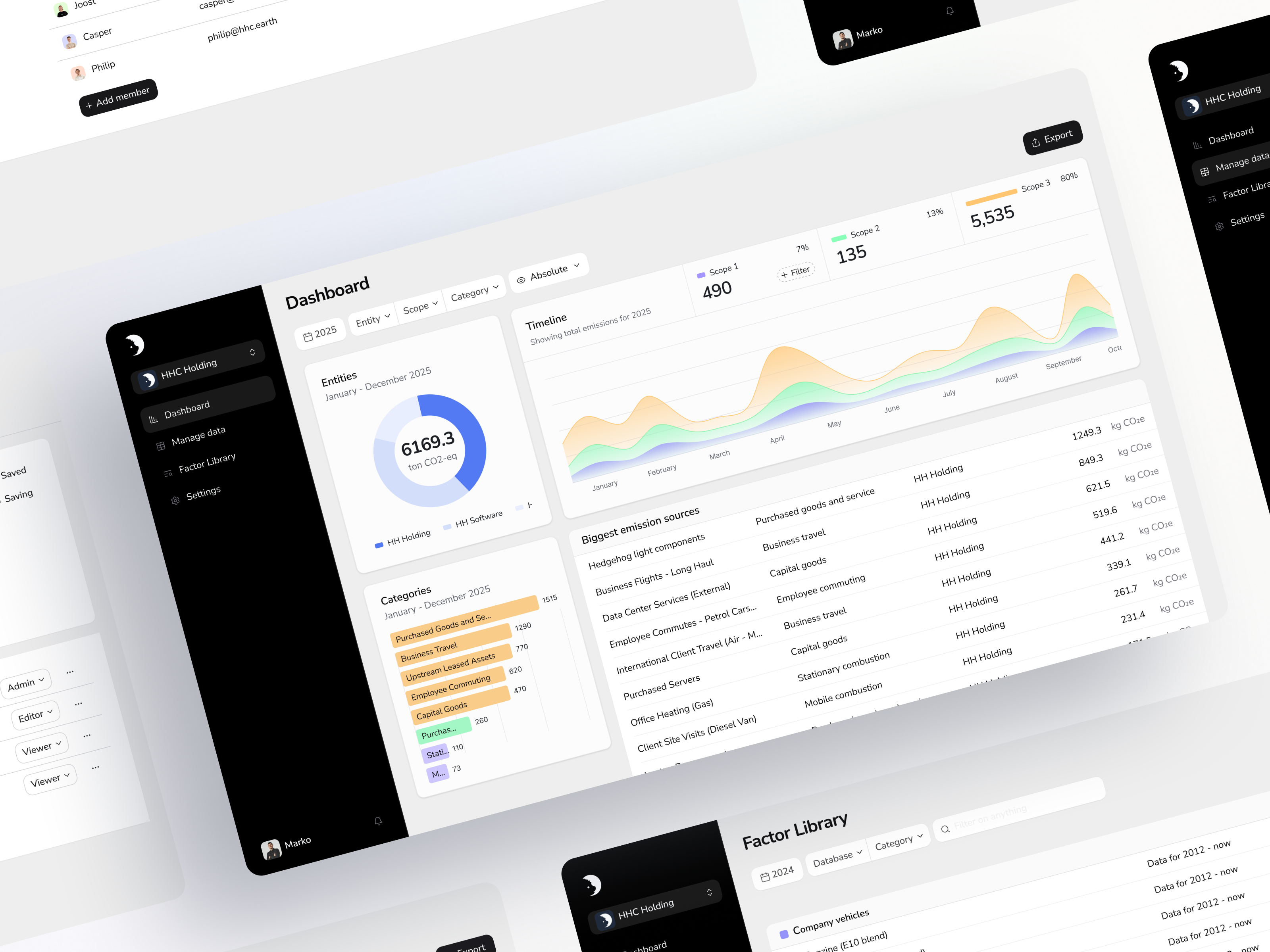
The platform guides you through GHG Protocol setup, inventory building, data upload and reporting with an AI assistant. It holds more than 20,000 spend-based and activity-based factors and lets you add organisation-specific or supplier-specific data. Entity management covers multiple locations and sites, with user roles for data owners, auditors and managers, which is the segregation control above. Reporting outputs include the GHG Protocol, PPN 006 and the CO2-Prestatieladder, and named legislation support covers CSRD, SECR and SB253.
A free account needs no sales call. Pro starts at EUR 1,200 per year, priced on user seats and business entities.
Two limits a finance reader should weigh before anything else.
Traceability is not complete today. A mid-market customer rated us 4 out of 5 on G2 in July 2026 and said applied conversion factors and distance calculations are not visible in the product, so a currency conversion or a distance calculation cannot always be traced from input to entry. For a team whose main contribution is auditability, that is the first thing to test against your own material lines.
Loading the data is the work. A small business customer said on G2 in August 2026 that once the data is loaded everything works perfectly, and getting it loaded is the challenging part. Budget hours for the first mapping exercise the way you would budget a system migration.
One scope note. The platform calculates organisational footprints. Product-level work, meaning LCA, EPD, MKI and PCF, is delivered as consultancy rather than as a feature, so if a customer is asking for a number per product, that is a different engagement.
What should you do first?
Pick one entity and one closed financial year, and calculate scope 1 and scope 2 from fuel, energy and mileage. That is a week of work at most and it tells you how your data behaves.
Then extract twelve months of purchase ledger for that entity and see what share of lines map cleanly to a category. That percentage is the single best predictor of what the full exercise will cost you in hours.
You can do both on a free account before committing to anything, or bring in carbon footprint consulting if the boundary question is the part holding you up.
Sources: Hedgehog platform, Hedgehog on G2. Verified 27 August 2026.
Facts on this page were last verified on 2026-09-17.

