
In short
- Pick a consolidation approach first: equity share versus control gives a genuinely different total, while the two control criteria usually agree except for joint ventures and similar edge cases.
- Acquisitions and disposals are the recurring problem. A written base year recalculation policy prevents a growth story reading as a reduction.
- Unlike subsidiaries need unlike data models. One template across a group of different businesses collects the wrong things badly.
Carbon accounting software for a holding company has to consolidate subsidiaries the group owns but does not run, on a stated ownership basis, and to keep that basis stable while the portfolio changes. The buyer is usually a group finance or reporting lead who has been asked for a single number by a lender, an investor, a large customer or the board. Unlike a franchise network, you have the authority to require data. What you do not have is a shared system, a shared chart of accounts or a shared idea of what a good number looks like. Start by choosing a consolidation approach and writing it down.
Which consolidation approach should a group choose?
This decision comes before any software, and it is really two decisions: equity share versus control, and then, if you choose control, financial versus operational.
| Approach | What is included | Where it suits a group |
|---|---|---|
| Equity share | A share of emissions matching the share of ownership | Portfolios with many minority and joint holdings |
| Control, financial criterion | 100 percent of entities the group controls financially | Groups aligned to the statutory consolidation |
| Control, operational criterion | 100 percent of entities the group operates | Groups that manage their subsidiaries directly |
The GHG Protocol Corporate Standard defines two approaches, equity share and control, and a company choosing control must pick between the financial and operational criteria. In most cases the two control criteria identify the same set of operations, so choosing between them usually does not move your boundary; the standard names the oil and gas industry as the notable exception, and more generally it bites wherever ownership and operatorship come apart: joint ventures, jointly operated sites, leased assets. If your group wholly owns every operation, the choice between the two criteria changes nothing at all.
Financial control is the pragmatic default for a holding company, because it lines up with the accounts you already consolidate and makes reconciliation with the annual report straightforward, with one wrinkle: under financial control, a joint venture where partners hold joint financial control is still accounted for on an equity share basis, so it is not a clean either/or. Operational control tends to fit better where the group runs its subsidiaries as one business. Equity share is the honest choice when the portfolio is genuinely investments rather than operations, and it is the most work, because a partly owned entity still has to be measured before you take a share of it.
What matters most is that you pick equity share or control, apply it to every entity, and state it wherever you publish the number. A group total whose basis is unstated is a number that cannot be compared to anything, including its own prior year.
Who actually needs a group footprint, and why now?
Four requests drive this, and they want different things from the same inventory.
Lenders and investors ask at the group level because that is the level at which they are exposed. They usually want a consolidated figure and an intensity measure.
Large customers ask the operating subsidiary that sells to them, not the holding company. If four subsidiaries answer four questionnaires with four methods, the inconsistency becomes visible the moment two of those customers compare notes.
Regulatory scope attaches to different entities in different ways depending on where they are and how big they are. Whether the group or an individual subsidiary falls under CSRD, and on what timetable, is a legal analysis rather than a software feature, and it is where CSRD advice earns its fee.
A group target. If the board has committed to a reduction, the target has to be set on a defined base year with a defined boundary, which is the same discipline again. That is the ground science based targets work starts from.
What happens when you buy or sell a company mid year?
This is the recurring operational problem for a holding company and almost nothing else in this article matters as much.
Acquire a business in September and your group emissions rise. That rise is not a performance failure. Sell a business in March and your emissions fall. That fall is not a reduction. Without a policy, both show up in the same line as your actual operational performance and the number stops carrying information.
Write down four rules in year one.
A base year recalculation threshold. A significance test, expressed as a percentage of group emissions, above which an acquisition or disposal triggers a base year restatement.
A partial year convention. Whether an acquired entity is included from the acquisition date or from the start of the following reporting year.
A disposal convention. Whether history is restated to remove the entity or left intact with a note.
A structural change disclosure. A short statement each year of what moved, so a reader can separate portfolio change from performance.
Why does one template break a group of unlike businesses?
Because a logistics subsidiary, a manufacturer and a professional services firm do not have comparable data. The first has fuel cards and tonne kilometres. The second has energy meters and a bill of materials. The third has travel bookings and an office lease.
A single group template designed for the largest subsidiary will collect the wrong things from the others, and the usual outcome is that the small subsidiaries submit spend totals while the large one submits activity data. The group then compares them as if they were the same quality of number.
The workable pattern is a common structure with sector-appropriate depth: every entity reports the same scopes and categories, but the method for each category is set per business type and recorded per entity. Intensity metrics stay local, because tonnes of CO2 per million of revenue means nothing across a mixed portfolio. Total emissions and coverage percentage roll up cleanly.
A carbon inventory and a broad ESG reporting suite are also two different purchases, and the difference is set out in ESG reporting software versus carbon accounting.
What should a group-level tool actually do?
Five things to test with two real subsidiaries.
Hold entities in a hierarchy that mirrors your legal structure, including partly owned entities.
Apply an ownership percentage if you consolidate on an equity share basis, without asking the subsidiary to do the arithmetic.
Keep periods locked and restatable. A group close needs a version of last year that does not move, and a route to a restated version that is labelled as one.
Separate roles per entity. A subsidiary controller enters and reviews their own data. Group sees everything. Auditors read.
Price predictably per entity. Ask directly what happens when you add ten subsidiaries, because entity based pricing is standard in this market and a growing group feels it.
What does Hedgehog do for holding companies?
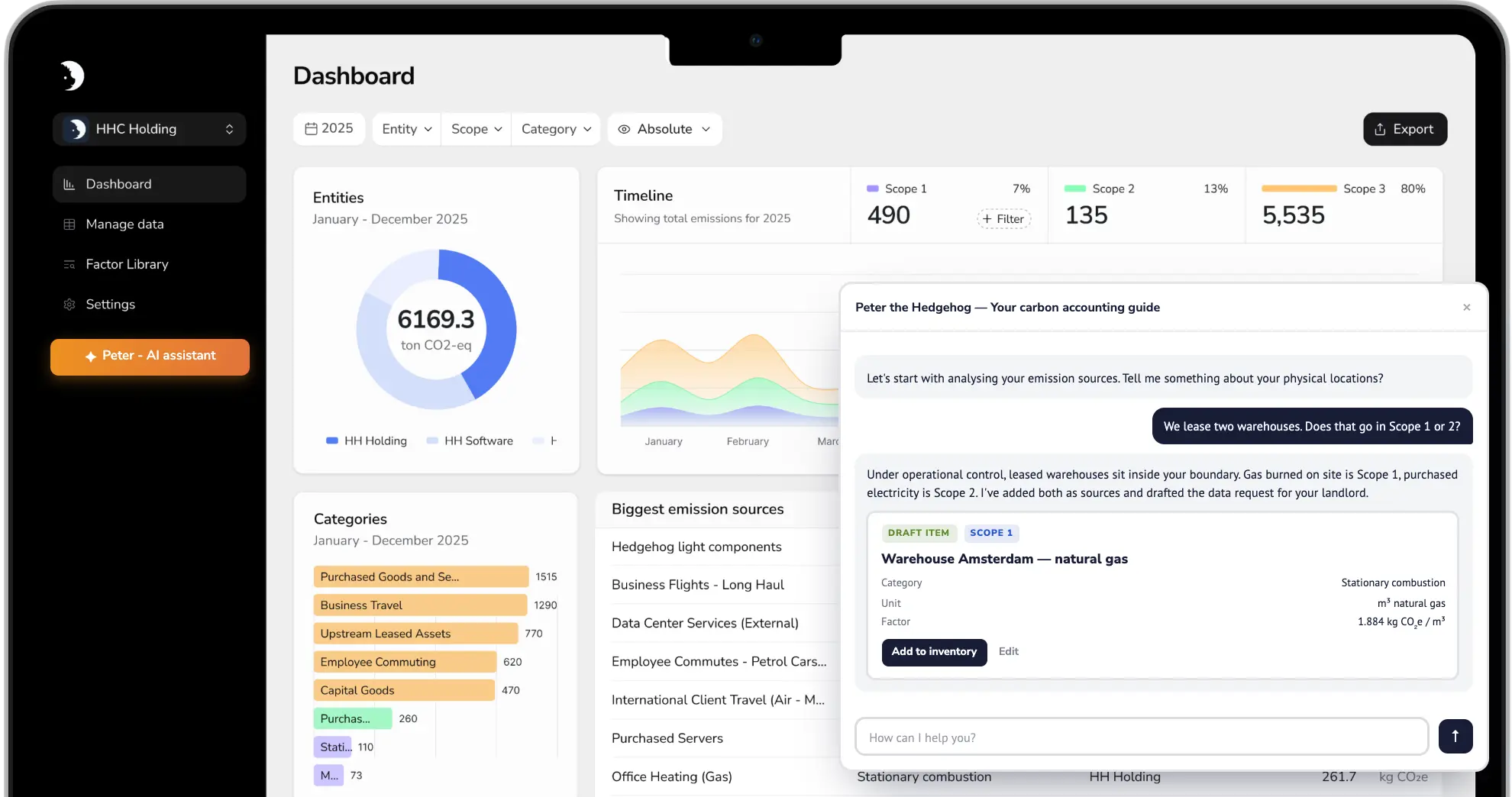
The platform supports entity management across locations and sites with user roles for data owners, auditors and managers, which is the group and subsidiary split above. It guides you through GHG Protocol setup, inventory building, data upload and reporting with an AI assistant, holds more than 20,000 spend-based and activity-based factors and accepts organisation-specific and supplier-specific data, so a subsidiary with good primary data is not dragged down to the group's lowest common method. Named legislation support covers CSRD, SECR and SB253, and it is available in English, French and Dutch for groups spanning markets.
A free account needs no sales call. Pro starts at EUR 1,200 per year, priced on user seats and business entities, which for a group means the entity count is the main driver of what you will pay.
Two limits to weigh before a group rollout.
It is a carbon platform, not a full ESG suite. A mid market customer rated us 3.5 out of 5 on G2 in June 2026 and said exactly that: less complete for broader ESG and CSRD reporting, with no data source management feature and no decarbonisation target monitoring. If the group needs a wide sustainability reporting system, this is one component of it.
Loading the data is the work. A small business customer said on G2 in August 2026 that once the data is loaded everything works perfectly, and getting it loaded is the challenging part. Multiply that by the number of subsidiaries and you have your year one plan.
One scope note. The platform produces organisational footprints. Product-level work, meaning LCA, EPD, ECI (MKI in Dutch) and PCF, is delivered as consultancy.
What should you do first?
Take your statutory consolidation schedule and add two columns: consolidation approach applied, and who at that entity owns the data. Any row you cannot fill in is a decision waiting to cause an argument later.
Then run one subsidiary end to end for a closed year before touching the rest. A single completed entity teaches you more about your group rollout than a design workshop will.
You can build that first entity on a free account, or book a conversation if the consolidation approach is the question you want settled first.
Sources: GHG Protocol Corporate Standard, Hedgehog platform, Hedgehog on G2. Verified 27 August 2026.
Facts on this page were last verified on 2026-09-17.

