
In short
- Procurement is asked in two directions at once: supply the numbers for your own scope 3, and score carbon criteria in your own tenders.
- Start spend-based for coverage, then move only the categories you intend to act on to supplier-specific data.
- A questionnaire programme spends supplier goodwill. Spend it on the twenty suppliers that matter, not on four hundred.
Carbon accounting software for a procurement team turns your purchase ledger into emissions data, and gives you something checkable to score when you put carbon criteria into your own tenders. It is for buyers, category managers and purchasing leads who have been handed a scope 3 category 1 number to produce, or who have to write and evaluate a sustainability criterion in a sourcing exercise. The first decision is which categories you calculate from spend and which you calculate from supplier data, because that single choice sets your workload for the entire year.
What does procurement actually get asked for?
Two things, from two different people, and they are frequently confused with each other.
Upstream, your own footprint. Somebody in sustainability or finance needs purchased goods and services for the corporate inventory. In most non-industrial businesses this is the largest scope 3 category and it lives entirely in your systems. They need it split in a way that maps to emission factors, which is rarely how your category tree is built.
Downstream, your suppliers' footprints. Your customers or your bid team need supplier-level evidence, either because a large customer is asking for value chain data or because a tender asks you to demonstrate that you manage emissions in your own supply chain.
The first is an accounting exercise on data you already own. The second is a relationship exercise on data somebody else owns. Confusing them is why so many procurement carbon programmes stall in month three: the team promises a supplier-data answer to a question a spend-based answer would have closed in a fortnight.
Spend-based or supplier-specific: which do you start with?
Both, in that order, and for different categories.
| Aspect | Spend-based | Supplier-specific or activity-based |
|---|---|---|
| What it needs | Ledger lines mapped to categories | Questionnaires, supplier inventories, product data |
| Time to a first number | Days | Months |
| Moves when prices move | Yes | No |
| Shows the effect of switching supplier | No | Yes |
| Effect on supplier relationships | None | You are asking for a favour |
| Best used for | Coverage, first baseline, ranking categories | The few categories you actually plan to act on |
The practical route is to run the whole ledger spend-based first. That gives complete coverage and, more usefully, a ranking. Then you know which four or five categories carry the weight, and only those are worth a supplier engagement programme.
The failure mode is the reverse: launching a supplier questionnaire across the whole base before you know which suppliers matter. That produces a low response rate, a lot of irritation and a number no better than the one the ledger would have given you. If you are still deciding how much of this to run yourself, choosing the right carbon accounting software for an SME is a reasonable place to start.
What does a supplier data programme really cost you?
Goodwill, and it is a finite budget. Every questionnaire is a request for unpaid work from a company with its own quarter to survive, and small suppliers receive these from several customers at once in formats that never match. Response rates reflect that.
Three things separate a programme that works from one that quietly dies:
Ask few suppliers. Rank by emissions contribution rather than spend alone and engage the top of that list. A short list gets attention from your own team, which is what actually drives response.
Ask for something that already exists. A supplier who already reports has a number. Asking for their inventory, certificate or published plan gets an answer. A bespoke template gets silence.
Know what you may not ask. For SME suppliers, there is a defined limit to what a large reporting company can reasonably demand, which is worth understanding from both sides of the request. We cover it in the value chain cap and the ESG questions you can decline.
If your own scope 3 programme is heading past category 1 into transport, waste and the rest, that is a bigger design question and scope 3 consulting is the shape of the help.
How do you write carbon into a tender without getting a number you cannot check?
Ask for evidence that exists independently of the bid.
A supplier can write anything in a bid response. What they cannot invent is a certificate, a published plan on their own website, or an inventory that an auditor has seen. So write the criterion against an artefact rather than against a promise.
Then decide three things before the notice goes out, not after the responses land.
What you are scoring. The absolute number is almost never right, because a large supplier will always emit more than a small one. Score boundary completeness, plan credibility, or a per-unit intensity relevant to what you buy.
What counts as evidence. Name the acceptable formats. Accept anything and you will receive everything, and comparing it is your problem.
Who scores it. Carbon criteria are frequently written by procurement and then scored by nobody in particular. Name the evaluator and give them a rubric, or the criterion becomes decorative.
And keep unsupported environmental claims out of your own tender documentation. Green claims rules apply to buyers as much as to sellers.
What should a procurement team test in a tool before buying it?
Four questions, in the order they will cost you.
Can it ingest your ledger as it is actually structured? Not a clean demo file. Your real export, with its supplier names, cost centres and miscoded lines.
Can it hold two methods for the same category? You will move categories from spend-based to supplier-specific over time, and you need the series to survive that transition without looking like a reduction that did not happen.
Can you see which factor was applied to which line? Procurement gets challenged on numbers more than most functions, and showing the working is what ends the argument.
What does it cost in year two? This becomes an annual routine tied to your close, and a first-year price that resets changes the real number materially.
It is also worth being clear with yourself about what you are buying. A carbon accounting tool and a broad ESG reporting suite are different products with different jobs, which we set out in ESG reporting software versus carbon accounting.
What does Hedgehog do for procurement teams?
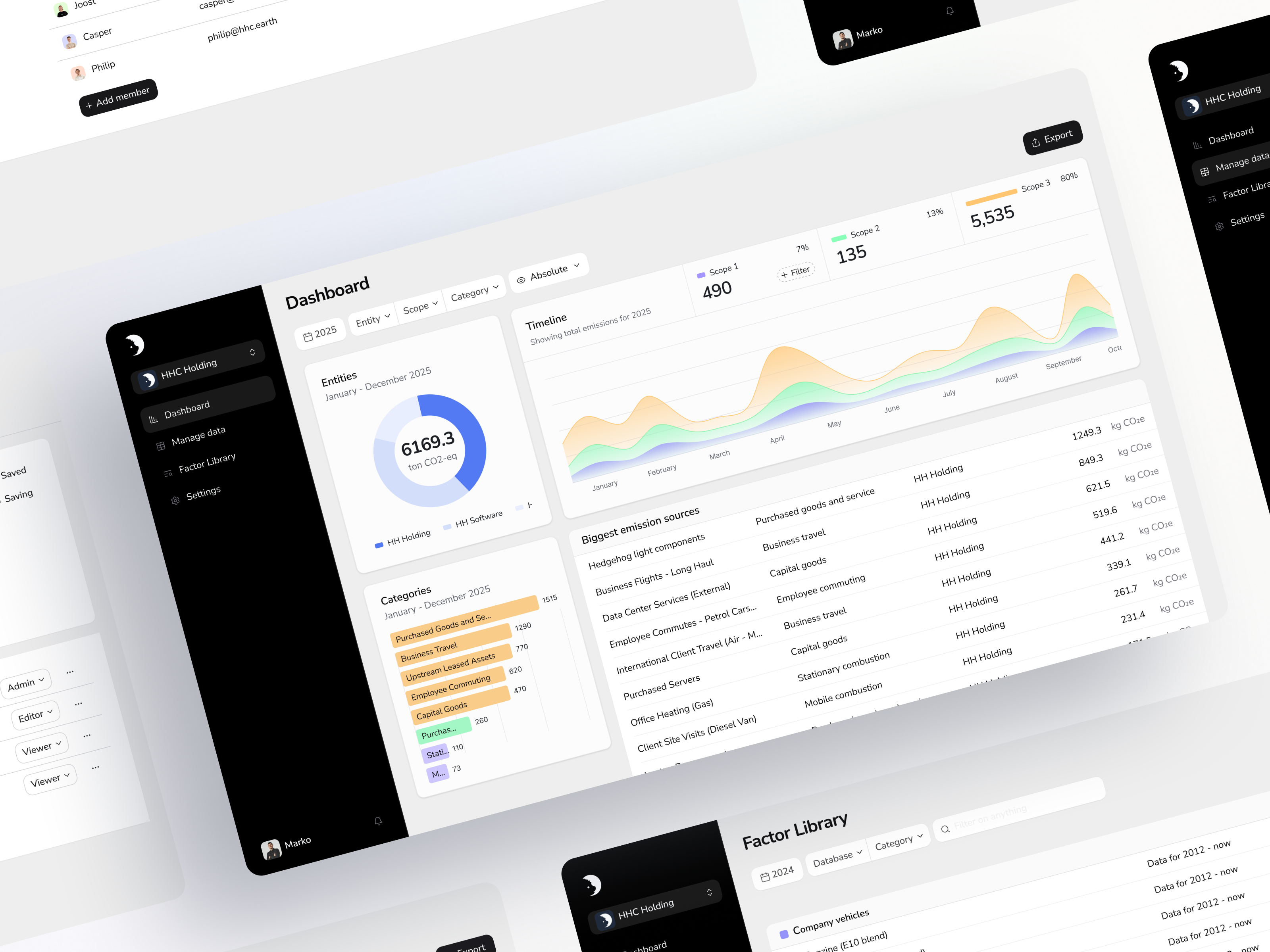
The platform covers more than 20,000 spend-based and activity-based emission factors and lets you add organisation-specific or supplier-specific data, which is what makes the move from ledger lines to supplier numbers possible inside one inventory. It guides you through GHG Protocol setup and inventory building with an AI guide. Entity management covers multiple locations and sites, with roles for data owners, auditors and managers, so each buyer sees their own scope. Reporting outputs include the GHG Protocol, PPN 006 and the CO2-Prestatieladder.
Free account, no sales call. Pro from EUR 1,200 per year.
Three honest limits for a procurement reader.
Getting the data in is the slow part. A G2 reviewer said in August 2026 that once the data is loaded everything works perfectly, and that getting it loaded is the challenging part. For a procurement team that means the ledger mapping is the project, not the software.
There are few integrations with other software today. A mid-market reviewer asked for more of them on G2 in June 2026. If you were hoping to point it at your P2P system and walk away, test the export and import path with your own file before you commit.
Product footprints are a service, not a feature. The platform does organisational footprints. If a customer wants a footprint for a specific product or an EPD, that is LCA work delivered as a service rather than something you generate in the tool.
What should you do first?
Pull twelve months of purchase ledger, grouped the way your finance system already groups it, and run it spend-based. You will have a category ranking within days.
Then take the top five categories to your next category review with one question rather than a report: which of these do we intend to do anything about. Those are the only ones that justify a supplier engagement programme this year.
You can build that first ranking on a free account before committing to anything, or book a call if you want to work through the category mapping with someone first.
Sources: GHG Protocol Corporate Value Chain (Scope 3) Standard, Hedgehog platform, Hedgehog on G2. Verified 27 August 2026.
Facts on this page were last verified on 2026-09-17.

