
In short
- Run the inventory as a management system, not a project. You already know how to do that.
- The audit question is never what the number is. It is how the number was produced and who checked it.
- A one-person QHSE function needs the method recorded in the system, not in the person.
Carbon accounting software on a QHSE desk is a records system with a calculation engine attached: it holds the boundary, the input evidence, the emission factors and the sign-off trail that an external auditor will ask to see. It is for the QHSE manager, KAM-coordinator or HSE lead who acquired carbon reporting because environment was already in the job title. The useful first move is not to pick a tool. It is to decide that this is a management system with a documented procedure, an internal audit and a management review, rather than a spreadsheet somebody rebuilds each spring.
Why does carbon land on the QHSE desk?
Because of the E, and because you are already the person who survives audits.
In most mid-sized companies there is no sustainability department. There is a QHSE function that already holds ISO 9001, ISO 14001 and ISO 45001, already runs an internal audit programme, already writes corrective actions and already sits in front of an external assessor once a year explaining how a process is controlled. Carbon reporting arrives and it looks, to everyone else in the building, like more of the same.
They are not wrong, and the overlap is your advantage. ISO 14001 already made you define the organisation's boundary and its environmental aspects, which is the same decision a GHG inventory needs. You already retain dated, retrievable evidence behind an assertion, which is new to most people who take carbon on. And plan, do, check, act is exactly the shape of an annual inventory.
What is genuinely new is the calculation: choosing emission factors, setting a base year, deciding between market-based and location-based electricity, and building scope 3 categories from data other people own. That is where the tool earns its money, and carbon accounting from scratch covers the mechanics.
What does an auditor ask that a dashboard does not answer?
Auditors do not audit numbers. They audit the process that produced the numbers, and then they sample.
| The question you will be asked | What you have to be able to show |
|---|---|
| What is inside the boundary and what is outside | A written scope decision, dated, with the reason |
| Where did this figure come from | The source document, retrievable in minutes |
| Which emission factor was applied and from which set | The factor, its version and where it came from |
| Who checked this before it was published | A sign-off record with a name and a date |
| Why did this change since last year | A change log distinguishing real change from method change |
| What did you do about the last finding | A closed corrective action |
Only one of those rows is about the number. The rest is traceability, and traceability is what separates an inventory that passes a CO2-Prestatieladder audit from one that does not. The ladder is assessed by an external certifying body against a documented system, which is a familiar shape of work for a QHSE team. We cover it in the CO2-Prestatieladder for SMEs.
Is a carbon inventory a project or a management system?
It is a management system, and treating it as a project is the single most expensive mistake available.
The project version looks like this. A customer asks for a number. Someone builds it in a workbook over six weeks, submits it, and files the workbook. Eleven months later the same question arrives, the assumptions are gone, and the six weeks happen again on slightly different choices. The year-on-year comparison is then meaningless and the difference cannot be explained to an assessor.
The management system version has four components you already run for other standards:
A documented procedure. Who collects what, from where, by when, in what format.
Defined records. Which evidence is retained, for how long, and where it lives.
An internal audit. Sample the inventory the way you sample anything else. Pick five entries and trace them back to source before the external assessor does it for you.
A management review. Emissions as a standing agenda item with the same seriousness as incident rates, so the reduction measures in your plan have owners and budgets rather than good intentions.
What breaks when the QHSE function is one person?
Everything, at exactly the wrong moment, and it is worth designing around from the start.
The method lives in a head. Assumptions obvious in March are unrecoverable in November. Write the method note as you go. Two pages is enough.
Data collection depends on goodwill. Fuel comes from operations, spend from finance, travel from whoever books it. If those handovers are personal favours rather than scheduled tasks with named owners, they fail the moment somebody is busy.
Everything lands in one quarter. Year end, tender deadline, surveillance audit and carbon report inside six weeks. Collect scope 1 and 2 monthly rather than annually, which turns one impossible month into twelve easy hours.
There is no second reviewer. Give someone outside QHSE the job of checking five entries. It is the cheapest quality control available.
What should a QHSE team test before buying?
Four things, weighted towards the audit rather than the dashboard.
Can you trace one entry from the report back to the source file? Try it in the demo. This is the question you will be asked and it is the one demos are least often built to answer.
Can it hold a base year fixed and record a restatement separately? Method changes have to be visible as method changes.
Does it support roles? Data owners, auditors and managers seeing different things is not a luxury when an external assessor wants read access without edit rights.
Can you get the evidence out? Reports, exports and the underlying records, in a form that goes straight into an audit file.
What does Hedgehog do for QHSE teams?
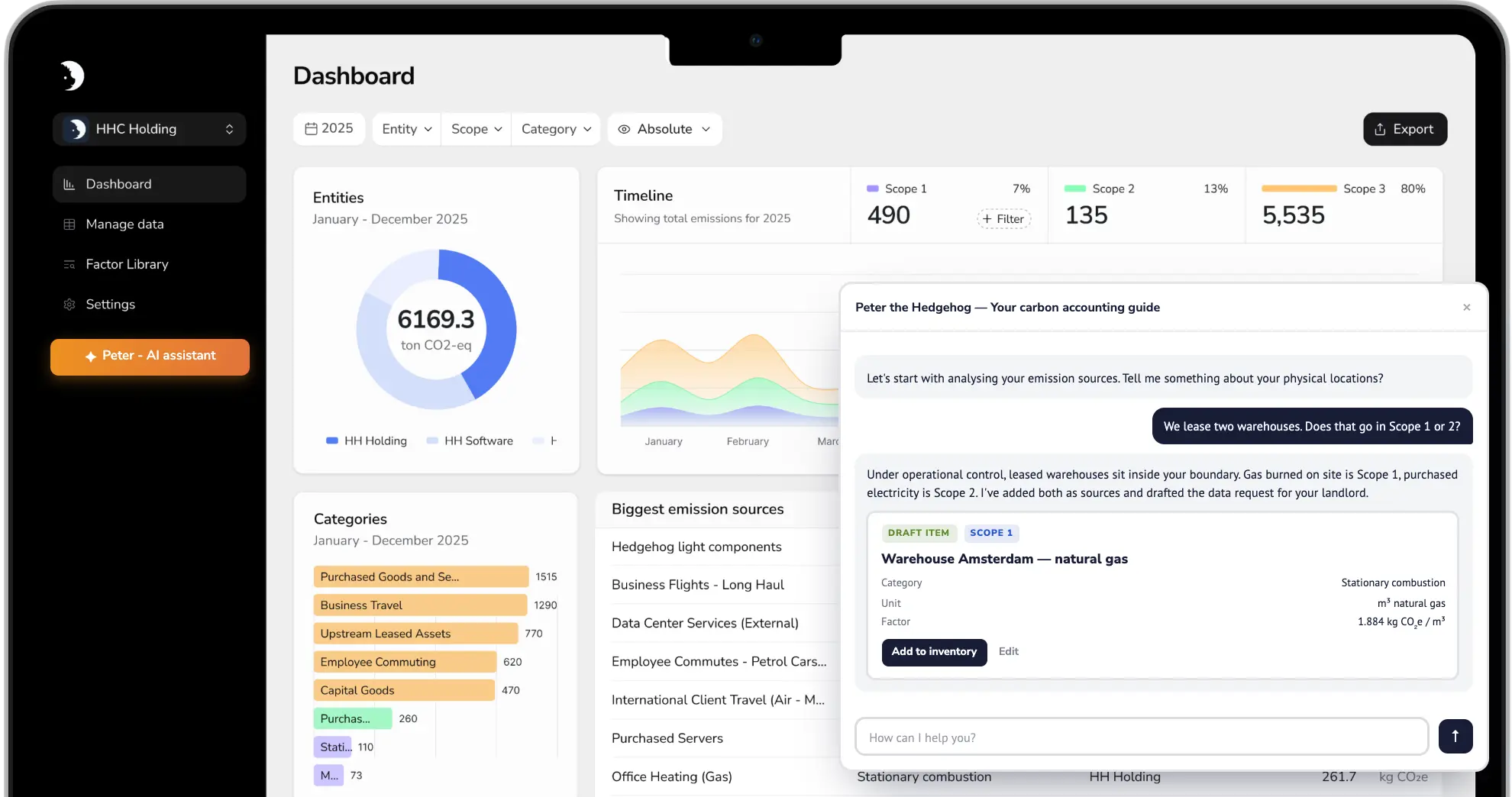
The platform covers the GHG Protocol, PPN 006 and the CO2-Prestatieladder as reporting outputs, and supports SBTi, B-Corp and EcoVadis workflows. It guides you through GHG Protocol setup, the data collection plan and inventory building with an AI guide, with human GHG experts reachable in the product. Entity management runs across locations and sites with roles for data owners, auditors and managers, which maps onto how a QHSE function is usually organised. Over 20,000 spend-based and activity-based factors, plus your own organisation-specific or supplier-specific data. English, French and Dutch.
Free account, no sales call. Pro from EUR 1,200 per year.
Three honest limits, and the first one matters more to a QHSE reader than to anyone else.
Traceability is not complete today. A mid-market reviewer rated us 4 out of 5 on G2 in July 2026 and said the applied conversion factors and distance calculations are not exposed in the interface, so a currency conversion or a distance calculation cannot always be traced from the original input to the platform entry. If your audit file needs that link for every entry, ask about it directly and test it against your own data before you commit.
Loading the data takes effort. A reviewer said in August 2026 that once the data is in it works perfectly, and that getting it in is the challenging part. In a one-person QHSE function that is the line to protect in the plan.
Product footprints are a service. The platform does organisational footprints. When a customer asks for an EPD or a product carbon footprint, that is LCA work delivered through carbon footprint consulting, not something you generate in the tool. It is also worth being clear that a carbon accounting tool is not a broad ESG suite, a distinction we draw in ESG reporting software versus carbon accounting.
What should you do this quarter?
Write the boundary down. One page: which entities, which sites, which scopes, what is excluded and why. Date it and sign it. That page answers the first audit question and it takes an afternoon.
Then set up monthly collection for scope 1 and 2 only: fuel, electricity, gas. Leave scope 3 until the easy data arrives on schedule without chasing, because a process that fails on the easy categories will certainly fail on the hard ones.
You can build the boundary and a first scope 1 and 2 position on a free account and see how it behaves against your own records before you put it in the management system.
Sources: GHG Protocol Corporate Standard, ISO 14001, SKAO CO2-Prestatieladder, Hedgehog platform, Hedgehog on G2. CO2-Prestatieladder audit mechanism verified 17 September 2026. Other facts verified 27 August 2026.
Facts on this page were last verified on 2026-09-17.

