In short
- New build is a material calculation. The standing portfolio is an annual energy calculation. Different jobs, different tools.
- BPM 2.0 has been in force since 1 July 2026 and gives utility buildings an MPG requirement for the first time.
- The landlord and tenant boundary decides half your number. Fix it before you collect anything.
Real estate runs two carbon questions in parallel and they need different tools. New build in the Netherlands falls under MPG and BPM 2.0, which is a building-level material calculation done once, at design. The standing portfolio is an operational energy problem you pay for every year, split awkwardly between what you control and what your tenants do. Carbon accounting software is for the second one: a repeatable annual footprint per asset that rolls up to a fund or a group.
Which rule actually applies to real estate, and when?
MPG and BPM 2.0 apply to new build in the Netherlands. BPM 2.0 has been in force since 1 July 2026. It aligns to EN 15804+A2 and expands the impact categories from 11 to 19. Offices are 15 percent tighter, and utility buildings get an MPG requirement for the first time, which is the change most portfolio owners underestimated because it lands on assets nobody previously had to calculate. We set out what moved in the MPG score and BPM 2.0.
Everything else is driven by counterparties. Lenders, funds, buyers and large corporate tenants ask for asset-level emissions in due diligence and in annual reporting cycles. That is not a single rule with a single deadline, which is exactly why it is harder to plan for. The request arrives with a two week turnaround and a template you have never seen.
A word on the EU Taxonomy, because it comes up and because most of what is written about it is now out of date. Two things are true and neither is the thing people expect. First, since Directive (EU) 2026/470 of 24 February 2026 the Taxonomy's reporting duty only reaches undertakings above both EUR 450 million turnover and 1,000 employees, so most property owners have no direct obligation at all. Second, and more useful: where it does apply to a building you own, the test is not an emissions figure. It is an Energy Performance Certificate class A, or being in the top 15 percent of the national or regional stock by operational primary energy demand. Kilowatt-hours, not tonnes.
Where the Taxonomy actually lands on a mid-sized landlord is through the lender. Banks report a Green Asset Ratio with explicit lines for loans collateralised by residential immovable property and for building renovation loans, and they cannot fill those in without evidence from you. So the Taxonomy question is answered from energy data, and the carbon question is a separate deliverable driven by CSRD or by your counterparties.
Where do real estate emissions actually sit?
In two places that behave nothing like each other.
Embodied carbon at build. Decided once, at design, in the material take-off. By the time the concrete is poured, the number is fixed. Nothing you do operationally moves it.
Operational energy thereafter. Electricity, gas, district heating, across a portfolio of assets, every year, forever. Smaller per year than the embodied figure, larger over a hold period, and the only part you can actually manage.
That split explains why real estate teams so often buy the wrong tool. A platform that is excellent at annual organisational footprints will not do your MPG calculation, and a material assessment tool will not run your portfolio reporting. Both are legitimate purchases. Buying one and expecting the other is the common expensive mistake.
Where does the data come from, and who holds it?
Three sources, and only one of them is fully yours.
| Data source | Who holds it | Typical difficulty |
|---|---|---|
| Landlord-controlled energy (common areas, plant, vacant units) | You, in utility invoices | Low, once meters are mapped to assets |
| Tenant energy in let space | The tenant, or the supplier | High, depends on lease and goodwill |
| Material take-offs for new build | Design team and contractor | Project-based, not annual |
The middle row is the whole problem. Whether tenant energy is in your number depends on the boundary you choose, and the boundary you choose has to survive the next four years of reporting or your trend line means nothing.
Who owns the meter, you or the tenant?
Settle this before you collect a single invoice, because it decides roughly half your reported figure.
Under an operational control boundary, landlord-supplied energy is scope 1 and 2 and tenant-procured energy is scope 3. Under a financial control or equity share view, the split moves. Neither is wrong. What is wrong is choosing implicitly, asset by asset, because whoever was collecting the data that month found one set of invoices easier to get.
Three practical rules that save a restatement later.
Write the boundary down per asset type, not per asset. Single-let industrial, multi-let office and residential behave differently and will need different defaults.
Record estimates as estimates. Where a tenant will not share data and you model from floor area, the tool needs to hold that as an estimate you can replace, not as a fact indistinguishable from a metered read.
Do not change the boundary to make a year look better. If you widen or narrow it, restate the base year alongside it and say so.
What should an asset manager test before buying?
Five things, in the order they will cost you.
Can it hold assets as entities and roll them up? A portfolio is not one company. You need per-asset figures, per-fund views and a group total that does not double count shared services.
Can it survive an acquisition or a disposal mid-year? Ask directly what happens to the prior year comparison when an asset leaves the portfolio. Most demos never show this and it is the single most common real estate reporting headache.
Can you trace a reported number back to an invoice? Due diligence questions arrive months after the reporting is done, usually from someone else's advisor.
Can it export into somebody else's template? Every lender and every fund investor has its own format. Test with a real one you have already received.
What does year two cost? This is an annual routine across a growing portfolio. A price that scales per entity is fine, as long as you know the shape of the curve before you sign.
What does Hedgehog do for real estate portfolios?
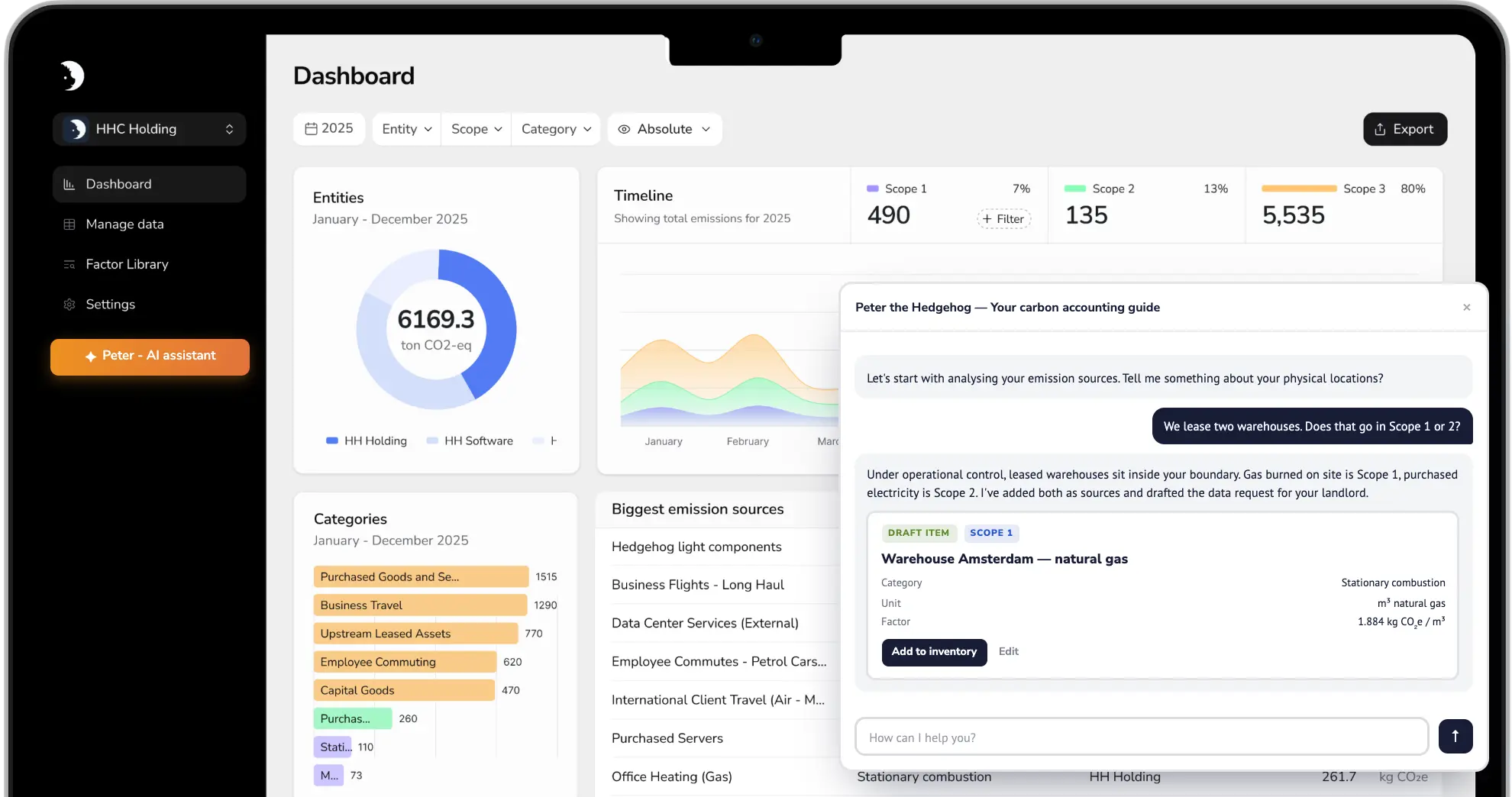
The platform does organisational footprints and supports entity management across locations and sites, with user roles for data owners, auditors and managers, which is the mechanism for running assets as separate entities under one group. It guides you through GHG Protocol setup, a data collection plan and inventory building with an AI guide, and holds over 20,000 spend-based and activity-based factors. You can add your own organisation-specific or supplier-specific CO2 data, which matters when a district heating network or a green tariff has a factor that is not in any generic library.
Free account with no sales call. Pro from EUR 1,200 per year.
Two honest limits worth knowing before you start.
Getting the data in is the slow part. A Small-Business reviewer said so on G2 in August 2026: once the data is loaded everything works perfectly, and getting it loaded is the challenging part. For a portfolio of thirty assets with mixed metering arrangements, that is the honest shape of year one. Budget for it.
Building-level and product-level assessment is a service, not a feature. An MPG calculation or a material assessment for a new build is consultancy work rather than something the platform produces. The platform handles the organisational and asset-level operational footprint. If you need both, you can buy both, and you should know which is which before you sign anything.
What should you do first?
If you have new build in design, the MPG work is on the project clock and cannot wait. Treat it as a separate workstream with a separate owner.
For the standing portfolio, start with landlord-controlled energy only. It is the data you already hold, it produces a defensible first number in weeks rather than quarters, and it tells you honestly how much work the tenant data will be. Then widen the boundary once, deliberately, and restate.
You can start a free account and get a first asset-level footprint out of your own utility invoices before asking a single tenant for anything, or talk it through with us first via carbon footprint consulting.
Sources: Dutch Building Decree and BPM 2.0 documentation, Hedgehog platform, Hedgehog on G2. Verified 27 August 2026.
Facts on this page were last verified on 2026-09-17.